Table of Contents
- Scope and Technical Structure of API 2610 for Terminals
- Site Design and Safe Operational Yard
- Dikes, berms, and secondary containment
- Product Transfers at Loading Stations
- API 2350 and Overfill Protection
- Fire Protection in Tank Farms
- Emissions, Waste, and Environmental Prevention
- Mechanical Integrity, Corrosion, and Maintenance
- Smart Terminals and Data in API 2610
- Conclusions
- References
- Frequently Asked Questions (FAQs)
An oil terminal fails when its safety barriers cease to operate in a coordinated manner: level control, transfer, drainage, foam, containment dikes, maintenance, and operational response. API 2610 integrates these barriers into a technical system to ensure that the tank farm operates safely, continuously, and with environmental control.
The standard governs terminal and tank facilities associated with the storage, transfer, and distribution of liquid hydrocarbons. Its value lies in organizing the entire life cycle: site selection, design, construction, operation, maintenance, inspection, corrosion, fire protection, pollution prevention, product transfer, and decommissioning.
Scope and Technical Structure of API 2610 for Terminals
API 2610 applies to facilities where atmospheric tanks, piping, pumps, valves, loading stations, drains, industrial services, electrical systems, internal roads, and containment areas are operationally integrated. A modern petroleum terminal must be managed as a storage and transfer facility, not as a collection of isolated tanks.
The essence of the standard lies in treating the terminal as a complete life-cycle facility. For this reason, it encompasses site selection, tank farm design, construction, operation, maintenance, inspection, testing, corrosion control, fire protection, environmental management, and facility decommissioning.
In terms of design, API 2610 provides guidelines for tanks, dikes, berms, mechanical systems, piping, valves, pumps, yards, industrial services, drainage, and loading areas. This approach allows a loading station, a manifold, a transfer line, or a secondary containment system to be evaluated as interconnected parts of the same operational system.
During construction, maintenance, and inspection, the standard reinforces the need to verify the quality, integrity, and functionality of relevant components: tanks, dikes, berms, mechanical systems, structures, cathodic protection, coatings, instrumentation, drains, and equipment associated with product transfer.
It must also be supplemented by specialized standards. API 650 governs the design of welded tanks; API 653 provides guidance on inspection, repair, modification, and reconstruction; API 2350 addresses overfill protection; and API 570 or API RP 2611 support the inspection of piping associated with terminals.
Site Design and Safe Operational Yard
The yard design minimizes interference between people, vehicles, equipment, and ignition sources. Truck routes, turning radii, slopes, lighting, staging areas, scales, racks, fire hydrants, and emergency access points all influence the likelihood of collisions, spills, or delays during an operational response.
At a loading station, the layout must allow for safe alignment, speed control, ergonomic connection of arms or hoses, grounding, permit verification, and departure without unnecessary maneuvers. The pavement slope must direct spills or contaminated water toward designated collection systems.
The site analysis also reviews flooding, seismicity, wind, proximity to third parties, environmental sensitivity, fire water, and routes for fire crews. Yard engineering reduces maneuvers, blind spots, ambiguous drainage, and exposure of critical equipment.
Dikes, berms, and secondary containment
In API 2610, dikes, berms, and containment areas are part of the terminal’s spill control system. They are not merely civil engineering structures; they function as physical barriers to limit the migration of product from tanks, manifolds, transfer lines, or auxiliary equipment.
Their design cannot be limited to geometric volume. It must consider useful capacity, freeboard for rainfall, permeability, pipe crossings, drains, normally closed valves, slope maintenance, and access routes for operational response. Secondary containment must retain the contents defined by the facility’s design basis and manage precipitation, foam, firefighting water, and contaminated runoff.
Recommended management includes topographic surveying, capacity verification, coating inspection, settlement monitoring, and documentation of vulnerable points. In older yards, unblocked drains, cut berms, unsealed pipes, and channels connecting incompatible areas are common.
Product Transfers at Loading Stations
Transfer operations at a loading station involve risks such as overfilling, static electricity, human error, product incompatibility, emissions, leaks from couplings, and operator exposure. API 2610 requires that these areas be managed using verifiable procedures, maintainable equipment, independent controls, and supervision before, during, and after dispensing.
A reliable loading station combines specific technical elements:
- Compatible loading arms or hoses and quick-closing valves.
- Fiscal or control metering and grounding permits.
- Tank identification and flow control.
- High-level shut-off, vapor recovery, and safe drain of couplings.
Automation must prevent the loading of the wrong product, the opening of incorrect routes, or continued filling in the event of an abnormal condition.
The operation requires brief checklists: product confirmation, available capacity, steam connection, electrical continuity, valve alignment, reduced initial flow rate, and monitoring until shutdown. The worst procedure is one that exists on paper but cannot be executed in real time during dispatch.
This video from Inspenet TV, recorded during NISTM 2026, shows how liquid transfer systems enhance safety, reduce leaks, and improve operational continuity at storage terminals.
API 2350 and Overfill Protection
API 2610 complements API 2350 when terminal operations involve filling, transfer, and inventory control in storage tanks. The former standard governs the installation and operational systems; the latter delves into levels, alarms, response times, and overfill prevention systems.
A terminal should not rely on a single level measurement, a single alarm, or a single human intervention. It must define levels of concern, available capacity, response times, shutdown authority, criteria for automatic systems, and operator responsibilities. A tank with a miscalibrated measurement, an outdated calibration table, or a disabled alarm does not have reliable operational capacity, even if the nominal volume appears sufficient.
Practical alignment links tank measurement, the basic control system, an independent high-high level alarm, motorized valves, pump shutdown, and transfer procedures. Any change in service, product, filling rate, tank bottom, floating roof, instrumentation, or calibration table must trigger change management.
Fire Protection in Tank Farms
In tank farms, API 2610 addresses fire protection as an integral part of the terminal’s design, operation, and maintenance. Engineering must account for seal fires on floating roofs, surface fires, spills confined within dikes, incidents at loading stations, pump fires, thermal exposure between tanks, and the release of flammable vapors.
Each fire condition requires flow rate, extinguishing agent, access, detection, isolation, and response tactics. A comprehensive system includes fire water, a pressurized network, monitors, hydrants, foam chambers, a foam proportioning system, flame or gas detection where applicable, accessible valves, clear access routes, and coordination with external fire brigades.
The transition from AFFF (Aqueous Film-Forming Foam), historically used in liquid hydrocarbon fires, to fluorine-free foams requires engineering. Changing the concentrate can alter viscosity, dosing, equipment compatibility, discharge range, and performance on specific fuels. The decision must be validated with the manufacturer, testing, equipment cleaning, waste management, and updating of emergency plans.
Emissions, Waste, and Environmental Prevention
An emissions control program at terminals must address tank venting, loading losses, displaced vapors, floating roof seals, valves, flanges, pumps, vents, drains, and recovery systems. Vapor recovery units, vapor balancing, floating roofs, secondary seals, and leak monitoring reduce product losses and environmental exposure.
Pollution prevention requires separating clean water, potentially contaminated water, and oily streams. Drains from berths, loading yards, and pump areas must have criteria for opening, prior inspection, sampling when applicable, and traceability of the destination. An open drain valve during the rainy season can turn a minor spill into a major environmental event.
Waste management includes tank sludge, filters, absorbents, impacted soil, discharged foam, contaminated firewater, and purges. The value lies in anticipating containment, response, inventory, final disposal, and documentary evidence.
At storage terminals with high throughput volumes, environmental protection must be integrated with spill prevention and facility response plans. Regulatory pressure on distribution terminals has heightened the importance of controlling emissions from tanks, loading operations, and equipment in service; as a result, vapor recovery, leak detection, and maintenance traceability are now integral to the operational competitiveness of an oil terminal.
Mechanical Integrity, Corrosion, and Maintenance
Mechanical integrity in API 2610 covers tanks, piping, pumps, valves, supports, structures, cathodic protection, coatings, and drains. Deterioration is concentrated in tank bottoms, annular rings, areas under insulation, pipe supports, nozzles, flanges, transfer elbows, and points where water accumulates.
An effective program combines risk-based inspection, failure history, corrosion analysis, thickness measurement, cathodic protection monitoring, coating inspection, and repair prioritization. API 653 defines criteria for in-service tanks; API 2610 helps ensure that these assessments are not isolated from the operational risk of the yard.
Current trends reinforce four areas of improvement:
- 3D laser scanning for deformations, settlements, and dimensional documentation.
- Low-VOC coatings to reduce environmental impact.
- Lightning protection and grounding.
- Maintenance without draining when technology allows for servicing auxiliary equipment without taking the storage tank out of service.
Smart Terminals and Data in API 2610
Modernizing an oil terminal isn’t just about automating valves or installing more screens in the control room. Real progress lies in integrating level, alarm, transfer, emissions, maintenance, and inspection data into a single decision-making architecture.
In modern tank farms, level data enables the verification of transfer events, inventory reconciliation, detection of dispensing deviations, and enhanced protection against overfilling. This traceability helps confirm whether an operation occurred within defined limits or if an alarm requires technical investigation.
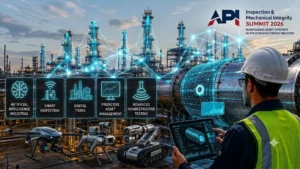
Drones, 3D laser scanning, IIoT sensors, barrier health dashboards, and mobile rounds help reduce personnel exposure, improve field documentation, and prioritize interventions. With this vision, API 2610 evolves from a facility guide into a tool for managing risk, reliability, and investment.
Conclusions
API 2610 provides a comprehensive approach to managing terminals, yards, and tank farms with technical rigor. Its greatest value is realized when it integrates secondary containment, product transfer, overfill protection, fire protection, emissions control, and mechanical integrity into a single barrier system.
A competitive oil terminal is not measured solely by volume shipped, but by its ability to operate without losses, without major incidents, and with traceable evidence. Applying API 2610 alongside API 2350, API 653, and current best practices allows compliance to be transformed into operational reliability and a technical advantage.
References
- API STD 2610 – Design, Construction, Operation, Maintenance, and Inspection of Terminal and Tank Facilities
- API Standard 2350 – Overfill Prevention for Storage Tanks in Petroleum Facilities
- GlobalSpec – API STD 2610
- NISTM. Aboveground Storage Tank Conference & Trade Show 2026.
Frequently Asked Questions (FAQs)
What does API 2610 cover in terminals and yards?
It covers the design, construction, operation, maintenance, and inspection of terminal and tank facilities. It includes criteria for site selection, fire protection, pollution prevention, product transfer, corrosion, utilities, yards, and facility decommissioning.
What does API 2610 require regarding secondary containment?
The standard provides guidance on the management of dikes, berms, and drains as secondary containment barriers. The facility must verify usable capacity, rainwater control, slope integrity, controlled drainage, material compatibility, and periodic maintenance.
How do you align API 2610 and API 2350 for tanks?
Alignment is achieved by linking terminal operations with overfill prevention. API 2610 establishes the management framework, while API 2350 defines levels, alarms, response times, prevention systems, and shutdown authority.
How does API 2610 apply to loading stations?
It guides the management of loading stations through transfer control, valve alignment, grounding, metering, vapor recovery, and overfill prevention. Its application reduces dispensing errors, leaks, emissions, and unsafe conditions during loading.
How is API 2610 related to emissions?
It links terminal operations to pollution prevention, emissions control, drainage, waste, and contaminated streams. This helps control vapors, oily water, tank sludge, absorbents, blowdowns, and maintenance waste.