
The FSRU project emerges as a solution to the gas shortage in Alaska
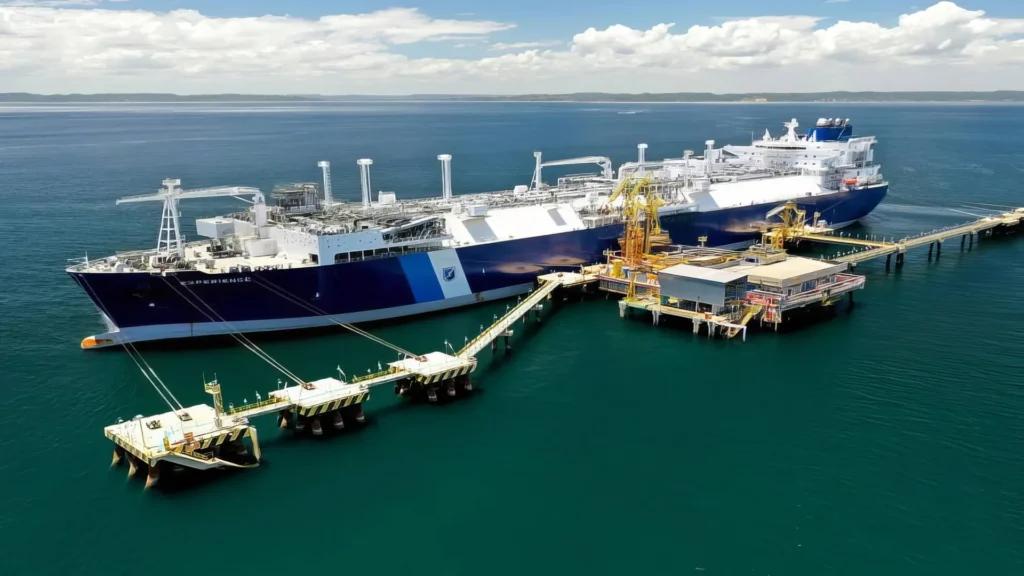
Growing concerns about future gas supplies in south-central Alaska have prompted the introduction of a Floating Storage and Regasification Unit (FSRU) project seeking a short- and medium-term solution to ensure the region's energy supply. The initiative involves importing liquefied natural gas (LNG) via a floating storage and regasification unit (FSRU) located in Cook Inlet .
The proposal is being developed by Cook Inlet LNG, a subsidiary of Gardes Holdings, in collaboration with Glacier Oil & Gas. Both companies maintain that the project will allow them to meet projected gas demand for the coming years while long-term supply alternatives continue to be developed.
Cook Inlet LNG plans to cover Alaska's gas deficit
Currently, various actors in Alaska's energy sector have warned about the risk that local production will not be sufficient to meet the future needs of homes, industries, and public services.
Given this scenario, Cook Inlet LNG proposes using a floating facility capable of receiving LNG cargoes from other markets. Once in the area, the fuel would be regasified and fed directly into the existing network to supply regional consumers.
The company states that the proposal seeks to complement other energy initiatives that are under evaluation and not to replace permanent projects that continue to be the subject of public debate.
The existing infrastructure will reduce development times
One of the highlights of the project is the use of existing facilities already operating in the Cook Inlet basin .
The company plans to moor the FSRU alongside the Osprey platform , located in the western part of the region. Through this infrastructure, the gas would be injected into the existing pipeline system without the need to construct new, large-scale onshore facilities.
Furthermore, most of the necessary infrastructure is already operational. According to the developers, the only significant additions would be the anchoring systems required to secure the vessel to the seabed.
The project could supply 22 BCF of gas per year
According to preliminary plans, the facility would have the capacity to supply around 22 billion cubic feet of natural gas annually.
This figure would cover a significant portion of the projected energy needs for south-central Alaska over the next few years.
The system also includes the periodic arrival of LNG carriers to resupply the floating installation. During the winter months, shipments would arrive approximately every 30 to 45 days, while in summer the intervals would be longer due to lower seasonal demand.
The project is moving forward with private financial backing.
Another relevant element is that the initiative has private financial backing.
Project managers believe this scheme will reduce the financial exposure of utility companies and local users during the construction and commissioning phases.
Once the infrastructure is operational, the supply conditions and associated costs will need to be evaluated and approved by the Alaska Regulatory Commission, following the same procedures that currently apply to other gas supply contracts in the region.
The first gas delivery is scheduled for 2029
According to the timeline released by Cook Inlet LNG , the first commercial flow of gas could be available by mid-2029.
Meanwhile, the company has already begun the necessary procedures with various U.S. federal agencies. These include the Federal Energy Regulatory Commission and the U.S. Coast Guard, entities responsible for overseeing technical, operational, and environmental aspects related to the development of this type of infrastructure.
Energy security becomes the main objective
Beyond the construction of a new floating facility, the central objective of the FSRU Project is to strengthen the energy security of Alaska's most populated region.
liquefied natural gas import capacity seeks to offer an alternative capable of responding to the immediate needs of the market while advancing structural solutions for the state's energy future.
News of additional interest
Centrica secures Canadian gas for Europe
Centric Energy signed an agreement with the Canadian production company Peyto Exploration & Development to purchase 50,000 MMBtu of natural gas per day for 10 years starting in 2029. The agreed volume is equivalent to about five cargoes of liquefied natural gas (LNG) per year and will be delivered to the AECO hub in Alberta, one of the main benchmarks of the Canadian gas market.
The contract stipulates that the supply price will be linked to the European TTF index, a benchmark used in the continent's gas markets. With this arrangement, Centrica aims to strengthen its LNG portfolio and improve its ability to manage price fluctuations while maintaining the flexibility to direct shipments to different markets based on global demand.
Floating data centers seek to gain space
Lloyd's Register (LR), Samsung Heavy Industries (SHI) and Capital Clean Energy Carriers Corp signed an agreement to develop the design of floating data centers capable of operating offshore. The initiative, presented during Posidonia 2026, offers an alternative for expanding digital infrastructure in the face of the accelerated growth in processing demand driven by artificial intelligence.
The project leverages techniques already used in shipbuilding to accelerate the development of these facilities. The design incorporates onboard power generation and seawater cooling systems, reducing reliance on land-based power grids and helping to address the space and resource constraints that affect many conventional data centers. Furthermore, LR validated aspects related to the safety, structure, and technical feasibility of the concept.
Hallador accelerates his energy project in Indiana
Hallador Energy announced the purchase of Siemens power generation equipment with a capacity of approximately 460 MW for $350 million. The transaction includes gas turbines, generators, a steam turbine, and other auxiliary systems that have never been used. The company also estimates an additional $100 million in transportation, refurbishment, and logistics costs to move the equipment to its Merom , Indiana, plant.
The acquisition aims to accelerate the development of a natural gas-fired power generation project that is currently progressing through the interconnection process with the regional operator MISO. According to the company, having critical equipment now allows them to avoid the lengthy waiting times that affect the new turbine market. Hallador expects to complete regulatory studies during 2026 and make a final investment decision thereafter, with the expectation of commencing operations between late 2028 and mid-2029 if the project receives the necessary approvals.
EDF secures solar energy for Los Angeles for 30 years
EDF Power Solutions North America signed a 30-year power purchase agreement with the Southern California Public Power Authority (SCPPA) for the supply of electricity from Utah Solar 1. The project will have a capacity of 400 MW DC and 300 MW AC and will supply the Los Angeles Department of Water and Power (LADWP), one of the largest public electric utility operators in the United States.
Millard County , Utah, and is scheduled to begin operations in mid-2027. During the construction phase, approximately 400 jobs will be created, and the project is estimated to generate over $140 million in local tax revenue, in addition to $27 million in state land lease payments. Once operational, it will produce approximately 766,000 MWh of clean energy annually, enough to power more than 126,000 average-sized homes in California.