Table of Contents
- Offshore exploration in Sri Lanka covers nearly 34,000 km² in Mannar
- Water depths of up to 3,000 meters increase the technological challenge
- Mannar has already demonstrated the existence of a working petroleum system
- Sri Lanka seeks operators capable of turning data into discoveries
- Gas could change the country's energy equation
Offshore exploration in Sri Lanka is entering a new stage with the opening of nearly 34,000 km² of maritime acreage to energy companies. The new licensing round focuses on four blocks in the Mannar Basin, a region of the Indian Ocean where previous drilling confirmed a working petroleum system and discovered gas and condensate accumulations, but where a considerable portion of the subsurface remains unexplored.
The initiative represents more than just a new licensing round. Sri Lanka is seeking to attract operators with financial strength, technological capabilities, and offshore experience to revive exploration activity that could reshape its energy landscape over the long term. The combination of large available areas, water depths reaching 3,000 meters, and new geological information makes Mannar a frontier opportunity where significant potential coexists with major technical challenges.
Offshore exploration in Sri Lanka covers nearly 34,000 km² in Mannar
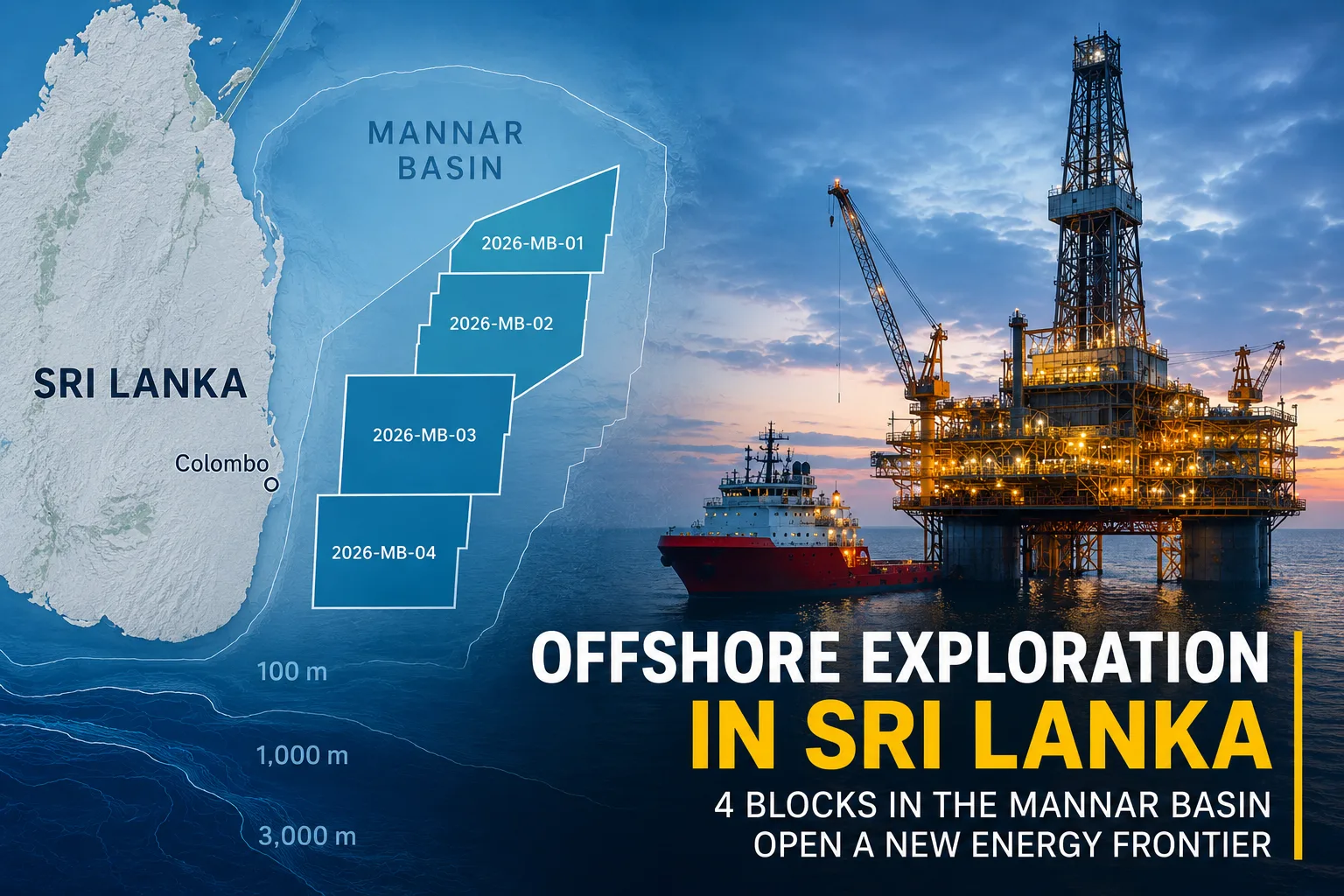
The Sri Lanka Licensing Round 2026 (SL2026-01) covers exactly 33,964 km² distributed across four areas: 2026-MB-01, 2026-MB-02, 2026-MB-03, and 2026-MB-04. Their sizes vary considerably. MB-01 covers 5,948.95 km² and MB-02 covers 5,689.05 km², while the two largest blocks extend across 10,597.67 km² in MB-03 and 11,728.30 km² in MB-04.
Interest in new offshore frontiers can also be seen in other regions. Recently, QatarEnergy entered three offshore exploration blocks in Uruguay, with areas reaching water depths of up to 4,000 meters and the participation of international operators such as Shell, APA Corporation, and Chevron.
The available technical package includes more than 11,000 linear kilometers of 2D seismic data, limited conventional 3D seismic coverage in western Mannar, well data, and approximately 40,000 km² of enhanced subsurface imaging derived from 2D data.
The availability of this information could be decisive in a frontier basin because it can help reduce some of the initial uncertainty before capital is committed to new seismic campaigns or exploration drilling.
Water depths of up to 3,000 meters increase the technological challenge
One of the most relevant aspects of the licensing round lies beneath the sea surface. The blocks extend across water depths ranging from approximately 100 to 3,000 meters, introducing very different operational scenarios within a single licensing round. In fact, the authority notes that a significant portion of Mannar exceeds 1,000 meters in water depth. This broad bathymetric range makes offshore exploration in Sri Lanka a challenge that will require differentiated strategies according to the characteristics of each block.
In the deepest areas, any future drilling campaign would require capabilities associated with deepwater operations. The selection of drilling units, well architecture, control systems, marine logistics, and potential subsea infrastructure would have to be adapted to conditions significantly more complex than those encountered in shallow waters. In this scenario, the technological transformations in offshore oil exploration are crucial for addressing environments with greater water depths and operational complexity.
This relationship between geological potential, risk, and economic viability also shapes other exploration frontiers, such as offshore exploration in Norway, where operators continue to evaluate new opportunities before committing to drilling campaigns.
Mannar has already demonstrated the existence of a working petroleum system
Sri Lanka is not starting entirely from a geological hypothesis. The exploration campaign conducted in 2011 drilled the Dorado, Barracuda, and Dorado North wells, while Wallago was drilled later. Dorado and Barracuda encountered gas and condensate, confirming that the elements necessary to generate and accumulate hydrocarbons exist within Mannar.
The significance of these discoveries extends beyond the volumes encountered. For a basin still considered a frontier area, confirming a working petroleum system reduces one of the main levels of geological uncertainty.
However, this does not mean that the four new blocks contain commercial accumulations. Exploration will have to determine the distribution of plays, reservoir quality, trap geometry, and the actual presence of hydrocarbons in prospects that may eventually be identified.
Technical studies published on Mannar have also highlighted difficulties in obtaining seismic images of certain sequences located beneath volcanic layers, a condition that can increase the complexity of subsurface interpretation.
Sri Lanka seeks operators capable of turning data into discoveries
The new licensing round also reflects an institutional change. The Petroleum Resources Act No. 21 of 2021 established the Petroleum Development Authority of Sri Lanka (PDASL) as the country’s upstream regulator and created the framework under which the current competitive process is being conducted. The advancement of offshore exploration in Sri Lanka will now depend on the country’s ability to attract companies that can demonstrate technical expertise, financial capacity, and specific capabilities in offshore operations.
The terms also reveal that awarding the blocks will be only the beginning of the process. The contractual model provides for a maximum exploration period of eight years divided into three phases, 3 + 2 + 3 years, while petroleum operations must begin within six months following the effective date of the agreement. A bank guarantee equivalent to 25% of the minimum work commitment and a minimum signing bonus of USD 500,000 are also contemplated.
Therefore, the competition will not focus exclusively on who obtains the blocks, but rather on which operators can transform the available geological information into technically executable programs.
Gas could change the country’s energy equation
Sri Lanka’s interest in Mannar also has a dimension that extends beyond the upstream sector. The country’s petroleum authority considers that natural gas could play an increasingly important role in the national energy system, particularly in power generation, industrial development, and supply diversification.
For now, that scenario remains dependent on exploration success. The existence of previous discoveries does not guarantee new commercially recoverable accumulations, and any deepwater development would have to undergo technical, economic, and environmental assessments before moving toward production.
For precisely this reason, offshore exploration in Sri Lanka is now entering a decisive phase. The availability of new blocks provides an opportunity to revisit a basin that has already provided evidence of hydrocarbons but still contains large areas that remain insufficiently evaluated.
If new geological interpretations make it possible to identify competitive prospects and attract operators capable of drilling them, Mannar could evolve from a frontier basin into a new energy province in South Asia. The first indicator will be the level of interest generated by the 2026 licensing round and, subsequently, the exploration commitments undertaken by the selected companies.
Sources: World Oil