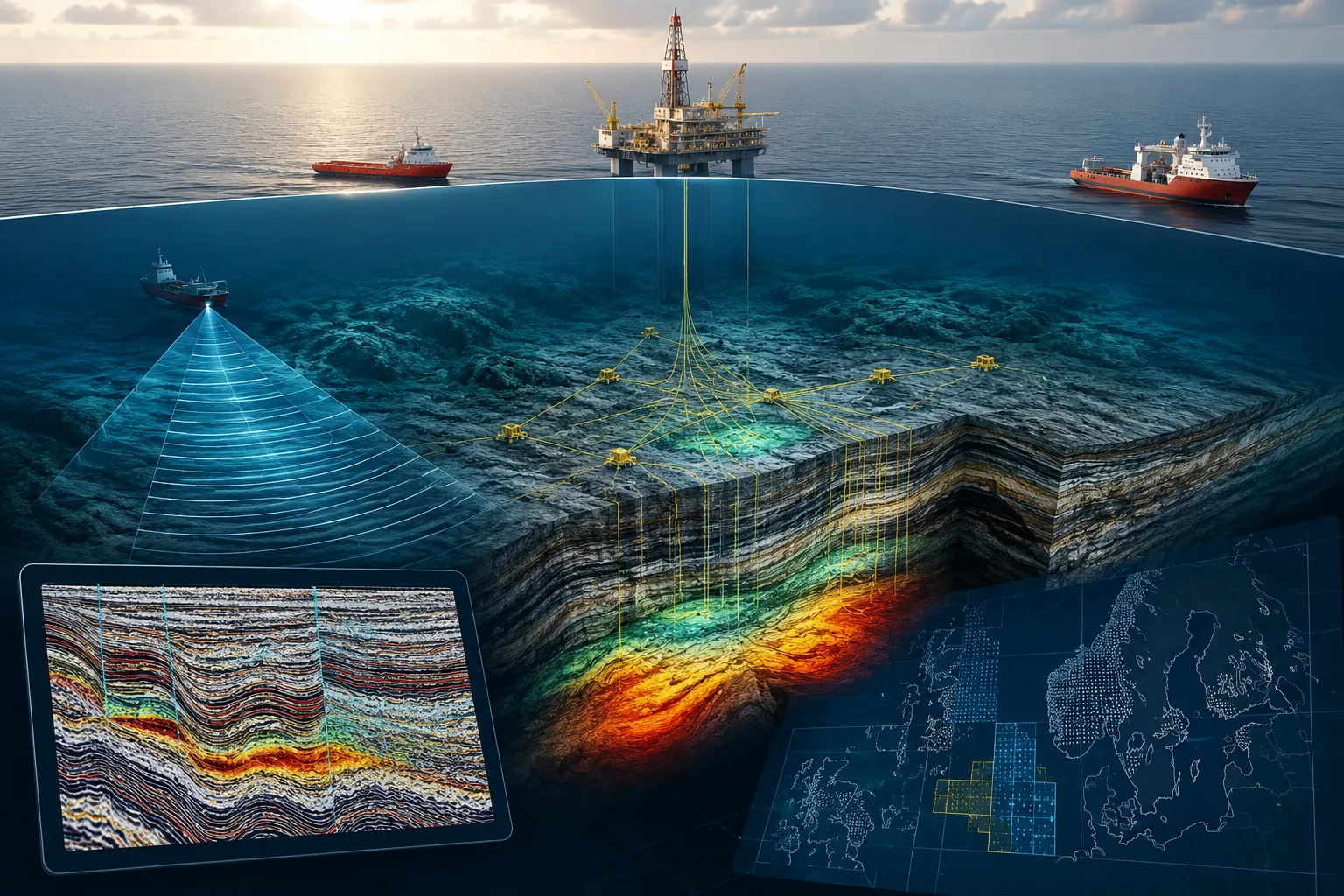
Offshore exploration in Norway is entering a new phase with the strategic alliance between Equinor, Aker BP, and Vår Energi to identify discoveries capable of sustaining oil and gas production on the Norwegian Continental Shelf over the coming decades. The companies will evaluate between 20 and 25 high-impact opportunities over the next four to five years, with the ambition of drilling around five exploration wells annually.
The objective goes beyond searching for small volumes near existing fields. The strategy aims to increase the probability of finding accumulations large enough to justify new standalone developments, a need that is becoming increasingly relevant amid expectations that production from the Norwegian Continental Shelf will begin to decline after 2035 unless new discoveries and projects are brought forward.
Offshore exploration in Norway targets five high-impact wells annually
The program sets an ambition to drill approximately five high-impact exploration wells each year as the companies mature and select the prospects with the greatest potential from an initial portfolio of between 20 and 25 opportunities.
The model involves sharing part of the geological and financial risk. The major opportunities that remain untested on the Norwegian shelf involve higher levels of uncertainty, technical complexity, and capital requirements, conditions that can make their development more challenging under conventional arrangements.
The collaboration will make it possible to integrate capabilities that each operator would normally manage within its own portfolio. Equinor, Aker BP, and Vår Energi intend to share risk and combine data, technology, subsurface expertise, and exploration capacity to evaluate a larger number of opportunities.
This strategy is particularly relevant in a mature petroleum province, where improving subsurface interpretation through new exploration technologies can be decisive in identifying resources that remained beyond the reach of previous campaigns.
Norway seeks to complement tie-backs with new major fields
In recent years, a significant portion of Norwegian exploration has focused around existing infrastructure. Discoveries located near platforms and existing subsea infrastructure can be developed through subsea tie-backs, reducing investment requirements while taking advantage of installed capacity.
That model will remain fundamental. Equinor maintains an exploration strategy in which approximately 80% of its wells are concentrated in known areas close to infrastructure, while a smaller proportion tests new concepts and less-explored areas. The company expects to drill between 20 and 30 exploration wells annually as part of its broader strategy on the NCS.
However, there is a limitation: small discoveries connected to existing facilities help extend production from current hubs, but collectively they may struggle to replace the capacity that will eventually be lost as major mature fields decline.
This is where the second component of the new strategy emerges: searching for accumulations capable of becoming standalone fields with their own infrastructure.
Norway’s subsurface still holds undiscovered resources
The maturity of the Norwegian Continental Shelf does not mean that its exploration potential has been exhausted.
The Norwegian Offshore Directorate’s Resource Accounts 2025 indicate that the country’s three major offshore regions still contain undiscovered resources. The Barents Sea holds the largest estimated volume, while the North Sea has fewer undiscovered resources but records the most intensive exploration activity.
The production context is also significant. Norwegian oil production in 2025 reached its highest level since 2009, while reserve growth made it possible to replace approximately 60% of production during the period.
The challenge is to progressively convert this geological potential into commercially recoverable resources.
The new alliance could increase the number of prospects capable of passing that threshold by distributing exposure among three operators with extensive portfolios and accumulated experience across different areas of the NCS.
Equinor and Aker BP are already deepening offshore cooperation
The new initiative is not emerging in isolation.
In May 2026, Equinor and Aker BP established another strategic collaboration aimed at accelerating resources and increasing value creation in selected areas of the Norwegian Continental Shelf. The agreement included changes in ownership interests related to Ringvei Vest, Yggdrasil, and Wisting.
Ringvei Vest illustrates precisely how this strategy could evolve. The project combines several discoveries into a subsea development tied back to Troll B and contains approximately 240 million barrels of oil equivalent in estimated gross resources.
Aker BP is also continuing to develop Yggdrasil, one of the largest concentrations of projects currently under construction offshore Norway. The area contains approximately 800 million barrels of oil equivalent in recoverable resources and maintains a target of eventually exceeding 1 billion barrels through additional exploration and reservoir maturation.
These moves reflect a broader trend: coordinating licenses, discoveries, infrastructure, and exploration to extract greater value from a mature basin.
New discoveries will be key after 2035
The strategic dimension of the agreement becomes clearer when considering the longer-term horizon. Equinor, Aker BP, and Vår Energi believe that, without new discoveries and developments, NCS production will decline after 2035. Therefore, the prospects selected over the coming years are not intended solely to meet immediate production needs; they are designed to build the portfolio that could feed the next generation of Norwegian offshore projects.
This also has implications for Europe. Norway has consolidated its position as a fundamental energy supplier to the continent, meaning that extending the productive capacity of its continental shelf carries significance beyond the individual performance of the companies involved.
Offshore exploration in Norway is therefore entering a phase in which two complementary strategies coexist: developing small and medium-sized discoveries through connections to existing infrastructure, while accepting greater geological risks in an effort to identify fields capable of supporting new standalone developments.
The alliance between Equinor, Aker BP, and Vår Energi is aimed precisely at this second frontier. If the portfolio of 20–25 opportunities delivers several discoveries of material scale, Norway could extend the productive life of its continental shelf and prepare a new generation of projects beyond 2035.
Sources: Offshore Energy / Equinor / Aker BP — Strategic exploration collaboration