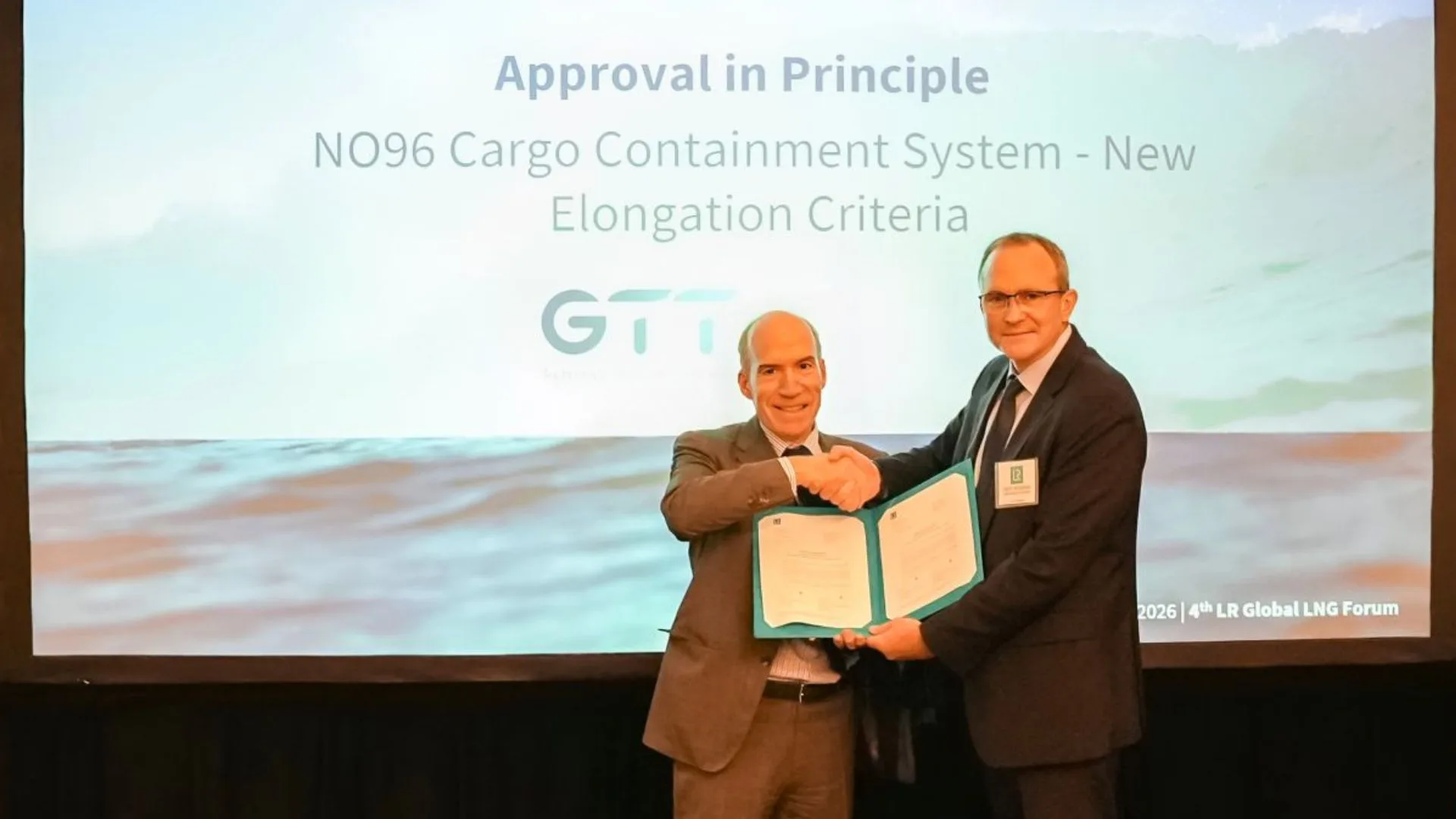
French technology company Gaztransport & Technigaz (GTT) has obtained approval in principle (AiP) from classification societies Lloyd’s Register (LR) and Bureau Veritas (BV) for its updated NO96 elongation criteria.
The technical validation confirms that modifications to the allowable hull deformation under the membrane and insulation system strictly comply with current international regulations. Through this resolution, the maritime industry gains access to new possibilities for the development of optimized structures in LNG carriers dedicated to liquefied natural gas transportation.
Structural Behavior and NO96 Elongation Criteria
Regarding the evaluation process, independent analyses covered operational, thermal, and mechanical loads induced by the hull. Hydrodynamic simulations applied to representative designs demonstrated that the proposed new limits preserve fatigue margins and containment membrane integrity. Likewise, testing confirmed the compatibility of different NO96 system variants with the complex geometries of modern hulls. This ensures safe navigation under demanding maritime conditions.
For his part, Lloyd’s Register’s Global Gas Segment Director, Constantinos Chaelis, noted that this technical revision seeks to generate certainty in the early phases of maritime project development. The executive specified that the updated criteria remain within established safety margins while simultaneously offering greater flexibility for engineers. Additionally, industry specialists agree that these certifications are essential as global fleet requirements demand greater operational efficiency.
Impact on Efficiency and Lightship Weight
As a result of these regulatory changes, naval designers will have greater flexibility to configure the architecture of LNG carriers. This technical advantage will facilitate a direct reduction in vessel lightship weight, translating into lower fuel consumption and greater payload capacity. Therefore, the NO96 system reaffirms its position as one of the most efficient cryogenic containment technologies for high-specification vessels, maritime transport, and gas storage.
Finally, GTT’s Chief Executive Officer, François Michel, emphasized that Lloyd’s Register’s endorsement consolidates the robustness of innovations implemented in the NO96 standard. The executive stated that these advanced parameters preserve the most stringent standards of protection against cryogenic loads. Ultimately, the technological update enables the design of more sustainable, competitive LNG carriers aligned with growing global regulatory requirements.
Source and photo: LR