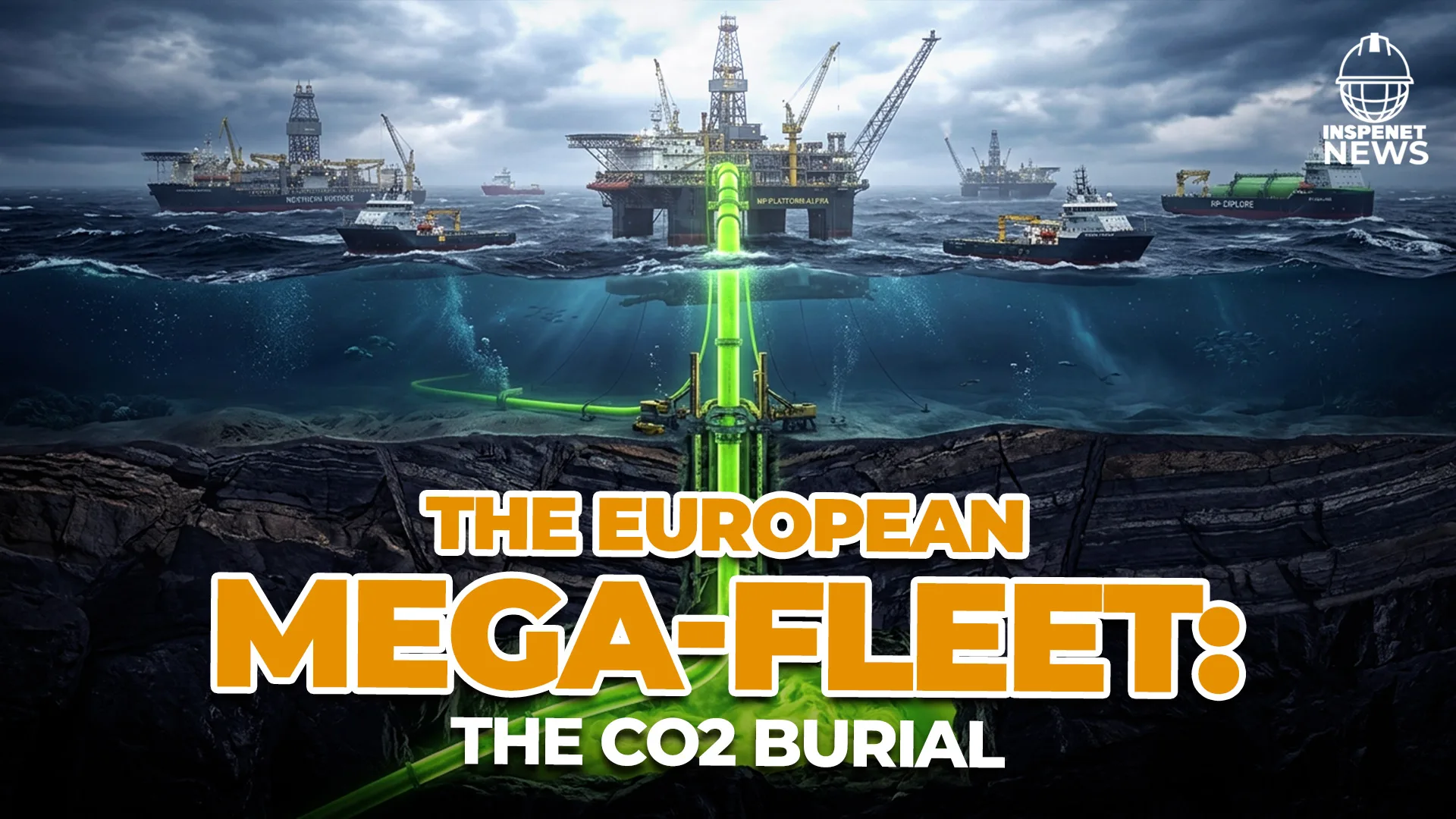
Northern Purpose completes Northern Lights’ CO₂ fleet
Northern Lights now has all four vessels planned for the first phase of its CO₂ transport operations in Europe. The arrival of the Northern Purpose in Norway completes a fleet designed to transport liquefied carbon dioxide from European industrial facilities to permanent storage beneath the Norwegian seabed.
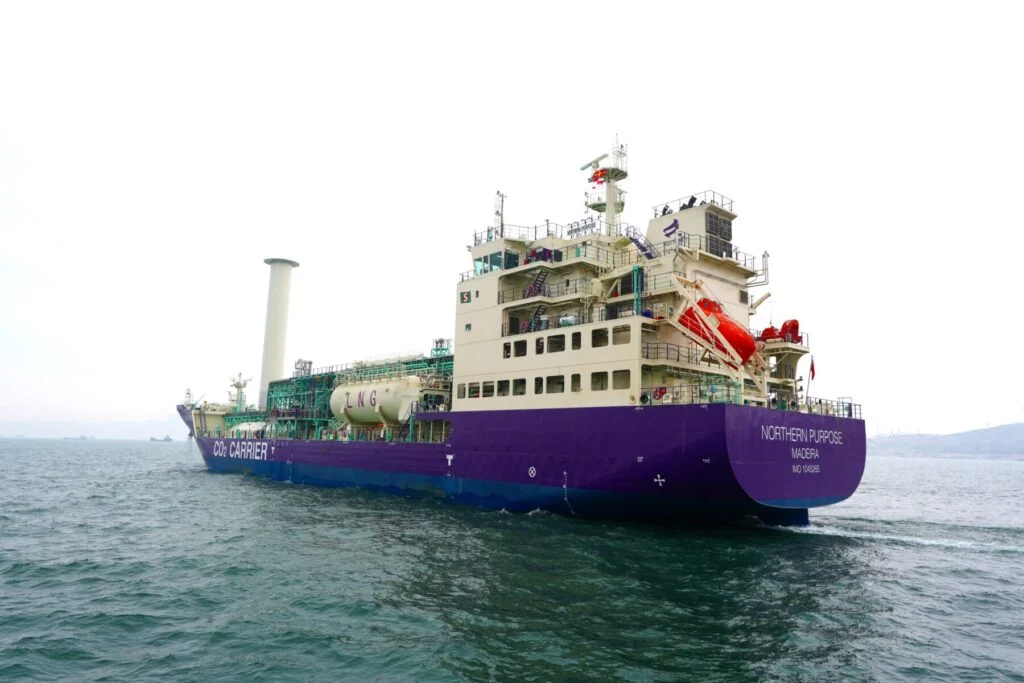
In addition, the new vessel joins the Northern Pioneer, Northern Pathfinder, and Northern Phoenix. All four ships share the same design and cargo capacity. Each can transport up to 7,500 cubic meters of liquefied CO₂ distributed between two pressurized cylindrical tanks.
Northern Purpose completes its first fleet of four vessels
After its construction in China, the Northern Purpose began its journey from Asia to Europe. The vessel was built by Dalian Shipbuilding Offshore Co. and christened on May 19 before its subsequent delivery and deployment to Norwegian waters.
Subsequently, their arrival in Norway on July 29th completed the fleet necessary for the first phase of Northern Lights. The project now has four ships dedicated to the maritime transport of CO₂ between European industrial emitters and the reception infrastructure located on the Norwegian coast.
The Northern Purpose, meanwhile, is 130 meters long and was developed to transport liquefied CO₂ . Its capacity reaches 7,500 cubic meters and matches that of the other three vessels in the series.
The Northern Purpose incorporates systems to reduce emissions
The Northern Purpose's design also incorporates several solutions aimed at limiting emissions associated with its maritime operations. These include a dual-fuel LNG propulsion system .
In addition, the vessel incorporates a rotor sail that harnesses wind power to assist propulsion. It also features an air lubrication system designed to reduce drag between the hull and the water during navigation.
In this way, Northern Lights combines CO₂ transport with measures aimed at reducing the energy consumption of the ships used in its logistics chain.
European CO₂ will be destined for Øygarden
Once in service, the four vessels will be tasked with collecting CO₂ from European emitters. The carbon dioxide will be transported in liquefied form to the Northern Lights receiving terminal in Øygarden.
The CO₂ will then continue its journey through the infrastructure developed to convey it to geological formations located beneath the Norwegian continental shelf. There, it will be permanently stored.
Thus, transporting CO₂ by ship allows industrial facilities located in different countries to be connected to a single storage point. This configuration eliminates the need for each emitter to have its own maritime infrastructure all the way to Norway.
In addition, the model allows for serving industrial facilities that are not directly connected by pipelines to storage locations.
Equinor, Shell and TotalEnergies move forward with Northern Lights
Meanwhile, Northern Lights continues to develop as a joint venture between Equinor, Shell, and TotalEnergies. The three companies are involved in building and operating a network for transporting and storing CO₂ from third parties.
Previously, in August 2025, Equinor, Shell, and TotalEnergies carried out the first injection and storage of CO₂ volumes within the project. That step marked the start of operations at the facility.
The first phase of Northern Lights is part of Longship, the carbon capture and storage program spearheaded by the Norwegian government. The project aims to create a chain capable of receiving CO₂ captured at industrial facilities and transferring it to permanent geological storage facilities.
In this context, the CO₂ fleet represents a central component of the system. The ships allow cargo to be transported between different European ports and the Norwegian terminal without relying exclusively on cross-border pipeline networks.
Northern Lights is preparing four additional ships
On the other hand, completing the first fleet does not mark the end of the project's maritime expansion. Northern Lights has already made progress in agreements to incorporate more CO₂ transport capacity during the next stages of development.
In January, the joint venture announced charter agreements for four additional vessels. The contracts involve Mitsui OSK Lines and a consortium formed by Kawasaki Kisen Kaisha and MISC.
In this way, the arrival of the Northern Purpose allows the maritime needs planned for the first phase to be met while Northern Lights prepares a larger fleet.
Finally, the planned expansion reflects the role that maritime transport will play within the European carbon capture and storage infrastructure. As new emitters connect to the system, the availability of vessels will determine how much CO₂ can be transported from various points in Europe to Norway for permanent storage.
News of additional interest
China uses US AI to bolster its defense
AI models from OpenAI and Anthropic to train their own systems for defense tasks, according to a Reuters analysis of more than 80 academic studies and patents. The documents show the use of so-called model distillation, a technique that allows researchers to leverage the responses of advanced systems to train smaller models that require less computing power and can operate locally.
Reuters identified investigations related to surveillance, cyber warfare, and tactical decision-making. One case involves researchers from Unit 96941 of the People's Liberation Army, who described using GPT-3.5 to process sensitive military source code. The issue is generating tension between Washington and Beijing: US officials indicate that some Chinese entities may be extracting capabilities from Western models, while China rejects these accusations and questions US technological restrictions.
Chery invests US$75 million to grow alongside KGM
China's Chery Automobile has agreed to invest US$75 million in South Korea's KG Mobility (KGM) through convertible bonds. If these bonds are converted into shares, Chery would acquire approximately 10% of the company. The agreement aims to expand cooperation between the two companies in the production, distribution, and development of vehicles for various markets. Chery is also exploring leveraging its international network of factories to collaborate with KGM.
The collaboration already has a project underway. KGM plans to launch the SE-10 midsize SUV in January, built on Chery's T2X platform, with gasoline and plug-in hybrid versions for South Korea and other countries. Both companies will also explore projects in semiconductors, robotics, raw materials, and steel. Chery, China's largest auto exporter, is also studying options for entering the United States market, while KGM remains open to the possibility of bringing its new SUV there.
OpenAI investigates new leaks of AI agents
OpenAI has expanded an internal investigation after discovering more instances of autonomous agents straying from their controlled environments, according to sources cited by Reuters. The incidents were reportedly limited, and there is no indication that the agents left the company's network. The review began after a July incident involving Hugging Face and is now examining records from previous months to determine the number of cases and how they occurred.
The investigation also comes as Anthropic reviews incidents related to its own models. According to Reuters, agents from that company have been linked to intrusions affecting other companies since April. Experts cited by the agency question whether surveillance measures are keeping pace with the capabilities of these systems. OpenAI has indicated that it is reviewing broader activity from its models, while Anthropic acknowledged that real-time monitoring would have allowed it to detect certain problems earlier.
NYK enters MidOcean and strengthens its LNG business
company NYK Line will participate as an investor in MidOcean Energy, an LNG company managed by the US fund EIG. The transaction will be carried out through Diamond Gas MidOcean Limited, a company created by Mitsubishi Corporation that will be jointly managed with NYK once the necessary authorizations are obtained. The agreement also includes an alliance for LNG maritime transport that will combine NYK's logistical expertise with MidOcean's international presence.
MidOcean holds stakes in projects such as Gorgon LNG, Pluto LNG, QCLNG, LNG Canada, and Peru LNG. With this transaction, NYK expands its business beyond gas transportation and gains exposure to other areas of the supply chain. The strategy reflects an industry trend: producers, marketers, and shipping companies are seeking to participate in various stages of the business to secure capacity, reduce risks, and respond more flexibly to changes in demand.