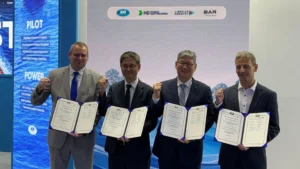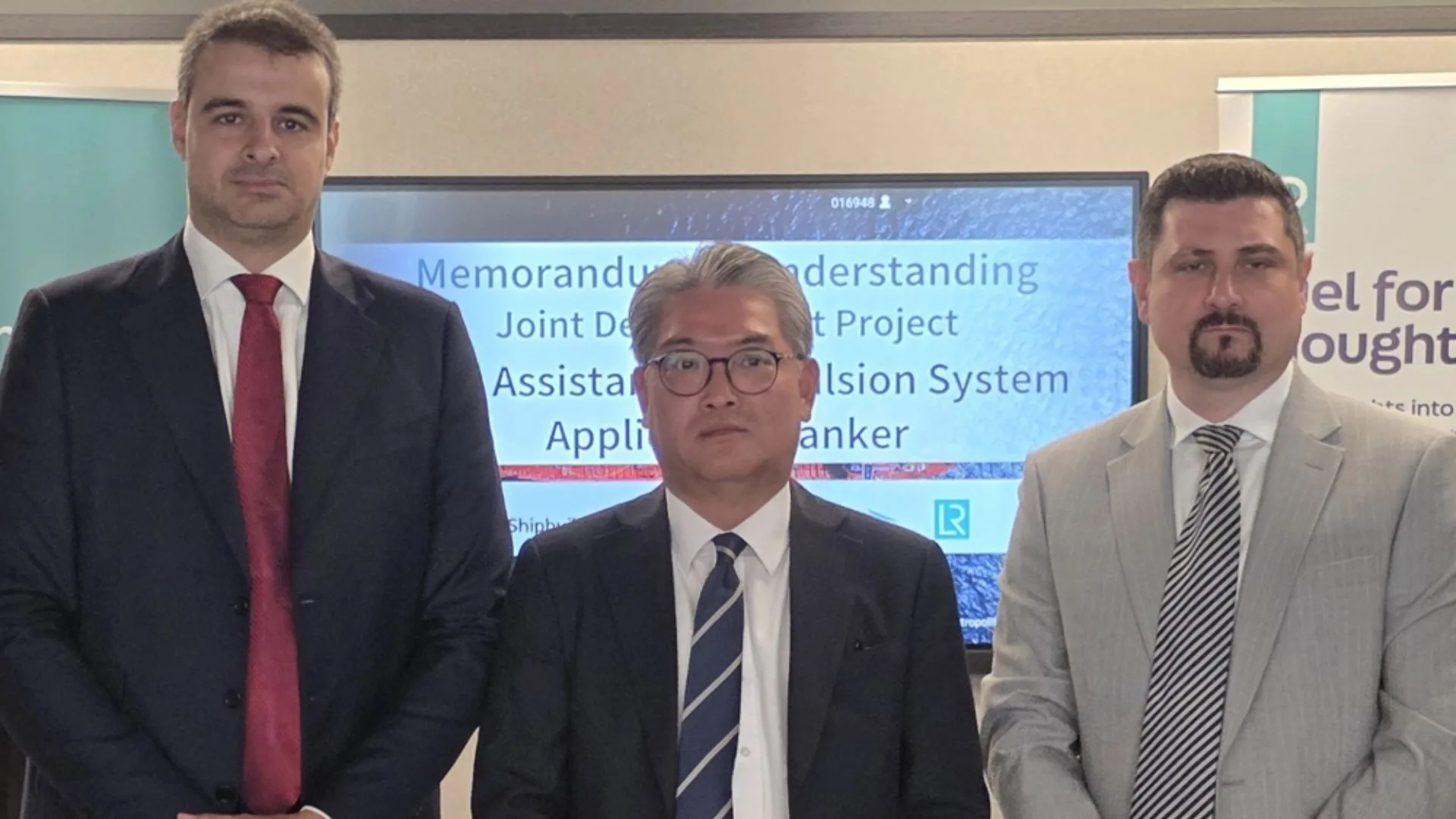
Lloyd’s Register (LR), K Shipbuilding, bound4blue, and the Liberian International Ship Corporate Registry (LISCR) signed a Memorandum of Understanding (MoU) to develop a design for a 50,000 deadweight tonnage (DWT) MR tanker equipped with Wind-Assisted Propulsion Systems (WAPS), an initiative aimed at accelerating the decarbonization of maritime transport.
The agreement was signed on June 4 during the Posidonia festival held in Athens and establishes a framework for collaboration to optimize the design of a new generation of MR tankers capable of reducing their fuel consumption and emissions by harnessing wind energy.
MR Tanker to Incorporate Wind Propulsion Technology
As part of the project, the vessel will incorporate the eSAIL technology developed by the Spanish company bound4blue. This system uses suction sail principles to generate additional thrust from the wind, complementing the vessel’s conventional propulsion.
Thanks to this integration, the partners expect to improve the vessel’s energy efficiency and contribute to compliance with increasingly demanding environmental regulations driven by the International Maritime Organization (IMO).
Likewise, the design will serve to evaluate the commercial potential of wind-assisted propulsion in the MR tanker segment, one of the most relevant for the transport of refined products.
Technical and Regulatory Design Evaluation
The agreement includes a comprehensive evaluation of the concept from a technical and regulatory perspective. Lloyd’s Register will contribute its expertise as a maritime classification society through design review, technical validation, and support during the Approval in Principle (AiP) process.
The organization, founded in 1760 and recognized for its certification, validation, and risk management services for critical infrastructure and complex projects, will collaborate closely with LISCR to ensure the project’s alignment with current classification standards and international regulatory requirements.
Reducing Barriers to WAPS Adoption
One of the main objectives of the initiative is to reduce the uncertainty that still exists regarding the adoption of wind-assisted propulsion systems within the tanker market.
By early validation of the design’s performance, safety, and regulatory compliance, participants seek to create a clear roadmap that facilitates the future commercial implementation of these technologies.
Alberto Pérez, Commercial Marine Markets Director at Lloyd’s Register, highlighted that the project is part of the organization’s commitment to reducing emissions in the maritime industry through scalable and economically viable solutions.
For his part, Tae-Hyun Koh, CTO of K Shipbuilding, noted that the growing demand for sustainable maritime transport solutions is driving the development of more efficient and competitive vessels for the international market.
An Additional Step Towards Maritime Decarbonization
For bound4blue, the initiative represents an opportunity to advance the integration of wind propulsion into new build designs. Daniel Mann, Commercial Director of the company, stated that WAPS are playing an increasingly relevant role in preparing vessels for the future challenges of the sector.
From a regulatory perspective, Thomas Klenum, Executive Vice President of the Liberian Registry, indicated that the incorporation of wind-assisted technologies can generate immediate reductions in fuel consumption and emissions, while strengthening the competitiveness and sustainability of global maritime transport.
With this joint project, the participating organizations seek to lay the groundwork for broader adoption of wind energy technologies in the MR tanker segment and contribute to the transition towards lower-emission maritime operations.
Source and photo: Lloyd’s Register