Asset integrity is one of the most consequential disciplines in industrial operations, yet much of the engineering behind it still runs on paper, spreadsheets, and institutional memory. Inspection findings live in PDFs and inboxes. Thickness readings are captured without the context that makes them meaningful. Fitness-for-service decisions, the most expensive judgment in integrity engineering, are worked out in workbooks that nobody can audit.
AsInt Edge was built to change that. It is a cloud-based Asset Integrity Management platform that puts API-grade engineering onto a single, asset-centric foundation, making the same rigor that large operators deploy accessible to organizations of every size.
Developed by AsInt, Inc., a Houston-based engineering software company serving oil and gas, petrochemical, chemical, and refining industries, Edge extends the company’s decade of enterprise asset integrity experience beyond the SAP ecosystem. Where AsInt’s established suite runs natively on SAP BTP, AsInt Edge broadens how and where that engineering intelligence can be deployed, without diluting the depth behind it.
Platform vision and objectives
The vision behind Edge is simple to state and demanding to deliver: one equipment record, and every integrity application that runs against it. Rather than a collection of disconnected point tools, AsInt Edge organizes inspection, corrosion monitoring, risk assessment, and fitness-for-service around a shared, asset-centric hierarchy so that engineering effort goes into judgment rather than reconciliation.
Its guiding objective is accessibility without compromise. AsInt Edge is designed so that a single consulting engineer and a global operator work on the same platform, with the same encoded standards and the same defensible audit trail. The engineering depth stays constant; only the scale changes.
The platform delivers this scale through a five-tier deployment ladder. Tier 1 is a shared multi-tenant substrate with headcount-scale pricing, ideal for small consultancies and independent engineers. Tier 2 provides dedicated schemas within shared infrastructure. Tier 3 delivers a dedicated substrate. Tier 4 lets the customer choose the region for residency requirements. Tier 5 adds bring-your-own-key encryption and, for the customers who need it, an air-gap deployment. Same platform. Same workflows. Same standards. Five deployment shapes that a customer moves between without ever replatforming their team.
In doing so, AsInt Edge democratizes capability that has historically been locked inside expensive, multi-year enterprise deployments, letting organizations adopt integrity engineering one application at a time, growing as their programs mature.
Key features and capabilities
At the center of the platform is the Asset-Centric Workbench, a unified workspace where projects are built around an asset class, unit, turnaround, or campaign. Engineers activate the applications they need inside a project and see a single, context-aware view in which inspection findings, thickness readings, risk rankings, and fitness-for-service results sit side by side on the same equipment — no exports, no switching between tools.
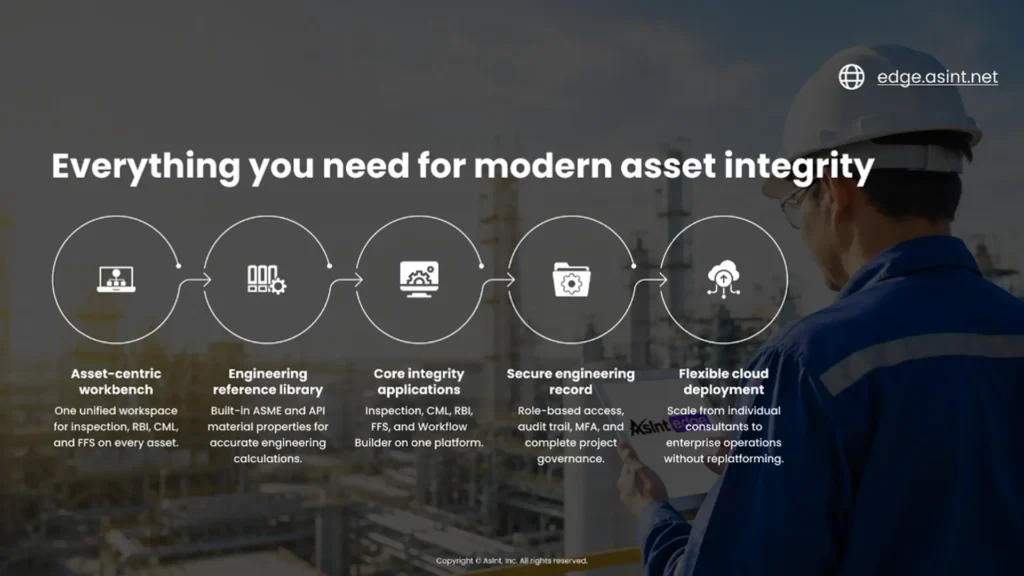
A governed Material Properties reference library, keyed to ASME Section II-D, ASME VIII, and API 579, supplies allowable stress, yield, tensile, and temperature-dependent values directly into calculations, so the numbers are looked up from a curated source rather than transcribed by hand.
Five engineering applications run on this foundation. Asset Inspection provides configurable workflows aligned to API 510, 570, and 653, taking work from checklist to closed finding with attachments, annotations, and a full audit trail. CML (Corrosion Monitoring Location management) captures thickness readings on schedule, computes short- and long-term corrosion rates, and projects remaining life against minimum thickness. RBI (Risk-Based Inspection) runs on a configurable engine supporting qualitative, semi-quantitative, and quantitative methods, with an API 571-aligned damage-mechanism library. FFS (Fitness-for-Service) delivers API 579-1 / ASME FFS-1 Level 1 and Level 2 assessments across brittle fracture, general metal loss, local thinning, and crack-like flaws, including a color-coded thinning heatmap generated from a single data upload. Workflow Builder rounds out the core apps, letting engineering teams codify custom workflows and rulesets for the parts of their practice that go beyond the standards’ scope.
Underpinning all of it are the platform capabilities included with every deployment: workspaces, role-based access, project folders, a cryptographic audit chain that captures every action and every cross-application data read and enforced multi-factor authentication. The result is a system of engineering record that is defensible end to end.
Operational benefits
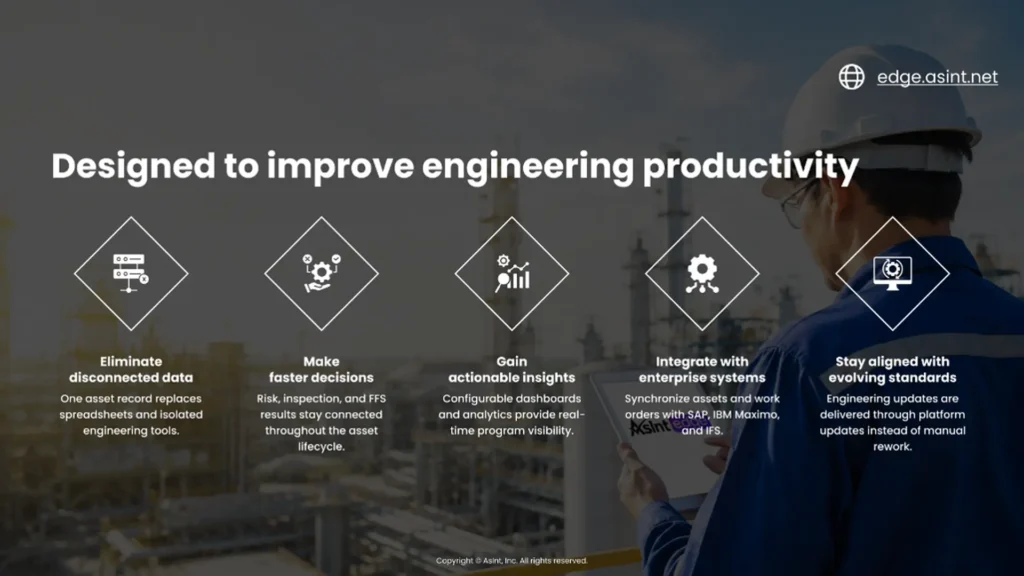
Because every application writes to the same asset record, the hours engineers once spent reconciling separate point tools largely disappear. Configurable analytics — findings by damage type, severity distributions, and build-your-own charts — roll up automatically, giving integrity leadership information they can act on without manual consolidation. A configurable RBI engine drives inspection frequency, technique, and scopes directly into the inspection workflow, closing the loop between risk and execution.
AsInt Edge is also engineered to coexist with existing enterprise systems rather than replace them. Native connectors keep the equipment hierarchy and work orders synchronized with ERP and maintenance backbones such as SAP, IBM Maximo, and IFS, so the engineering depth lives in Edge while enterprise transactions stay where they belong. And because standards revisions propagate centrally, keeping current with American Petroleum Institute (API) committee updates becomes a version update rather than a re-implementation project.
Commercial flexibility mirrors the engineering flexibility. AsInt Edge is a subscription platform with headcount-scaled pricing at entry, and customers move between deployment tiers as their program grows or contracts. Upgrading from Tier 1 to Tier 3 as a consultancy signs enterprise customers or moving a specific customer from Tier 3 to Tier 5 when a bring-your-own-key requirement lands — these are configuration changes, not re-platforming projects. The engineering the team is doing does not change. The workflows do not change. Only the deployment shape underneath them does.
Industrial applications
AsInt Edge is built for all the asset-intensive industries — oil and gas, petrochemical, chemical, pharma, FMCG — where mechanical and structural integrity governs both safety and uptime. It supports the full range of fixed equipment an integrity program is responsible for: pressure vessels, piping systems and circuits, above-ground storage tanks, and heat exchangers, along with the structural assets that surround them. Whether an organization is managing a single refinery unit or a multi-site operation, the same encoded codes — API 510, 570, 653, 579, and 580/581 — apply consistently across the fleet.
Use cases
The platform accommodates a spectrum of real-world integrity work. An inspection team configures API-aligned checklists once and executes them hundreds of times, capturing findings and recommendations against the equipment record. An analyst builds CMLs against a piping circuit, trends predicted thickness against retirement limits, and feeds those results into a risk assessment. An integrity engineer runs a risk-based inspection study, using an out-of-the-box model or a proprietary methodology encoded alongside published standards, and lets the outcome shape the inspection plan. A materials engineer performs an API 579 Level 2 fitness-for-service assessment on a corroded tank shell or exchanger tube in hours, replacing an un-auditable spreadsheet exercise that once took weeks. In each case, the work is performed on one shared record, visible to coordinators, reviewers, and program leadership alike.
Key differentiators
Several qualities set AsInt Edge apart. First, its methodology flexibility: most RBI tools ship a single risk model and force engineering to conform to it, whereas Edge runs on a configurable engine that accepts API 581, EN 16991, NR-13, PED, or an operator’s own proprietary methodology encoded alongside the standards. The risk model conforms to the asset, not the other way around.
Second, its calculations are encoded, not approximated. API 579-1, API 580/581, and the inspection codes are implemented to the standard, with reference data on the record.
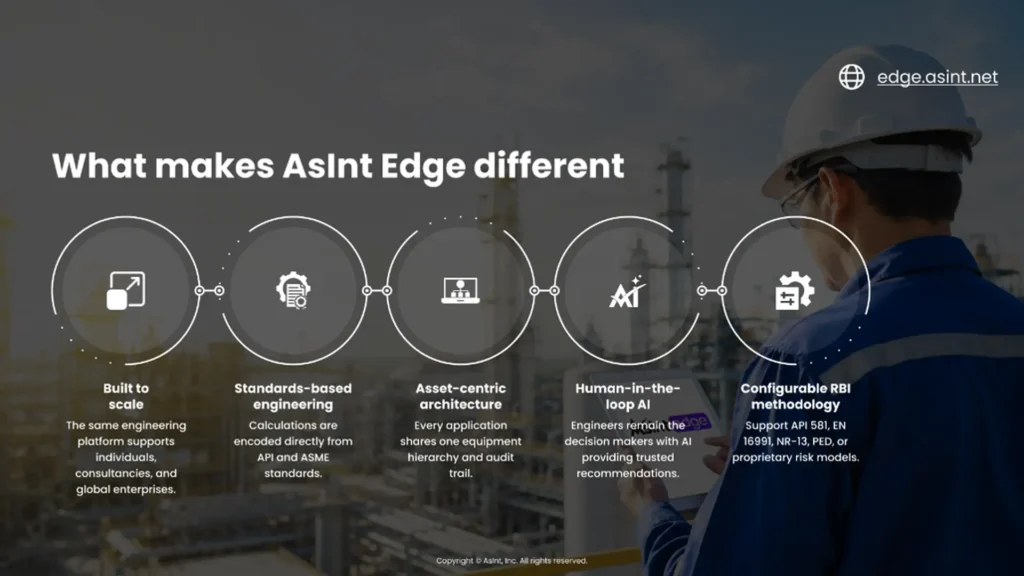
Third, the asset-centric architecture means every application share one equipment hierarchy and one audit trail, eliminating the silos that undermine defensibility.
Fourth, every action carries named-human accountability. Above the reasoning runtime’s confidence threshold, the engineer decides and the platform records their decision cryptographically. Below the threshold, the runtime escalates to a named subject-matter expert of record before any action is taken. The AI is a proposal engine. Human is the decision maker.
Fifth, Edge scales from an individual engineer to a global operator on a single platform, so capability is never gated behind an enterprise-only deployment.
Value for Mechanical Integrity and Asset Integrity programs
For Mechanical Integrity and Asset Integrity programs, AsInt Edge addresses the failure modes that most often undermine them: disconnected inspections, thickness data without context, methodology lock-in, and fitness-for-service decisions trapped in spreadsheets. By unifying inspection, corrosion monitoring, risk-based inspection, and fitness-for-service on one auditable record, it makes program data traceable, defensible, and ready for regulatory or internal scrutiny. Integrity leads to gaining visibility and reporting to manage compliance and program performance with confidence as operations grow, while engineers spend their time on judgment rather than procedure.
In bringing enterprise-grade engineering to organizations of every size, AsInt Edge reframes what a modern integrity program can look like — the same trusted engineering logic, made accessible to everyone responsible for keeping assets safely in service.