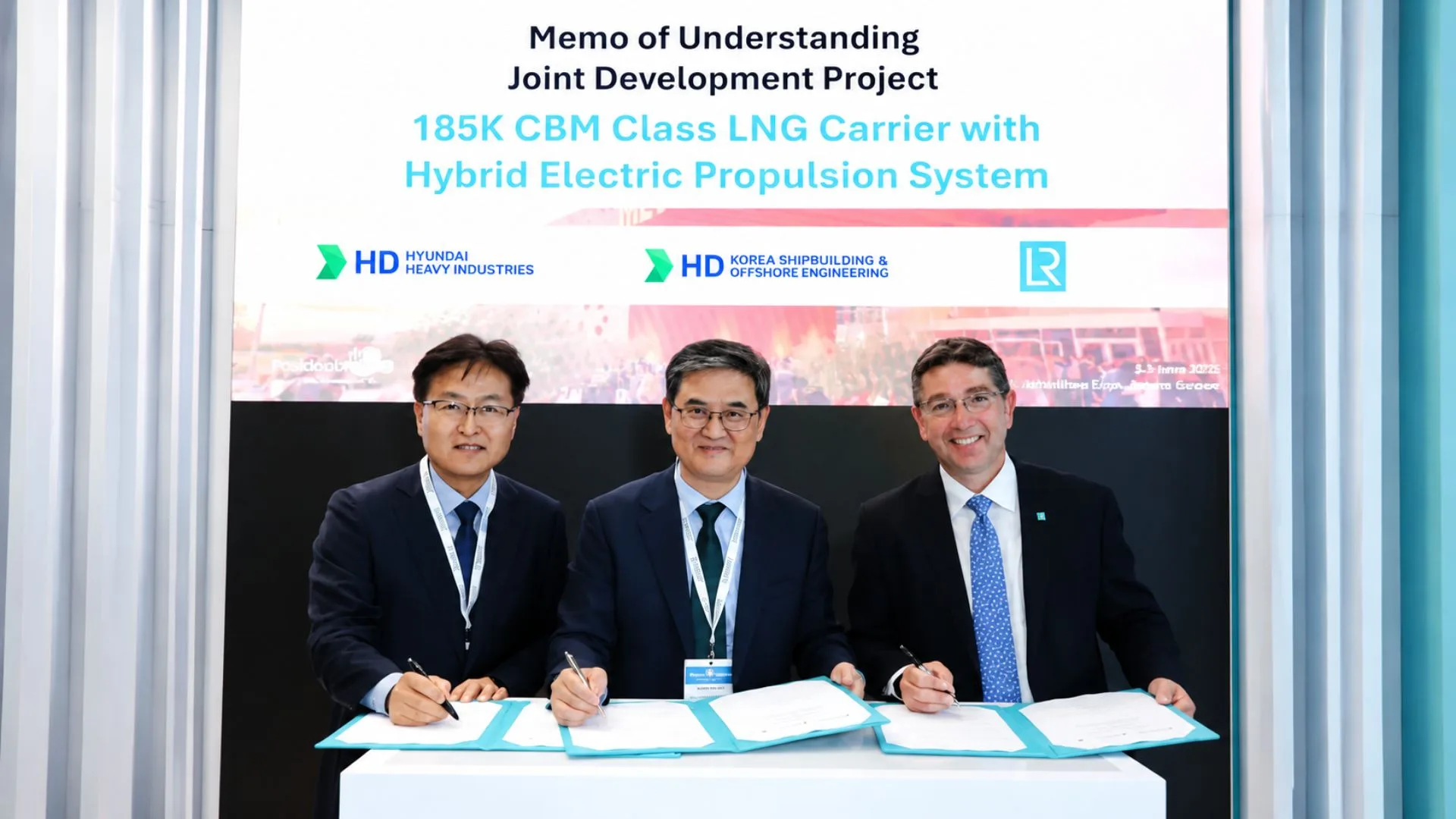
The maritime industry continues to move towards solutions with less environmental impact; in this context, Lloyd’s Register (LR), HD Korea Shipbuilding & Offshore Engineering (KSOE) and HD Hyundai Heavy Industries (HHI) have joined forces to develop a new generation of LNG carriers equipped with hybrid electric propulsion systems.
The agreement was formalized during Posidonia 2026 through the signing of a joint development project (JDP), whose objective is to design a liquefied natural gas (LNG) transporter with a capacity of 185,000 cubic meters that incorporates advanced naval electrification technologies.
A design focused on efficiency and low emissions
The initiative aims to evaluate how hybrid electric propulsion can improve the operational performance of large LNG carriers. The work will focus on optimizing energy consumption and reducing emissions associated with LNG maritime transport.
To achieve this, the partners will develop a system architecture capable of integrating conventional energy sources with battery energy storage. The project will also analyze redundancy and operational resilience strategies to ensure the safety and continuity of operations.
The development also includes the creation of technical requirements and guidelines that will contribute to the adoption of this technology by the international maritime industry.
LR strengthens safety in hybrid electric LNG carriers
One of the central aspects of the agreement will be the safety verification of the hybrid-electric system, because regulations for this type of application continue to evolve, and Lloyd’s Register’s participation will allow for the validation of technical criteria from the early stages of design.
Early collaboration will facilitate the creation of frameworks for future vessels with electrified propulsion systems and solutions aimed at reducing carbon emissions.
In addition, the project will serve to gather technical information that will contribute to the development of future classification rules related to the integration of batteries and advanced energy systems in large ships.
A step towards new maritime technologies
Participants believe the results obtained could extend beyond the LNG carrier segment. The knowledge gained could later be applied to the development of vessels incorporating fuel cells, hybrid energy systems, and other technologies aimed at accelerating the maritime sector’s energy transition.
According to Sung-Gu Park, president of Lloyd’s Register for Northeast Asia, hybrid electric propulsion offers opportunities to improve efficiency and reduce emissions. However, he stressed that its implementation in large-scale vessels requires a rigorous approach to design, technological integration, and operational safety.
With this project, LR, KSOE and HHI seek to lay the foundations for the next generation of LNG vessels, combining technological innovation, energy efficiency and advanced maritime safety standards.
Source and photo: Lr.org