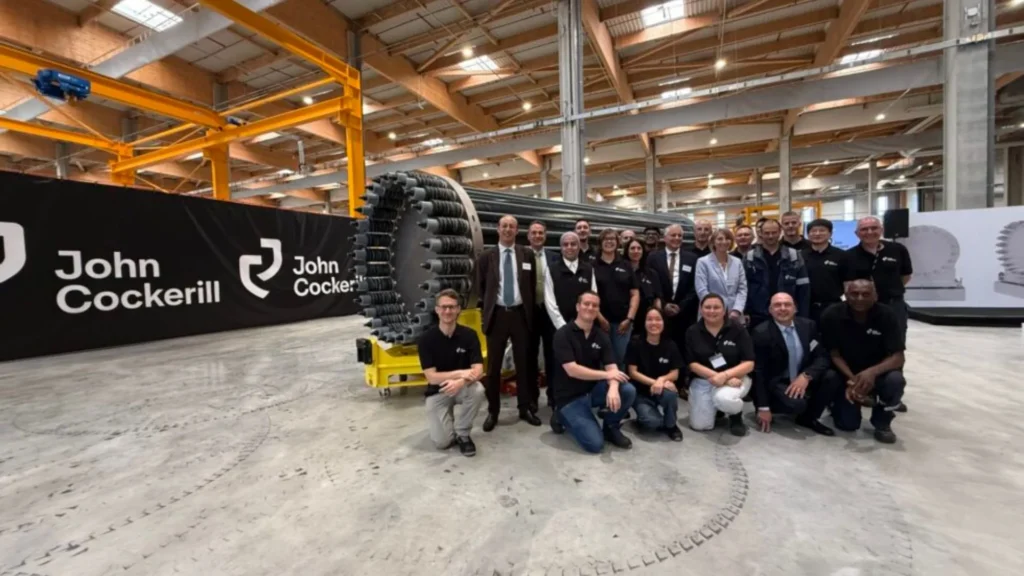
Belgian company John Cockerill Hydrogen presented the first 5 MW electrolyzer stack manufactured at its Foussemagne plant, near Belfort, marking the first major industrial result following the acquisition of strategic assets from French company McPhy one year ago. The development strengthens European capacity to manufacture equipment for green hydrogen production and accelerates the decarbonization of high-emission sectors.
The Foussemagne plant begins a new phase
Twelve months ago, John Cockerill acquired McPhy’s factory located in the Territoire de Belfort along with part of its personnel and technology portfolio. The operation preserved a facility considered strategic for the European hydrogen industry and reactivated the manufacturing of next-generation electrolyzers.
The plant now delivers its first industrial result with a stack approximately seven meters long, two meters in diameter, and weighing nearly 30 tons. The component constitutes the core of the electrolyzer responsible for splitting water into hydrogen and oxygen using electricity.
The hydrogen stack incorporates new polymer technology
One of the main technical advances consists of replacing traditional metallic bipolar plates with polymer plates.
This solution reduces the overall weight and significantly decreases corrosion problems that affect electrolyzer operation during extended periods. As a result, greater equipment durability and reduced maintenance requirements are also expected.
According to Benoit Barrière, technology integration manager at John Cockerill Hydrogen, this technology represents one of the first industrial applications of this type.
Competitiveness is one of the objectives
In addition to improving technical performance, the company seeks to reduce manufacturing costs.
John Cockerill estimates that this new generation of stacks will improve competitiveness by 10% to 15% compared to current models. The company expects to expand that margin when production reaches higher volumes through economies of scale.
In the long term, the French factory has capacity to produce up to 200 stacks per year, which would strengthen the manufacturer’s presence in the international hydrogen market.
Refineries and petrochemicals concentrate the commercial strategy
The company initially targets this technology toward large industrial hydrogen consumers such as refineries and the petrochemical industry.
Currently, the world consumes approximately 100 million tons of hydrogen per year, and approximately 99% is obtained through processes with high greenhouse gas emissions. Replacing that conventional hydrogen with hydrogen produced through electrolysis constitutes one of the main objectives of the energy transition.
John Cockerill also reported that it has an order backlog equivalent to 800 MW, driven among other projects by a major contract awarded in India at the end of 2024.
Project supported by France and the European Union
The industrial development is part of the IPCEI Hydrogen program and has funding from the French State through the France Relance plan, in addition to support from the European Union through NextGenerationEU.
With this initiative, France consolidates its commitment to developing a national supply chain for renewable hydrogen technologies while Europe seeks to strengthen its industrial autonomy in one of the segments considered strategic for decarbonization.
Source and photo: John Cockerill