Table of Contents
- Johan Sverdrup crude gains importance in ORLEN’s refining system
- Three countries will receive oil from Norway
- Norway strengthens its position as a European energy supplier
- Johan Sverdrup combines oil production scale and offshore electrification
- The contract will have implications beyond crude oil transportation
- Equinor and ORLEN expand a relationship that already included gas and upstream operations
- The agreement strengthens the energy corridor between Norway and Central Europe
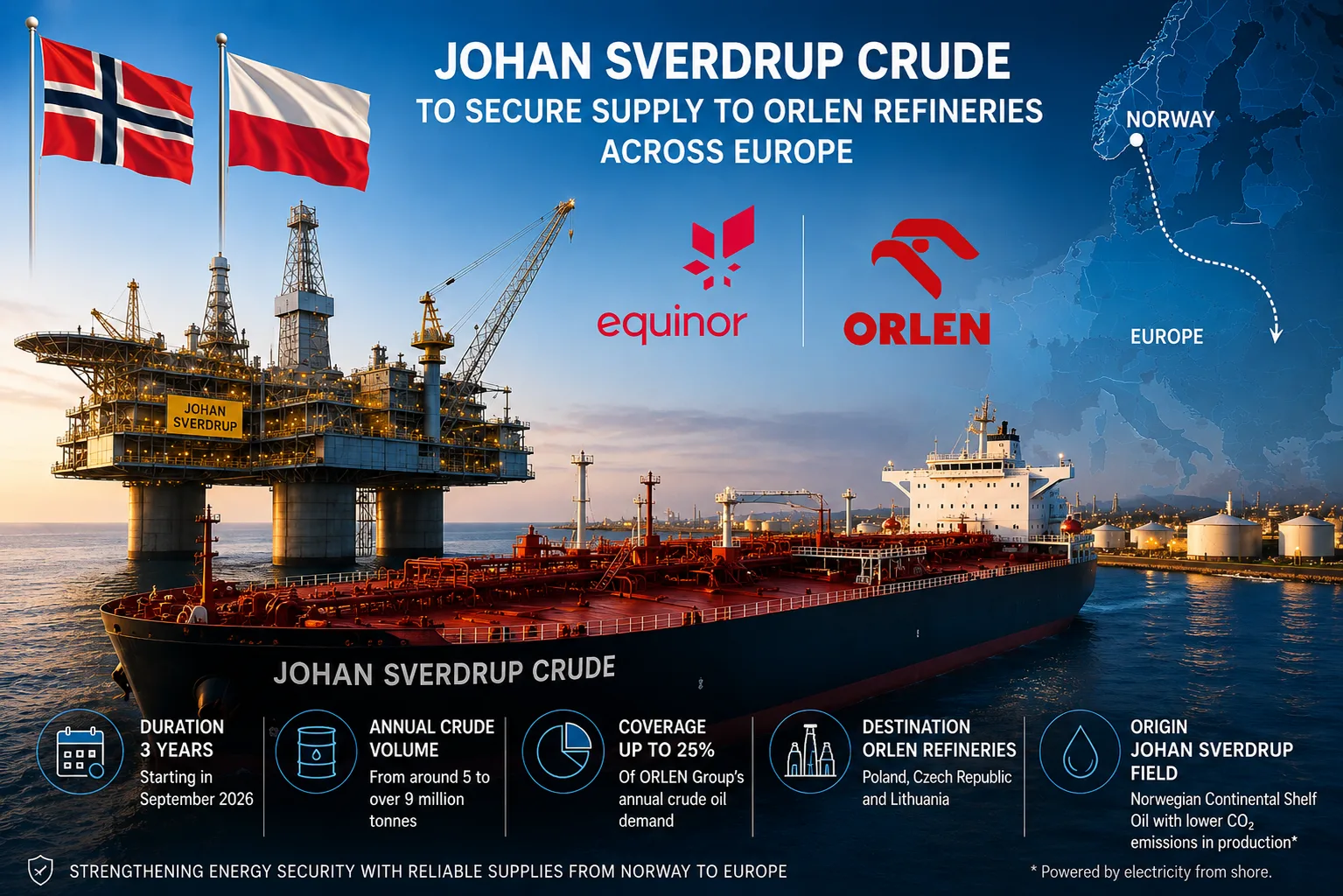
Johan Sverdrup crude will strengthen the supply of three major European refining systems through a new agreement between Equinor and ORLEN. The contract will run for three years and will enable the delivery of nearly 5 million to more than 9 million tonnes annually from the Norwegian Continental Shelf to refineries located in Poland, Lithuania, and the Czech Republic.
Deliveries will begin in September 2026 and will primarily be based on production from the Johan Sverdrup field, although the agreement includes the possibility of incorporating other crude grades from fields on the Norwegian Continental Shelf (NCS).
The scale is particularly significant for ORLEN. At the upper end, the contracted volumes could cover up to approximately one-quarter of the group’s annual crude oil demand, making the agreement a strategic component in the stability of its supply system.
More than a commercial transaction between a producer and a refiner, the contract strengthens an energy corridor that directly connects Norwegian oil production with refining capacity located across three European countries.
Johan Sverdrup crude gains importance in ORLEN’s refining system
The contract incorporates an element that is particularly important for a company operating multiple refineries: flexibility.
ORLEN will be able to receive between nearly 5 million and more than 9 million tonnes annually, adjusting volumes according to its operational requirements and market conditions. The specific commercial terms remain confidential.
If supplies remained near the upper limit throughout the three-year period, the cumulative volume could exceed 27 million tonnes. This figure is an arithmetic projection based on the announced annual maximum and does not represent a guaranteed contractual commitment.
Crude oil from Johan Sverdrup will form the basis of the deliveries.
This places one of Europe’s most important oil assets behind the contract. Located in the North Sea, Johan Sverdrup is currently the highest-producing oil field on the Norwegian Continental Shelf and accounts for approximately one-third of Norway’s oil production, according to the companies.
Equinor continues preparing the expansion of Johan Sverdrup through new resources intended to sustain its future production, reinforcing the asset’s importance within Norwegian oil production. Its scale helps explain why the field can support supply agreements of this magnitude rather than serving merely as a supplementary source within Europe’s crude slate.
Three countries will receive oil from Norway
The barrels will be destined for ORLEN’s refining operations in Poland, Lithuania, and the Czech Republic.
This distribution expands the significance of the agreement beyond a single refinery. Norwegian supply becomes part of a chain connecting offshore production, maritime transportation, terminals, storage, and processing across different markets in Central Europe and the Baltic region. In this context, ORLEN has also strengthened its logistics infrastructure with a transshipment terminal linked to the Gdansk refinery.
For ORLEN, predictability is one of the main arguments behind this strategy. Oil markets remain exposed to geopolitical tensions, logistics disruptions, and changes in international supply routes. Securing significant volumes from a geographically nearby producer helps reduce some of that uncertainty.
The contract does not eliminate ORLEN’s exposure to the international market, nor does it mean that all of its supply will come from Norway. However, potentially securing up to 25% of its requirements through a multi-year agreement provides a more stable foundation from which to manage the remainder of its crude oil portfolio.
Norway strengthens its position as a European energy supplier
The agreement also reflects a transformation that has accelerated across Europe in recent years: Norway’s growing importance to regional energy security.
Equinor already maintains a broad energy relationship with Poland that includes oil, pipeline gas, and LNG. At the same time, the company is developing offshore wind projects in the Baltic Sea together with Polenergia and maintains investments in onshore renewables and energy storage through its subsidiary Wento.
The new contract now adds a long-term oil commitment to that relationship. For Equinor, the agreement provides a way to supply production from the Norwegian Continental Shelf directly to a regional refining system over a three-year period. For ORLEN, it provides access to a supplier located within Europe’s own energy landscape.
That balance between producer and refiner becomes increasingly important as security of supply begins to be assessed not only in terms of price, but also according to origin, logistical distance, political stability, and supplier reliability.
Johan Sverdrup combines oil production scale and offshore electrification
Another element distinguishes the field serving as the primary source of crude under the contract. Johan Sverdrup’s facilities receive electricity from shore, a configuration that significantly reduces emissions associated with the power generation required to operate the platforms compared with offshore facilities that rely on local generation from gas turbines.
This does not make the oil produced a carbon-free fuel. Emissions associated with transportation, refining, and, ultimately, the use of the resulting petroleum products still exist.
The difference lies specifically in the emissions intensity of the offshore production stage. For Equinor, this characteristic allows Johan Sverdrup to be positioned not only in terms of its production volume, but also through the energy efficiency of its operations.
The contract will have implications beyond crude oil transportation
Moving more than 9 million tonnes annually involves a physical supply chain considerably broader than the commercial agreement itself.
The oil must leave the Norwegian production system, enter storage and export operations, be transported, and subsequently move through receiving facilities before reaching refinery processing units.
At every stage, assets whose availability is essential to maintaining continuity are involved: tanks, pumps, pipelines, terminals, transfer systems, and crude oil tankers, in addition to the processing facilities themselves.
For refineries, having greater predictability over a significant portion of future supply can also facilitate crude slate planning. The characteristics of each crude influence processing variables such as yields, operating conditions, blending, and the performance of different units. Supply stability does not eliminate the need to adapt operations, but it provides greater visibility for planning inventories and processing requirements.
From an integrity and reliability perspective, any sustained change in feedstock also requires operators to properly understand how its characteristics may interact with existing equipment and processes.
Equinor and ORLEN expand a relationship that already included gas and upstream operations
The contract does not start from scratch either. Both companies already cooperate on production activities on the Norwegian Continental Shelf and on gas supplies to Poland. They also participate in initiatives related to lower-carbon solutions. In addition, ORLEN and Equinor had already established an agreement for the supply of Norwegian oil from Johan Sverdrup.
The new agreement expands that relationship to include a substantial volume of oil over a period long enough to have implications for ORLEN’s supply planning.
The key difference compared with spot market purchases is precisely the time horizon. A three-year contract allows supply to be incorporated into operational and logistical decisions that extend beyond a single delivery.
In addition, the possibility of receiving other crude grades produced on the Norwegian Continental Shelf provides flexibility to adjust part of the supply when commercial or operational conditions require it.
The agreement strengthens the energy corridor between Norway and Central Europe
The most important figure is probably not just the maximum of 9 million tonnes. It is the combination of volume, duration, and geographic reach. A large-scale Norwegian offshore field will supply, for three years, a significant portion of the oil required by an energy group with refining operations distributed across Poland, the Czech Republic, and Lithuania.
In a market where supply routes have taken on an increasingly geopolitical dimension, having contracts with producers considered stable can become a tool for industrial resilience.
For ORLEN, the agreement provides flexibility to receive between nearly 5 million and more than 9 million tonnes annually. For Equinor, it consolidates a significant market for production from the Norwegian Continental Shelf.
And for the European energy system, the contract once again places Johan Sverdrup crude in a strategic position: not only as production from Norway’s largest oil field, but also as a feedstock capable of supplying a significant portion of the refining capacity of several countries over the next three years.