Table of Contents
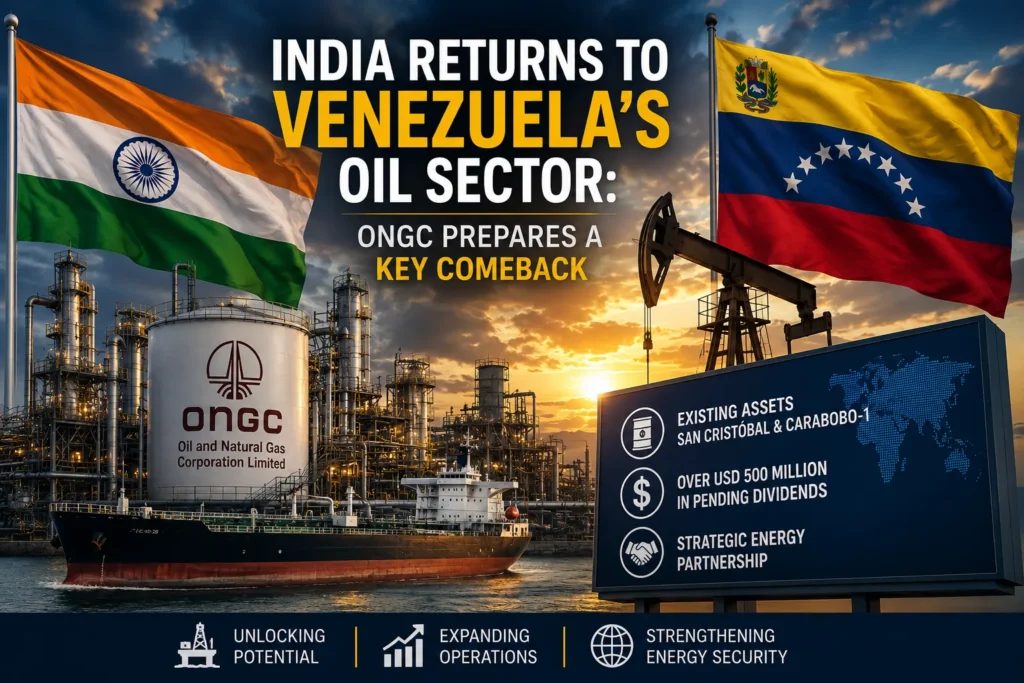
India returns to Venezuelan oil, with ONGC Videsh preparing a new phase of its presence in the South American country. ONGC Videsh is the international arm of Oil and Natural Gas Corporation (ONGC), India’s largest oil and gas exploration and production company. The company aims to regain operational capacity over its existing assets and take advantage of a reduced regulatory environment that previously limited its operations, investments, and access to Venezuelan revenues.
The move carries significance beyond the return of a single company. India imports nearly 90% of the crude oil it consumes, so expanding its supply options and maintaining direct interests in producing projects provides a way to diversify its energy exposure. At the same time, Venezuela is seeking to attract international capital and technical expertise back to an industry that requires investment to recover production.
The turning point now lies in the new conditions available for reactivating its Venezuelan assets. ONGC Videsh obtained a license from the U.S. Office of Foreign Assets Control (OFAC) allowing it to resume activities in Venezuela, following years in which sanctions significantly constrained its ability to operate and develop its investments in the country. The source also reported that the company expected to move forward with agreements that could give it a more significant operational role.
India returns to Venezuelan oil with familiar assets
ONGC is not entering Venezuela’s oil industry for the first time. Its international arm, ONGC Videsh, holds investments in two projects: San Cristóbal and Carabobo-1. At San Cristóbal, located in the Orinoco Oil Belt, ONGC Videsh holds a 40% interest. PDVSA holds the remaining 60%. The structure operates through Petrolera IndoVenezolana (PIVSA), a joint venture created to develop and produce hydrocarbons from the asset.
The situation at Carabobo-1 is different. ONGC Videsh directly holds an 11% interest, while Indian Oil Corporation and Oil India each control 3.5%. Repsol holds another 11%, while PDVSA currently controls 71%. Therefore, the three Indian companies together hold an 18% interest in the project.
This distinction is important because ONGC’s return does not involve acquiring two assets from scratch. The company already has exposure to significant Venezuelan oil resources; the challenge is to once again turn those interests into assets capable of generating production, cash flow, and returns on invested capital.
The next step could be gaining greater operational control
The most significant transformation could occur in how these projects are operated. The new phase could take ONGC Videsh beyond its current position as a partner in the projects. The company is holding talks with the Venezuelan government over new agreements that could expand its operational role, including the possibility of assuming operatorship of assets in which it currently holds interests. The final terms and scope of those agreements still need to be determined.
This is not a recent ambition. As early as 2024, ONGC Videsh was seeking U.S. authorization to operate the two projects. At the time, company management estimated that the two assets were jointly producing around 12,000 to 15,000 barrels per day, but believed that an operational recovery could increase volumes to approximately 30,000 bpd within one year and later bring them closer to 50,000 bpd.
These figures are company projections and do not represent guaranteed production. However, they help explain why gaining greater control over operations could be more important for ONGC than simply retaining minority interests.
More than US$500 million adds another incentive for the return
There is also a financial dimension accompanying the oil-related interest. The restrictions that affected Venezuelan operations also limited ONGC Videsh’s access for years to revenues generated by its investments. The company could now move toward recovering more than US$500 million in outstanding dividends associated with its stakes in Venezuelan oil projects.
Recovering those funds represents an additional incentive, but the strategy appears to extend beyond collecting previous obligations. ONGC has shown interest in investing if it secures conditions that provide greater ability to participate in the production, management, and development of the projects.
This changes the nature of the relationship. Instead of maintaining only financial exposure to assets operated primarily by PDVSA, the Indian company could assume a much more active role in restoring production.
Venezuela gains importance for India’s energy security
The timing is also significant for New Delhi. India is one of the world’s largest oil importers, and its heavy dependence on external supplies requires maintaining a diversified portfolio of suppliers. Risks affecting maritime routes and geopolitical volatility reinforce the strategic value of having alternatives from different regions.
Venezuela offers an additional advantage: India’s involvement is not limited to purchasing cargoes on the international market. ONGC directly holds upstream interests that could provide exposure to production from the fields themselves.
The company’s physical presence also did not disappear during the years of restrictions. ONGC Videsh currently maintains an office and a country manager in Caracas, according to its corporate directory updated in July 2026.
For India, therefore, Venezuela can simultaneously serve as a crude oil supplier and a destination for upstream investment.
The return will now depend on turning agreements into production
The environment is favorable for a reactivation, but there are still important differences between having authorization to move forward, reaching operational agreements, and actually increasing production.
San Cristóbal and Carabobo-1 will require capital, services, equipment, maintenance, and technical capabilities to recover volumes. The extent of ONGC’s operational control and how its relationship with PDVSA and the other partners will be structured must also be defined.
For these reasons, India is returning to Venezuelan oil at a time when energy security, asset recovery, and Venezuela’s need to attract investment into its oil industry are converging.
For ONGC, the return could mean recovering outstanding dividends and transforming existing stakes into operations with greater value-generation potential. For Venezuela, bringing back capital and expertise from one of Asia’s largest state-owned oil companies could help restore assets that have operated below their potential.
The next decisive signal will be operational. ONGC will need to turn the new regulatory window and its negotiations with Venezuela into agreements capable of mobilizing capital, restoring production capacity, and increasing the value of its existing stakes. Only then will it be possible to determine whether this return ultimately brings new barrels of Venezuelan oil to the international market.
Source: OilPrice