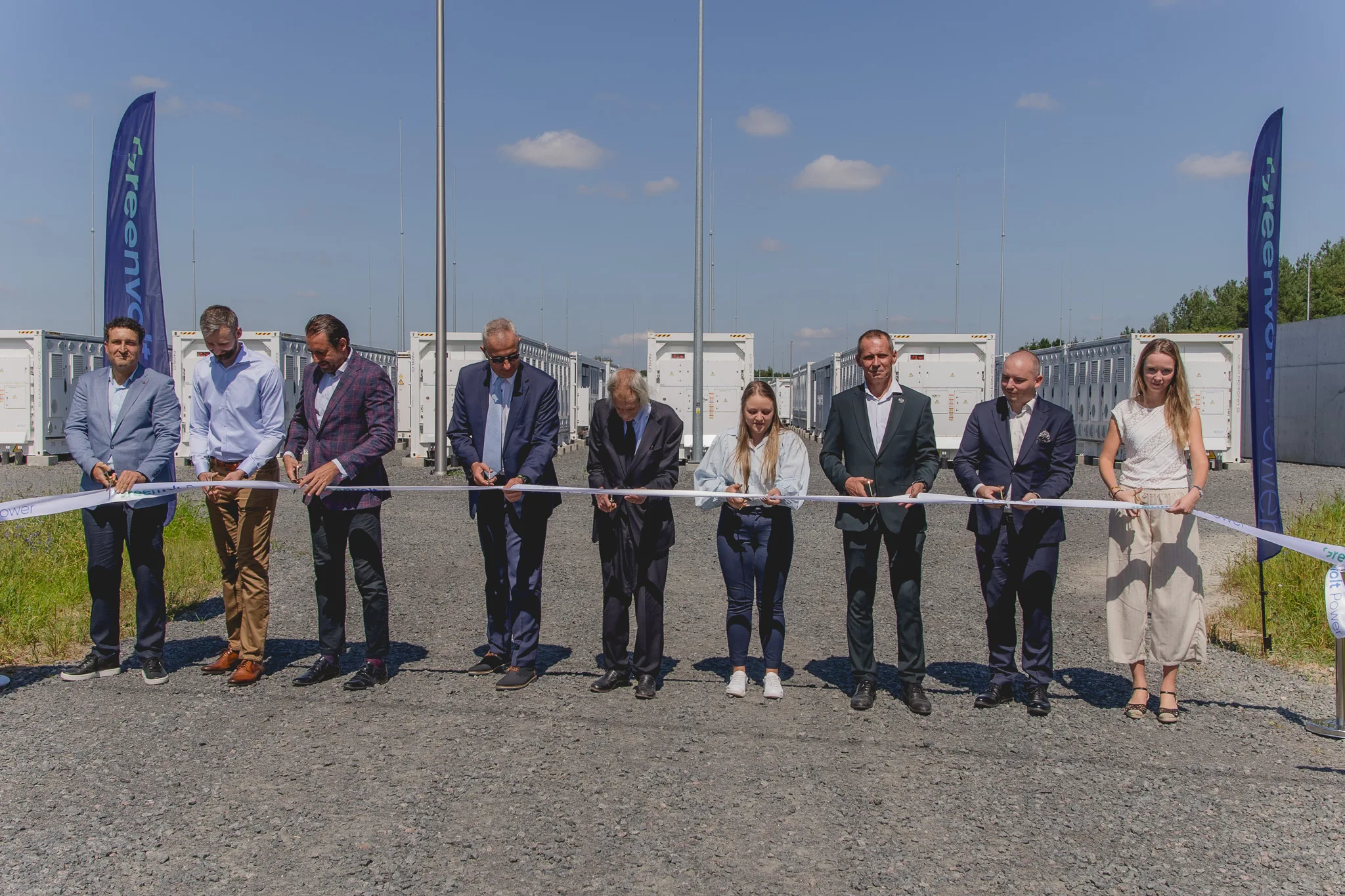
Greenvolt Power put into operation the energy storage system with batteries from Turośń Kościelna, an installation designed to bring flexibility and rapid response to the Polish electricity grid.
The plant has a nominal power of 200 MW and a storage capacity of 800 MWh this configuration allows it to deliver full power for about four hours and places the project among the BESS systems larger scale developed so far in Poland.
A battery plant connected to the 110 kV grid
The facility is connected to the national transmission network via a 110 kV connection, its function will be to store electricity during periods of high availability and return it to the system when demand increases or operational support is required.
Furthermore, the system can respond to network operator signals in a matter of seconds, this speed allows for balancing, frequency regulation, and backup services to integrate a greater proportion of renewable energy.
The infrastructure incorporates 196 containerized battery modules and 49 containerized transformer stations. P&Q acted as the main contractor, while BYD Energy Storage supplied the storage technology.
LFP technology and a lifespan exceeding 20 years
The project uses lithium iron phosphate batteries known as LFP batteries, this chemistry is frequently used in stationary systems due to its thermal stability, durability and ability to withstand numerous charge and discharge cycles.
According to Greenvolt, the plant will have a projected lifespan of more than 20 years, furthermore, the facility incorporates monitoring systems, fire protection, and acoustic barriers to reduce its impact on the environment.
The site occupies approximately 35,000 square meters, with over 25,000 square meters maintained as biologically active land, representing more than 70% of the total project area.
Capacity contract from 2028
Starting in 2028, the plant will participate in Poland’s capacity market under a 17-year contract, the capacity obligation will be 170 MW, equivalent to 85% of the system’s nominal power.
This mechanism will allow the facility to receive revenue for maintaining available capacity for the electrical system. In this way, the project will combine network services, energy arbitrage, and capacity backup.
The Polish market has become more attractive to storage developers due to the growth of renewable generation and the need for assets capable of responding quickly to changes in supply and demand.
Greenvolt expands its storage portfolio in Poland
Turośń Kościelna is part of an agreement between Greenvolt and BYD Energy Storage to develop up to 1.6 GWh of battery storage in Poland.
The company is also working on the Ełk project, which will have the same power output and capacity of 200 MW and 800 MWh. It is scheduled to begin commercial operation in the fourth quarter of 2026.
Together, both plants would contribute 400 MW of power and 1.6 GWh of storage capacity. In addition, Greenvolt is developing a 600 MW and 2.4 GWh project in Siedlce that could become one of the largest BESS facilities in Europe.
Warehousing is gaining importance in the group’s strategy.
The inauguration in Poland comes after the commissioning of the BESS system in Buj, Hungary, with 99.8 MW and 288.6 MWh.
Greenvolt Power develops energy storage projects in several European markets and considers this technology one of its main growth drivers. The company has a battery portfolio of approximately 5 GW within a broader portfolio of wind, solar, and storage assets.
The expansion responds to the increase in electrification and the growth of renewable energies, in this scenario, storage systems allow for the absorption of surpluses, the reduction of imbalances, and the reinforcement of the operational security of the grid.
Source: Ess News
Photo: Greenvolt Power