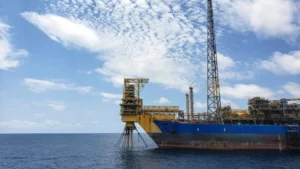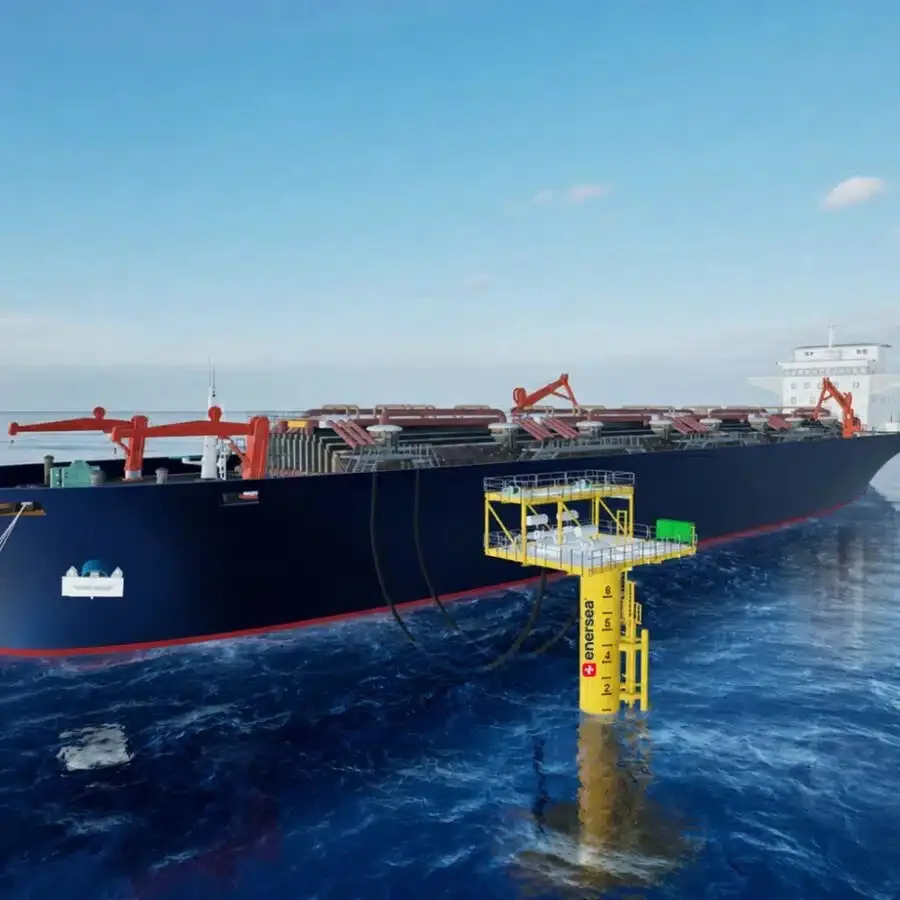
Dutch firm Enersea presented an LNG loading platform designed for shallow waters and coastal environments, positioned as an alternative to traditional jetty infrastructure.
The announcement follows a positive evaluation in a large-scale LNG infrastructure project in South America, whose identity the company did not disclose. But behind the statement lies a technical detail that explains why this type of solution is gaining ground in the region.
The Essential Technical Detail: Installation in a Single Operation
Enersea designed the platform to be fully assembled onshore and then installed at sea through a single lifting operation. This contrasts with the conventional jetty construction method, which requires months of continuous marine work, dredging, and staged assembly.
By moving nearly all fabrication onshore, operational risk is concentrated in a much shorter and more predictable installation window. It is the same principle Enersea already applies in minimal platforms for marginal oil fields and in single-lift modules for offshore wind, a field where the company has proven track record.
Reducing time in the water not only lowers construction costs; it also shortens exposure to adverse metocean conditions, a critical factor in South American coastal stretches where weather windows limit offshore campaigns.
Why the Jettyless Model Fits South America
Enersea’s platform belongs to a technology category known as jettyless systems: prefabricated floating solutions that enable the transfer of LNG, ammonia, or CO2 between a vessel and a terminal without the need to build a fixed jetty.
This family of technologies avoids large-scale dredging and port construction works, reducing both initial capital and environmental impact in sensitive coastal areas. For developers seeking to import LNG on short timelines, it is a way to shorten permitting and construction processes that traditionally take years.
The South American case is particularly favorable for this approach: much of the coast where the region’s LNG import projects are located combines shallow waters with access points where traditional port infrastructure would be more costly and slower to build.
The Regional Landscape: From Argentina LNG to Colombia
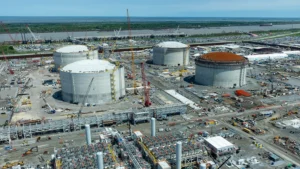
Enersea did not disclose the name of the project where it validated its concept, but the move comes at a time of strong LNG activity in South America. The Argentina LNG project, in the San Matías Gulf of Río Negro, contemplates a combined capacity close to 6 million tons per year distributed across two floating units.
Colombia is advancing in a similar direction: ECOnnect was recently contracted to develop a jettyless transfer solution for a new LNG terminal in the country, confirming that the jettyless model is no longer an isolated rarity but a regional trend.
For Enersea, with decades of experience in Dutch offshore engineering, the move into South America represents a natural expansion of a portfolio that already includes platforms for oil and gas, green hydrogen, and offshore wind.
Source and photo: https://www.enersea.nl/