The diesel price in the United States it is approaching record levels as refinery disruptions reduce the global supply of fuels.
The diesel market is experiencing strong international pressure, the average price of the fuel in the United States has reached $5.58 per gallon during the last week and came close to its all-time high.
However, the origin of this increase goes beyond the behavior of crude oil, although diesel is obtained from this resource, the refined products market faces its own supply and demand constraints.
Currently, the main bottleneck is the available capacity to transform crude oil into fuels, disruptions at major refining centers have reduced supply, while diesel demand remains difficult to cut.
Refining capacity is putting pressure on diesel prices
In particular, the disruptions recorded in The Middle East, Russia and China have limited the amount of refined fuels available on the international market.
In Middle East the damage suffered by refining facilities due to drone attacks has been compounded by problems in maritime transport across the Strait of Hormuz this has reduced the volume of fuel that can reach other markets.
For its part, Russia also has a significant role in this situation, the country is among the world’s largest suppliers of diesel, and several of its refineries were taken out of operation following Ukrainian attacks.
China represents another relevant factor, the country sharply reduced its fuel exports to protect domestic supply, although it recently began to ease those restrictions.
As a result, the world is processing approximately 5 million barrels of crude oil per day less than a year ago, a reduction equivalent to almost 10% of the world supply.
The problem shifts to refined fuels
Furthermore, market signals indicate that having crude oil available no longer guarantees a sufficient supply of diesel. The crack spread for US diesel, which reflects the difference between the value of the refined fuel and the oil used to produce it, recently exceeded $100 per barrel and reached an intraday high of over $102.
This indicator points to a strong appreciation of the refined product compared to its raw material, in other words, the pressure is focused on the ability to convert available crude oil into usable fuels.
Similarly, refineries operating near their limits have little room to respond quickly when production capacity disappears in other regions.
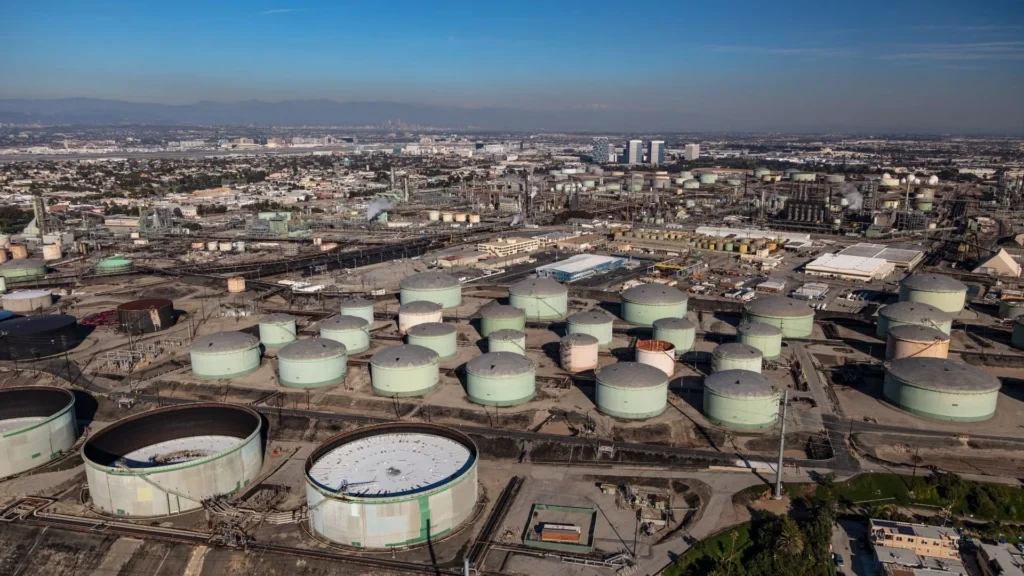
The United States is pushing its refineries close to their limits
The United States has a favorable position due to its extensive infrastructure of refining and fuel production. During July, US refineries produced more diesel than in any other July on record and reached a utilization rate of 97 %.
This level of activity helps to sustain domestic supply but also reveals a limitation, with plants operating at virtually full capacity, it is difficult to quickly increase production to compensate for an international reduction in supply.
Therefore, a high domestic oil production does not completely isolate US consumers from global fuel market conditions.
The increase in diesel prices is passed on to the economy
On the other hand, diesel maintains a demand that is particularly resistant to price increases due to its role in productive activities.
Cargo trucks, trains, ships, tractors, harvesters, excavators, and other heavy machinery depend on this fuel to maintain their operations.
For this reason, companies have less ability to reduce their consumption when prices rise, carriers must continue making deliveries, farmers need to operate their equipment, and construction sites require keeping their machinery running.
The increase in diesel prices can then be passed on to logistics, agricultural, and construction costs, from there, the pressure can spread to numerous goods that depend on freight transport.
Energy security also depends on refining
Finally, the market situation shows that energy security depends on more factors than just the availability of oil. Refining capacity, fuel inventories, shipping routes, and international trade determine how much diesel can actually reach consumers and businesses.
The United States has a large downstream infrastructure and its refineries are operating at high levels, even so, a significant reduction in international supply could be passed on to the domestic market due to the global nature of fuel trade.
As long as refining restrictions persist and demand remains strong, the price of diesel in the United States will continue to be exposed to the tensions affecting global supply.
Source: EnergyNow
Photo: Shutterstock