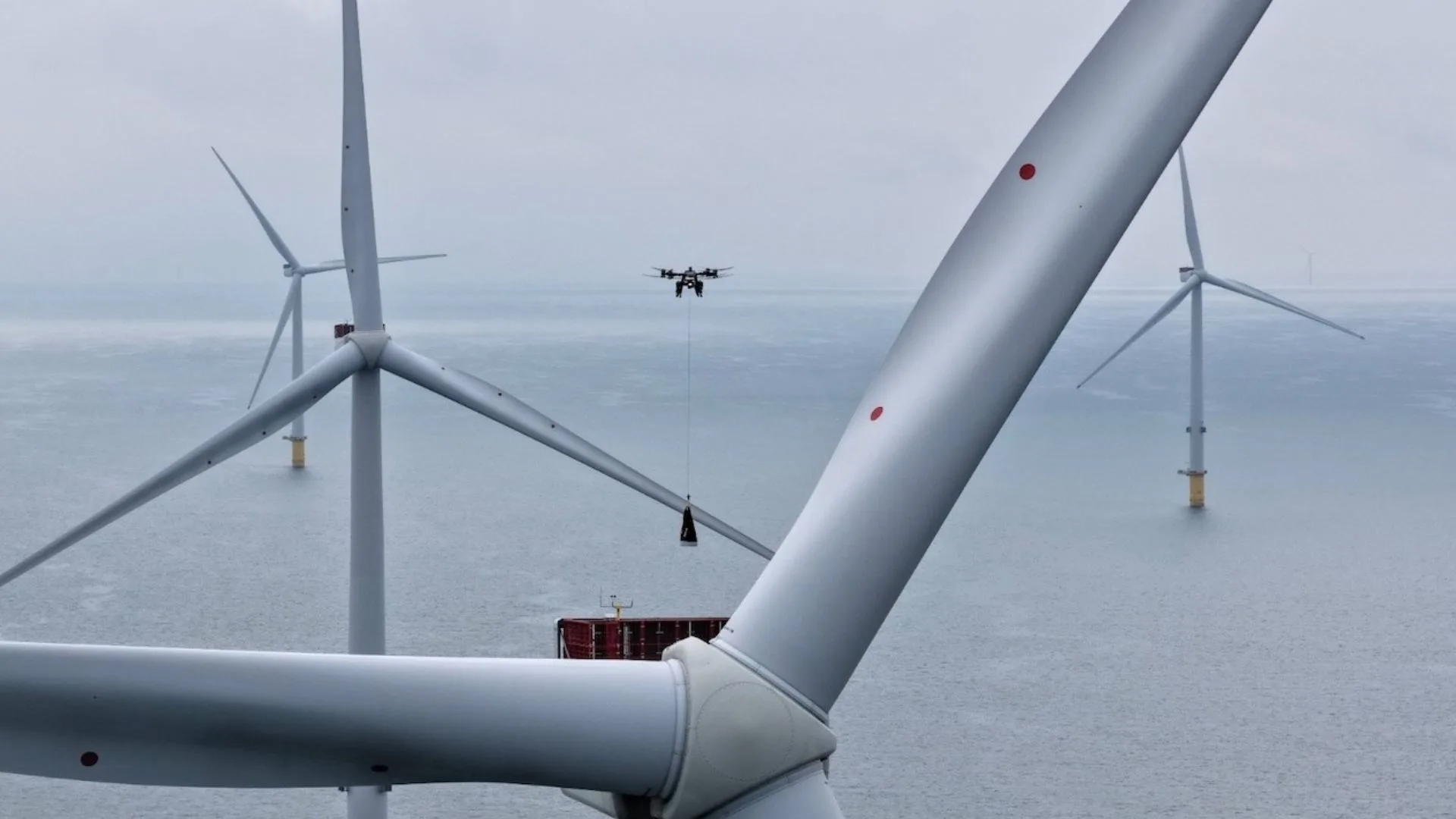
The specialized company Ampelmann has successfully concluded a six-week logistics campaign using cargo drones at the Triton Knoll offshore wind farm, operated by RWE in the United Kingdom. During this period between August and September, the company executed over 250 flights to transport more than nine tons of tools, spare parts, and safety equipment between a service operation vessel (SOV) and the generation platforms.
Results of the Logistics Campaign at Triton Knoll Wind Farm
Consequently, this technical initiative aligns with RWE’s strategy to evaluate the integration of unmanned aerial vehicles into its offshore maintenance logistics model. In this way, the energy company seeks to optimize infrastructure management before assuming direct operational responsibility for the facilities in 2027.
Operational Impact and Efficiency in Offshore Maintenance
Regarding operational benefits, the systems employed allowed for the proactive supply of turbines with required materials before technicians disembarked. Likewise, the technology facilitated the remote retrieval of cargo after work on the structures was completed, managing weights of up to 80 kilograms directly in the nacelle and on the main access platform using an automated collection mechanism.
Additionally, the use of these devices significantly reduces reliance on conventional cranes and decreases vessel movements. For its part, Ampelmann’s business development management noted that operating during nighttime hours allows for transforming vessel downtime into productive lifting shifts, maintaining continuous power generation during maneuvers.
As a result of these improvements, the firm’s estimates indicate an increase of between 15% and 20% in the effective time specialized personnel dedicate to the direct use of tools in each intervention.
Technological Evolution and Background of the Program with RWE
On the other hand, the technical architecture of this service has been consolidated since its commercial introduction in 2024. Currently, the system incorporates flight control software designed to perform automated routes between the service vessel and the wind turbines, under the constant supervision of trained pilots ready to intervene in case of contingency.
Following this trajectory, the operation at Triton Knoll — an 857 MW offshore facility located 32 kilometers off the coast of Lincolnshire and comprising 90 Vestas V164-9.5 MW turbines — represents a continuation of previous trials. Previously, in 2025, both companies collaborated on short-range tests at the Nordsee Ost offshore wind farm in Germany, followed by complementary operations at the Arkona complex.
Source and photo: Ampelmann