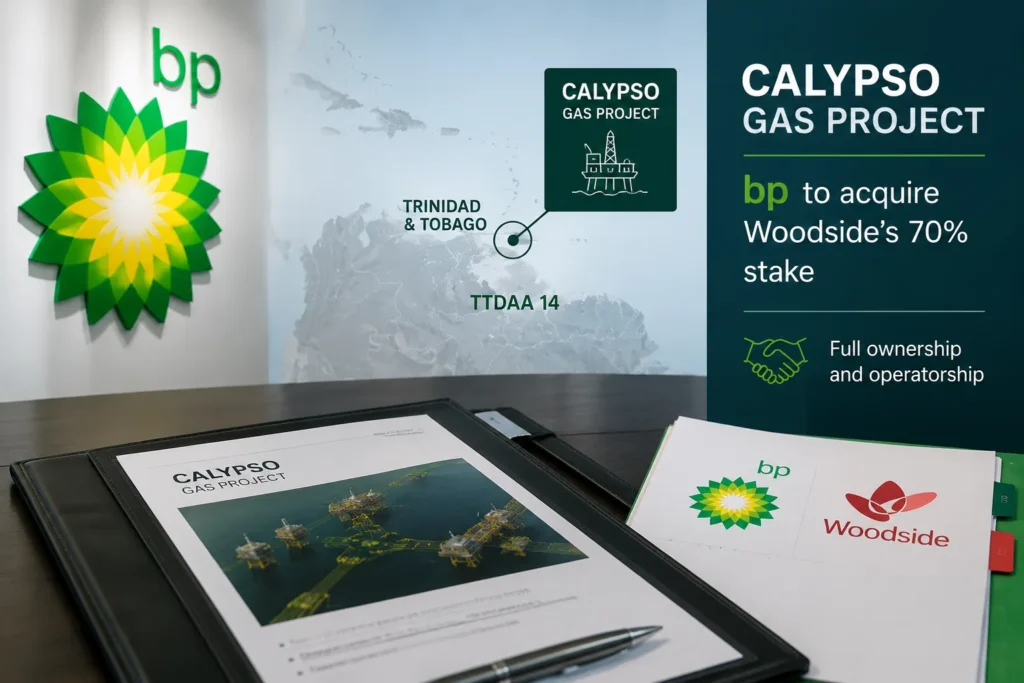
The Calypso gas project is entering a new phase following bp’s agreement to acquire Woodside Energy’s 70% interest in the offshore development in Trinidad and Tobago. Once the transaction is completed, bp will increase its stake from 30% to 100%, assuming full control of one of the country’s largest undeveloped gas resources.
The transaction is particularly significant given the current conditions in Trinidad and Tobago’s energy market. Declining gas availability has affected the utilization of petrochemical and liquefaction facilities, while the country needs to bring new reserves online to sustain infrastructure built around natural gas processing and exports. Reuters estimates Calypso’s resources at approximately 3.5 trillion cubic feet (Tcf).
For bp, the acquisition represents more than simply purchasing an additional stake. The company is already the largest supplier of natural gas to Trinidad and Tobago’s domestic market and holds a 45% interest in Atlantic LNG, meaning that full control of Calypso expands its options for integrating new reserves into its established energy position in the country.
The Calypso gas project holds a strategic deepwater resource
Calypso is located approximately 220 kilometers off the coast of Trinidad, in water depths of around 2,100 meters, and comprises several gas discoveries within Blocks 23(a) and TTDAA 14. Woodside had advanced conceptual studies and pre-FEED work to define a potential development option while holding commercial discussions to determine how the resource could be monetized.
The area’s appraisal has also delivered significant exploration results. The appraisal program comprising the Bongos-3, Bongos-3X, and Bongos-4 wells was completed in December 2021, with all three wells encountering hydrocarbons. Technical studies subsequently continued to refine the development concept and the project’s commercial framework.
The estimated scale of the Calypso gas project underscores its importance. S&P Global has also estimated its potential resource at around 3.5 Tcf, while Wood Mackenzie considers it the largest discovered but still undeveloped resource in Trinidad and Tobago. However, Calypso remains at a pre-final investment decision stage, meaning its resources should not be interpreted as guaranteed future production.
That will be one of bp’s main challenges: transforming a technically attractive deepwater discovery into a commercially competitive development.
bp can leverage its position to pursue a monetization pathway
Calypso’s strategic value increases when viewed within Trinidad and Tobago’s existing energy infrastructure. The country has processing facilities, a significant petrochemical industry, and LNG export capacity, although declining domestic gas production has put pressure on the utilization of these assets. Reuters notes that the shortage has contributed to reduced activity at LNG, ammonia, and methanol facilities.
bp produced around 1 billion cubic feet per day of natural gas in Trinidad and Tobago during 2025, equivalent to more than 15% of its global net gas production, according to company data cited by Reuters. This presence provides bp with operational expertise, commercial relationships, and a downstream position that could prove relevant when evaluating development alternatives for Calypso.
However, monetizing the Calypso gas project will require addressing one essential question: how to economically transport the gas from a development located more than 200 kilometers offshore and in ultra-deep waters.
Woodside had previously selected a concept based on an in-field host and advanced its definition through engineering studies. The future design, gas evacuation infrastructure, and commercial destination of the gas will be key factors in determining the project’s competitiveness.
For this reason, it would still be premature to state that Calypso gas will directly supply Atlantic LNG. bp’s stake in the facility offers a potential commercial advantage, but the final monetization pathway will depend on the development concept, gas sales agreements, and a future investment decision.
Woodside exits Trinidad as bp concentrates its portfolio
The transaction also marks Woodside’s exit from Trinidad and Tobago. The company had previously sold other offshore assets in the country and will now transfer its remaining interest in Calypso to bp. The transaction value was not disclosed; the agreement includes cash consideration and contingent payments and is expected to close before the end of 2026, subject to the relevant approvals.
For bp, the move aligns with a strategy of concentrating on assets where it can leverage existing capabilities and infrastructure. The acquisition also removes Calypso’s previous partnership structure: if the necessary approvals are obtained, a single company will control the development’s technical, commercial, and investment decisions.
That change could simplify project governance, but it does not eliminate the challenges inherent in a deepwater development of this scale.
Calypso could become a key component of gas supply
Full ownership gives bp greater control over Calypso’s future, but the true significance of the acquisition will depend on what happens after the transaction closes.
Trinidad and Tobago has developed extensive gas and petrochemical infrastructure over several decades, but the country needs new sources of production to offset declining output from mature fields. In this context, bringing a potential resource of approximately 3.5 Tcf into development could help sustain domestic supply and improve the utilization of existing assets if the project achieves commercial viability.
The Calypso gas project is therefore transitioning from a jointly owned development into an opportunity fully controlled by one of the country’s leading gas producers. For bp, the next challenge will be to demonstrate that its increased ownership can translate into a competitive development pathway, a final investment decision and, eventually, new gas volumes for a market that needs to restore supply.
Sources: World Oil