Brent crude prices rose above US$86 per barrel during early European trading on Tuesday, July 14, after an attack on two tankers linked to the United Arab Emirates in the Strait of Hormuz.
At 9:00 a.m. in London, Brent was trading around US$86.06 per barrel, up more than 3%. The move extended the oil market’s gains since Friday amid rising tensions in the Middle East.
Meanwhile, West Texas Intermediate, the U.S. benchmark, gained about 3.1% and rose above US$80 per barrel for the first time in a month. Prompt-delivery futures stood at around US$80.58 during the European session.
Attack on oil tankers raises risk in the Strait of Hormuz
The United Arab Emirates Ministry of Defense reported that the tankers Mombasa and Al Bahiyah were hit by Iranian cruise missiles while sailing along the southern sea route of the Strait of Hormuz within Oman’s territorial waters.
The attack left one Indian crew member dead and eight injured. Four of them were in critical condition, according to information released by Emirati authorities.
The United Arab Emirates described the incident as a violation of international law and warned that it reserves the right to respond to the escalation.
In addition, ADNOC Logistics and Services confirmed that both vessels suffered significant damage. Al Bahiyah is a large crude oil tanker owned by the company, while Mombasa B operates under a time-charter contract.
Brent crude builds in a higher risk premium
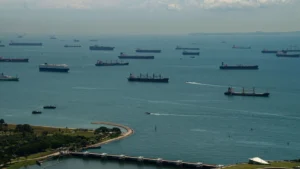
Brent’s reaction reflects fears that commercial shipping could lose security even in the southern channel near Oman. That route had been considered an alternative to reduce exposure for vessels transiting the strait.
Hormuz accounts for a significant share of global seaborne oil trade. Therefore, any threat against tankers, terminals, or shipping routes can quickly raise the risk premium priced into crude futures.
Likewise, the market is closely watching marine insurance costs, potential vessel diversions, and the ability of Persian Gulf producers to maintain their exports.
WTI follows Brent’s advance
WTI’s rise confirms that upward pressure is affecting the main international benchmarks. U.S. crude was supported by fears of a supply disruption and increased demand for hedging contracts.
The spread between the two benchmarks continues to show Brent’s greater sensitivity to tensions affecting international shipping routes. However, a prolonged blockade or new attacks could shift pressure to inventories and fuel prices in several markets.
Hormuz returns to the center of energy security
The trajectory of the oil price will now depend on the United Arab Emirates’ response, Iran’s decisions, and conditions for commercial transit through the strait.
An effective reduction in flows would raise supply risk for refineries in Asia and Europe. It could also increase refining margins and make products such as gasoline, diesel, and jet fuel more expensive.
For now, Brent’s move above US$86 shows that traders are pricing in a scenario of heightened tension. Whether that trend continues will depend on whether the attacks are repeated or whether the parties manage to contain the escalation.
Source: Oil Price
Photo: Shutterstock