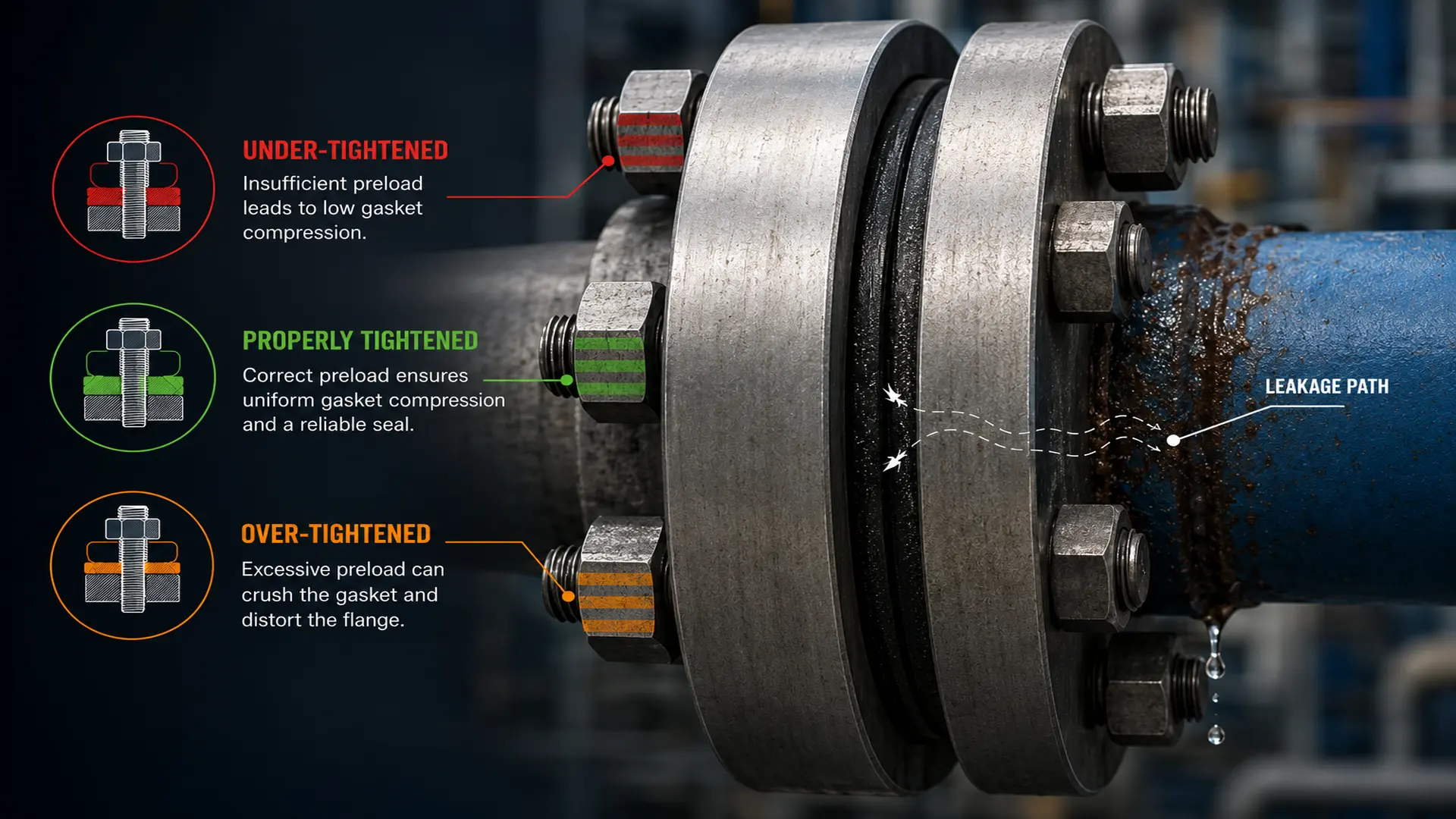
Leaks in bolted flange joints are often initially attributed to gasket deterioration, corrosion, or operating pressure conditions. However, in a significant number of cases, the root cause lies in improper bolt loading. Insufficient, excessive, or uneven preload can compromise the integrity of the seal and turn an apparently properly assembled joint into a source of progressive leaks.
The performance of a bolted flange joint does not depend on the bolt subjected to the highest torque but rather on the ability of the assembly to distribute the load uniformly and maintain the required gasket compression throughout its service life.
Mechanical function of the bolt
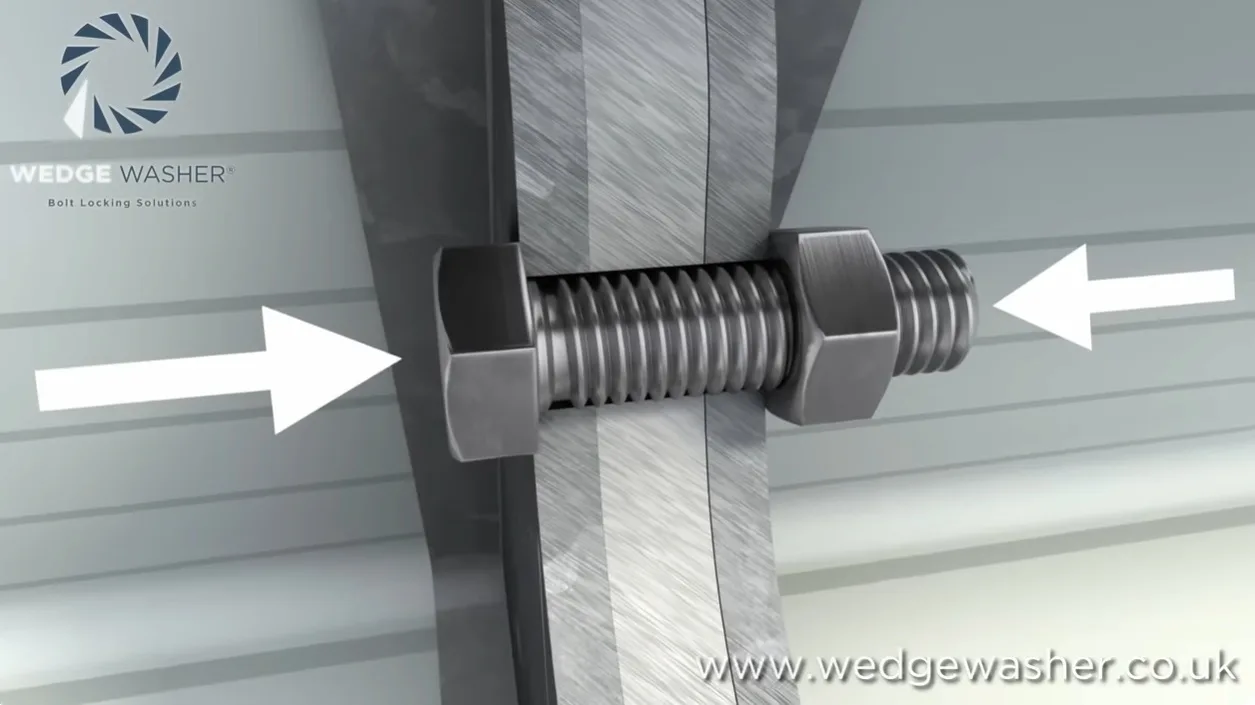
In a bolted flange joint, the bolt serves a purpose beyond simply fastening the components together. Its primary function is to generate preload, the initial tensile force that compresses the gasket and holds the flange faces in contact. This compression is the fundamental mechanism that prevents the process fluid from escaping through the joint.
From a mechanical standpoint, the bolt behaves as an elastic element that must be stretched within its operating range to generate a stable clamping force. Insufficient elongation fails to produce the sealing pressure required, whereas excessive elongation may result in bolt yielding, thread damage, flange distortion, or premature gasket failure.
However, the torque applied during assembly does not always translate into the intended preload. A substantial portion of the input energy is dissipated through friction in the threads and at the bearing surfaces beneath the bolt head or nut. Consequently, two bolts tightened to the same torque may develop significantly different preload levels. For this reason, a joint may appear to have been tightened according to specification while still exhibiting a non-uniform stress distribution that promotes leakage.
What exactly is “preload,” and why is it so crucial in engineering? In the following video, Wedge Washers explains the concept in a simple and 100% visual way. Once you understand how it works, it becomes clear why maintaining preload is absolutely vital for safety and stability in critical applications.
Leak formation mechanism
Leakage occurs when the contact pressure acting on the gasket falls below the level required to withstand the internal pressure and the separating forces acting on the joint.
This condition may result from under-tightening, in which the gasket never reaches the minimum required compression; over-tightening, where excessive compression causes gasket crushing or flange distortion; or non-uniform tightening, resulting from an improper tightening sequence or inconsistent torque application, which creates localized areas of excessive loading and regions with insufficient gasket seating stress.
Therefore, sealing reliability is not achieved by applying higher torque but by ensuring a uniform distribution of preload.
The most common contributing factors include incorrect tightening sequences, the use of uncalibrated torque tools, inconsistent bolt lubrication, flange misalignment, and improper gasket selection. Each of these factors alters the load distribution and reduces the sealing capability of the joint.
In the early stages, loss of sealing integrity typically manifests as minor weeping, coating discoloration around the flange joint, slight pressure loss, or leakage that becomes evident only under elevated temperatures or during operating thermal cycles.
Effects of improper bolt loading
Failures associated with improper bolt loading rarely result from a single cause. Instead, they generally arise from the combined effect of multiple assembly-related deviations.
When the applied torque is below the specified value, the gasket fails to develop the required seating stress, allowing the internal pressure to progressively separate the flange faces. Conversely, excessive torque may lead to gasket crushing, flange rotation, and bolt stresses approaching the material’s yield strength.
Likewise, an asymmetric tightening pattern produces a non-uniform circumferential load distribution, creating localized stress concentrations and irregular gasket sealing.
Furthermore, flange misalignment forces the bolts to absorb bending moments and lateral loads for which they were not designed, reducing the uniformity of gasket compression. Under these conditions, it is common to attempt to correct the problem by increasing the applied torque when the actual root cause is improper alignment or assembly.
Design and assembly considerations
The design of a bolted flange joint should not be limited to verifying the mechanical strength of its components. Its primary objective is to maintain stable contact between the sealing surfaces while preserving sufficient gasket seating stress under all anticipated operating conditions.
Accordingly, bolt sizing, gasket selection, operating pressure and temperature, material properties, and installation procedures must be treated as interdependent elements of a single sealing system.
For this reason, industry standards and assembly procedures specify cross-pattern tightening sequences, incremental torque application, staged retightening, and the use of properly calibrated tightening tools. These practices are intended to achieve a uniform preload distribution while minimizing distortion of the joint components. They also explain why a properly designed flange joint may still experience leakage if installation procedures are not performed in accordance with established technical requirements.
Another important consideration is the selection of the proper bolt or stud length, which should comply with the dimensional requirements specified in ASME B16.5 for flanges up to 24 inches in nominal diameter and ASME B16.47 for larger flanges within the U.S. piping standards. For piping systems designed according to European standards, the applicable reference is EN 1092-1.
From a mechanical integrity perspective, the performance of a bolted flange joint depends on achieving the specified preload, following the appropriate tightening sequence, and considering the interaction of all components within the sealing system. Consequently, a large proportion of flange leaks originate from improper bolt preload rather than from gasket failure itself.
Incorrect loading of bolts: A preventable failure
Incorrect bolt loading remains one of the most common yet often overlooked causes of leakage in flanged joints. Beyond the applied torque value, joint reliability depends on achieving uniform preload, maintaining adequate gasket compression, and following installation procedures that comply with recognized engineering practices and applicable standards. Understanding the interaction between bolts, flanges, and gaskets is essential for preventing leaks, improving mechanical integrity, and extending the service life of industrial assets.
Conclusions
Incorrect bolt loading disrupts the uniform distribution of preload across the gasket, reducing sealing performance and increasing the likelihood of leakage in flanged joints. Proper installation practices, including controlled tightening sequences, calibrated tools, and correct flange alignment, are essential to prevent associated failures.
The reliability of a flanged joint depends not only on the applied torque but also on achieving consistent preload that maintains sealing performance throughout all operating conditions. Compliance with standards such as ASME B16.5, ASME B16.47, together with recognized bolting best practices, helps minimize the risks associated with incorrect bolt loading, enhancing operational safety and long-term asset integrity.
References
- Nelson, N. R. (2023). Structural Integrity and Sealing Behaviour of Bolted Flange Joints: A State-of-the-Art Review. ScienceDirect.
- API. (2018). Appendix J: Bolting Preload.
- Baker, J. C. (2009). Analysis of Bolting in Flanged Connections.
- Estrada, H., et al. Analysis of Leakage in Bolted-Flanged Joints. David Publishing.