Table of Contents
The price of Brent crude managed to stabilize this Friday near $80 per barrel. However, the energy market is heading toward a weekly loss of more than 8%, affected by uncertainty regarding the sustainability of the provisional agreement reached between the United States and Iran and by the continuity of tensions in the Middle East.
As traders evaluate the next diplomatic moves, Brent futures advanced slightly to $79.94 per barrel. For its part, West Texas Intermediate (WTI) recorded moderate gains, although both benchmarks continue to reflect the pressure generated by expectations of an increase in global crude supply.
The agreement between Washington and Tehran changes market outlooks
The cancellation of scheduled talks between US and Iranian representatives once again raised doubts about the stability of the peace process. The decision came after US Vice President JD Vance suspended a scheduled trip, a situation that increased caution among market participants.
Despite this, the provisional agreement recently signed by both countries has reduced some of the concerns related to potential prolonged disruptions in the oil supply from the Persian Gulf.
According to industry analysts, the evolution of negotiations will remain one of the main factors determining price behavior over the coming weeks.
The Strait of Hormuz maintains its strategic relevance
The Strait of Hormuz continues to be a key piece for global energy trade. Approximately one-fifth of the global supply of oil and liquefied natural gas passes through this maritime route.
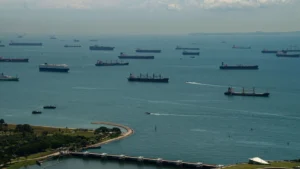
The movement of several tankers through the area following the announcement of the agreement between the United States and Iran was interpreted by the market as a positive sign for the normalization of trade flows. Nevertheless, experts warn that the full recovery of exports and logistical capacity could require several months.
Likewise, the progressive reopening of maritime routes would allow the market to incorporate significant volumes of crude that remained limited by restrictions derived from the conflict.
Brent crude faces pressure from increased global supply
Expectations of an easing of sanctions on Iranian oil have reinforced forecasts of an increase in global supply. Various estimates suggest that millions of additional barrels could gradually return to the international market.
In this context, financial institutions such as Citi consider a scenario of sustained normalization of energy flows likely. Under this perspective, the oil market could enter a surplus stage over the coming years, favoring a downward trend in prices.
For its part, Commerzbank revised its forecasts for Brent and anticipates that the recovery of production will contribute to moderating prices, although it expects prices to remain above the levels observed before the conflict for much of next year.
Iraq prepares for the return of its production while demand continues to grow
The recovery of supply will also feature contributions from Iraq. The country’s authorities indicated that several fields are ready to resume operations and move toward production levels seen prior to the regional crisis.
On the demand side, the outlook remains favorable. According to OPEC projections, global oil consumption could reach 113.3 million barrels per day in 2030 compared to the 105.1 million recorded for 2025.
This expected growth reflects the continued importance that oil will have within the global energy matrix over the next decade.
The situation in Lebanon maintains uncertainty
Despite signs of stabilization in the market, the continuity of Israel’s military operations against Hezbollah in Lebanon keeps a risk factor open for investors.
The evolution of this conflict will be closely watched by energy markets, as any deterioration in regional security could once again affect expectations regarding global oil supply and price stability.
Source: Reuters
Photo: Shutterstock