Canary Islands incorporates in Tenerife a 8 MWh arico battery associated with an 8 MW solar plant to manage renewable surpluses.
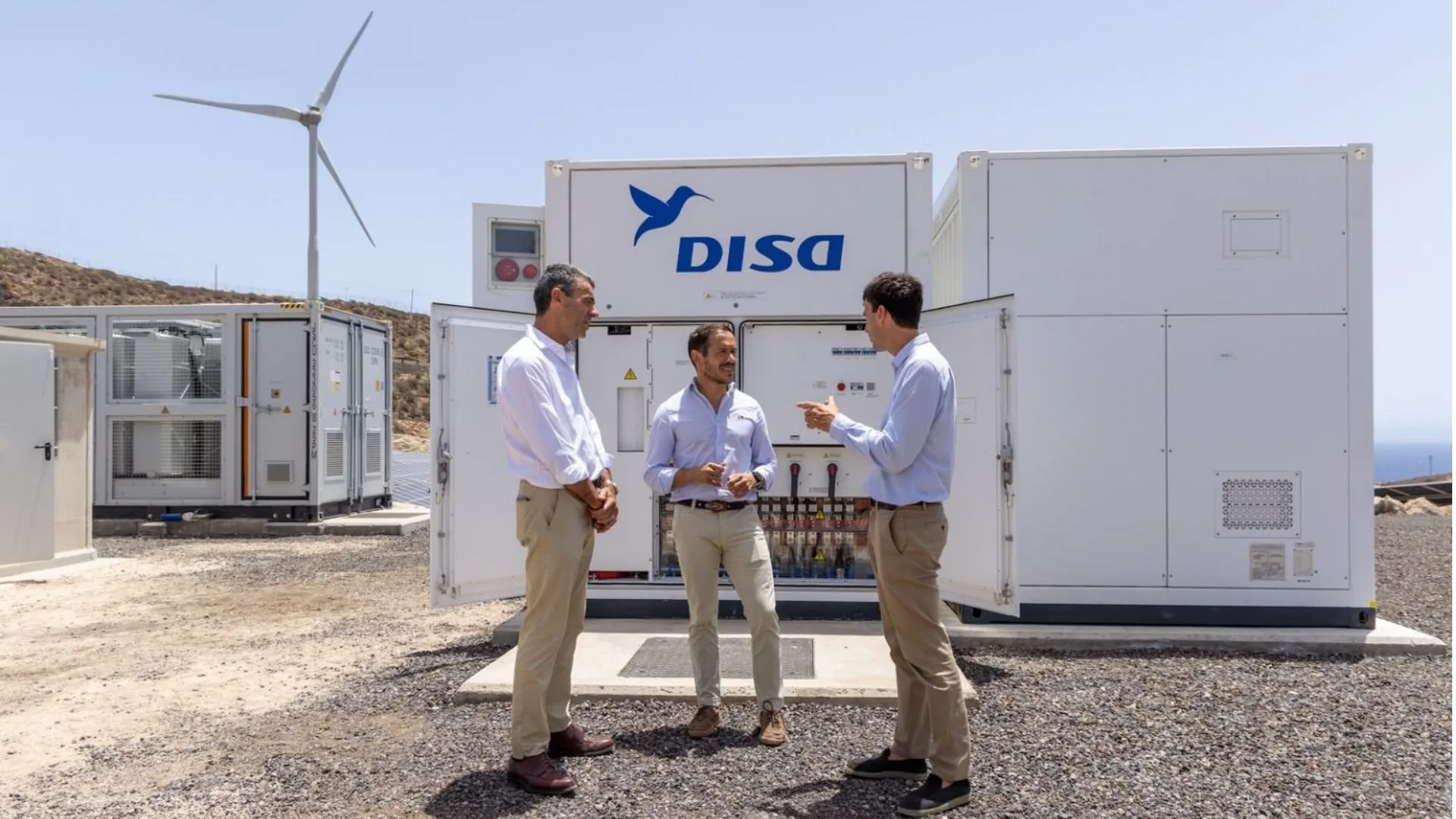
The municipality of Arico, in Tenerife, is home to the largest battery storage facility in the Canary Islands, the project combines a 8 MW photovoltaic plant with a battery capable of storing 8 MWh of energy and improving the management of solar production.
The infrastructure has been promoted by SOME it required an investment of €2 million, financed with European Next Generation funds. Its main function is to store some of the electricity generated during peak solar radiation hours and deliver it to the grid when demand increases.
Thus, the system allows the use of energy that would otherwise be lost when photovoltaic generation exceeds available grid capacity. It can also retain surplus energy during temporary restrictions imposed by the electricity provider.
Arico battery brings flexibility to the grid
Unlike a conventional power plant, a battery does not produce electricity itself; its role is to receive energy, store it for a certain period, and return it to the system at the most convenient time.
In Arico, this process allows part of the solar production from the middle of the day to periods of lower generation or higher consumption. This reduces the amount of renewable electricity fed back into the grid and makes better use of the photovoltaic plant’s capacity.
Furthermore, battery storage can respond quickly to frequency variations, changes in demand, or grid disruptions. This capability is especially useful in island electrical systems, where there is less interconnection with other territories.
An investment of 2 million euros
The energy storage system has received €2 million from the European Union’s Next Generation funds. This funding is part of measures aimed at accelerating the integration of renewable energies and reduce dependence on fossil fuels.
During a visit to the facility, the Minister of Ecological Transition and Energy of the Government of the Canary Islands, Mariano Hernández Zapata, highlighted the need to increase storage capacity in the archipelago.
For his part, the director of DISA Energía, Santiago Rull Cullen, pointed out that the combined production and storage capacity could cover a demand equivalent to that of La Palma for an hour and a half.
Renewable energy storage is gaining ground in the Canary Islands
The high availability of solar resources gives the Canary Islands a large photovoltaic potential; however, solar production varies depending on the time of day and weather conditions.
For this reason, batteries allow the availability of renewable electricity to be adjusted to the actual needs of the system. They also help maintain more stable operation and facilitate the integration of new solar plants.
The Canary Islands Government is studying the possibility of promoting similar infrastructure on other islands; La Palma is among the territories where these systems could strengthen the security of supply and increase the share of renewable energies.
Recovery of a degraded space in Arico
The facility was built on previously disturbed land that had been occupied by an illegal motocross track. This location avoids disturbing new land with natural value and allows for the recovery of a degraded space through energy use.
The project also combines the expansion of electrical infrastructure with territorial protection criteria, the model seeks to leverage already developed areas to reduce the impact of future renewable energy installations.
The Arico battery will serve as a benchmark for other energy storage projects in the Canary Islands, its operation will allow for the evaluation of these solutions’ performance in island grids and their capacity to reduce energy curtailment, balance solar generation, and reinforce the electricity supply.
Source and photo: Energias-renovables