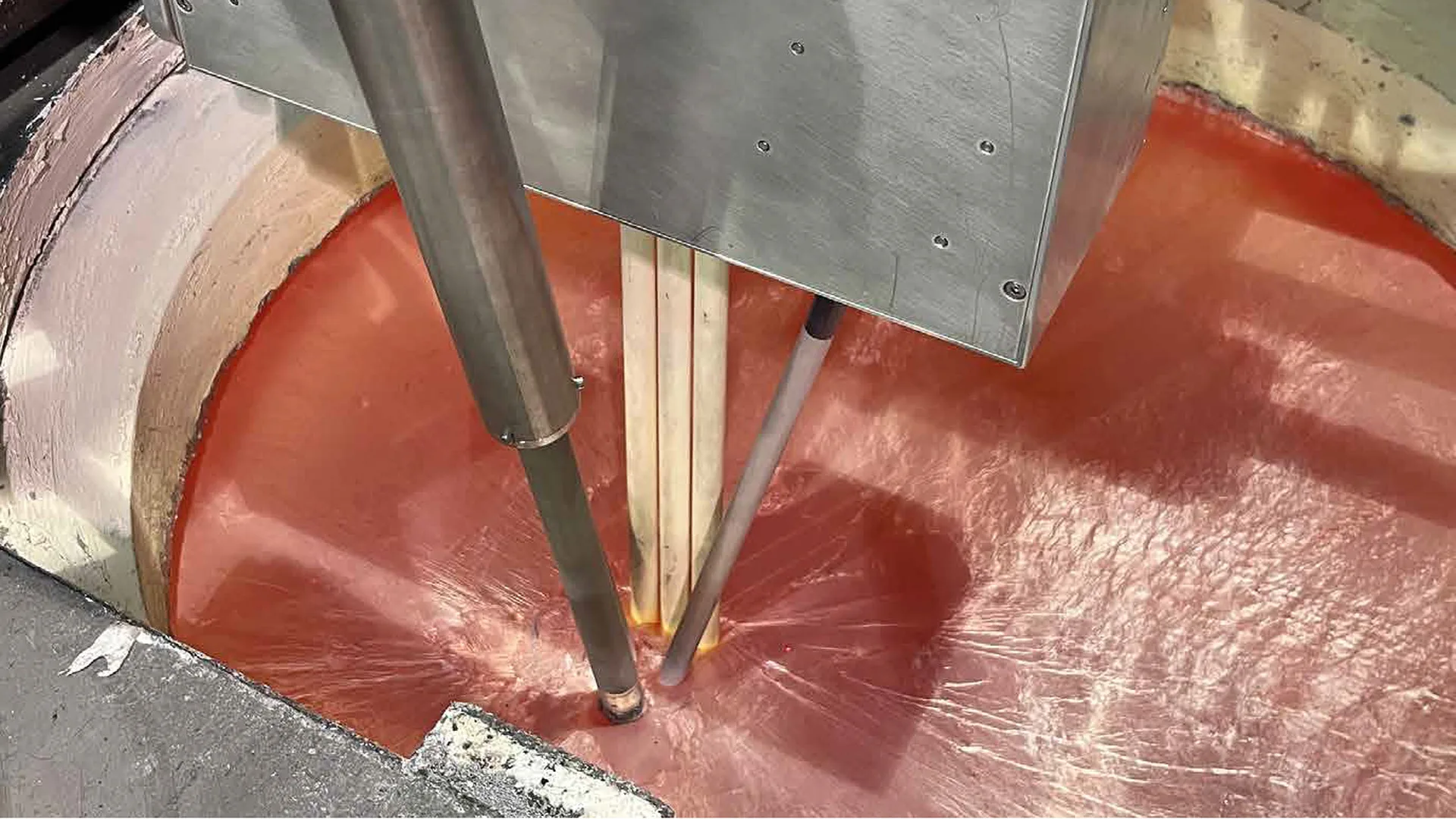
Fraunhofer IZFP will present its AloX system at SENSOR+TEST 2026, an ultrasonic measurement solution designed to detect non-metallic inclusions in molten aluminum during the production process.
The system will be exhibited from June 9 to 11, 2026 in Nuremberg, at the Nuremberg Exhibition Centre, Hall 1, Stand 1-317. The presentation will be given by specialists from the Fraunhofer Institute for Non-Destructive Testing (IZFP), including Dr. Thomas Waschkies and Andrea Mroß.
A critical problem in aluminum smelting
In the foundry industry, non-metallic inclusions can directly affect the quality of the final component. These particles act as stress concentration points, internal cracks, or weak areas within the material.
Therefore, its early detection is fundamental in sectors such as automotive, aerospace and light construction, where aluminum is used for its low weight, good resistance and recyclability with lower energy consumption.
Furthermore, the increasing use of secondary aluminum is driving the need for faster, more stable, and easier-to-integrate inspection systems. Traditional methods are often slow, expensive, difficult to reproduce, or dependent on highly specialized personnel.
How AloX Works
AloX uses the principle of ultrasonic backscattering; the system couples ultrasound waves to molten aluminum and analyzes the reflected signals to determine the presence of inclusions.
With this approach, the team can quantify the number of particles, their size, and their distribution within the casting. It also allows for measurements to be taken both in the channel and in the crucible, even in complex measurement positions.
The operational advantage is clear: monitoring can be performed during production without requiring advanced knowledge of non-destructive testing. This makes it easier for foundry personnel to use and improves real-time decision-making.
Applications and upcoming developments
During SENSOR+TEST, visitors will be able to see the AloX system in operation and talk with the project leaders. The technology was designed for cast aluminum, although Fraunhofer IZFP is already evaluating its adaptation to other metals.
According to the researchers, the next step will be to explore low-melting-point alloys such as magnesium, tin, and zinc, all below 600 °C. In the long term, steel could also become a target for this technology.
With this proposal, Fraunhofer IZFP seeks to strengthen the role of non-destructive testing in sustainable manufacturing, aluminum recycling, and quality control of critical metal components.
Source and photo: Izfp.fraunhofer.de