Tank Farms: integrated engineering redefines storage
The expansion of energy and logistics infrastructure has elevated the complexity of industrial storage projects. In this scenario, Tank Farms have moved beyond solely relying on the design of large tanks to become highly integrated facilities where every system must operate in a coordinated manner.
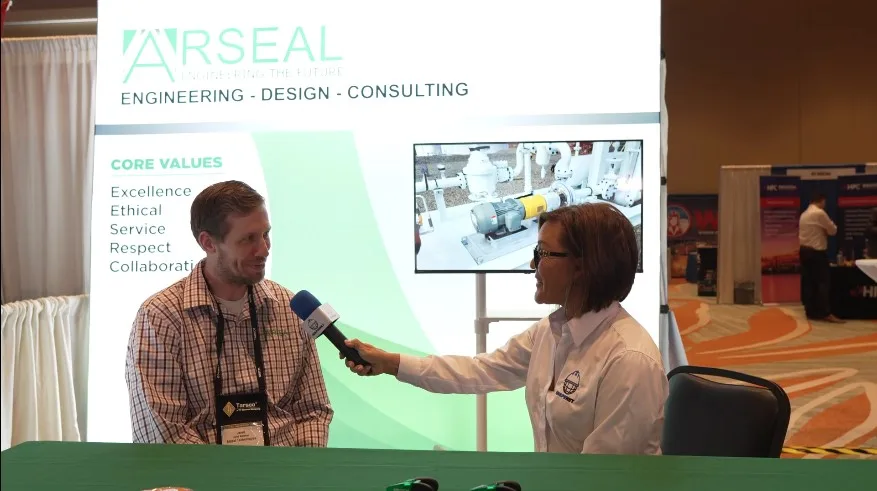
During NISTM 2026, Jared Markham, Director of Projects at Arseal, explained how multidisciplinary engineering has become one of the most relevant factors in ensuring the technical and operational viability of these types of facilities. According to the executive, the biggest challenge in the sector is often not a specific component but rather the lack of integration among all areas involved in the project.
Arseal, a firm specializing in industrial engineering, architecture, and project management, focuses precisely on this approach. The company develops comprehensive solutions for energy and industrial infrastructure, participating in projects related to storage terminals, pumping systems, automation, piping, and electrical infrastructure.
Beyond the tank: the infrastructure supporting a Tank Farm
Although the focus is often on the tank, Markham explained that a storage facility involves a considerable number of complementary systems that must be designed in a coordinated manner from the earliest stages of the project.
The tank needs a foundation. It needs secondary containment. It needs pumps, piping, power, and controls.
Markham commented.
In a Tank Farms project, engineering work may include:
- Structural foundation design
- Secondary containment and dike systems
- Industrial piping design
- Pumping systems
- Electrical infrastructure
- Alarms and instrumentation
- Automation and controls
- Power studies
- Civil and drainage design
Each of these areas directly depends on the others; an adjustment in the pumping system can modify electrical requirements. Likewise, changes in piping configuration can alter structures, foundations, or containment systems.
Therefore, early coordination between disciplines has become an essential aspect to reduce rework and maintain the operational continuity of the project.
Lack of integration remains one of the biggest challenges
One of the most relevant points of the conversation revolved around a recurring problem in the industry: fragmented work between companies and technical disciplines.
According to Markham, many projects continue to be developed under a scheme where each contractor works in isolation. In such cases, mechanical engineering progresses separately from electrical engineering, while civil or automation areas operate under different criteria.
The result often translates into incompatibilities during construction, late modifications, and deviations in budget or schedule.
The main problem is when clients try to develop the project one piece at a time and no one is integrating the entire system.
Jared explained.
This scenario represents one of the greatest risks for Tank Farms projects, especially when dealing with terminals with high operational requirements or tight schedules.
Lack of communication between disciplines can lead to conflicts related to:
- interferences between piping and structures
- insufficient capacity in electrical systems
- automation issues
- coordination errors during assembly
- construction delays
- field modifications
- cost overruns
In modern energy facilities, where operational continuity and safety are critically important, these types of failures can significantly affect the overall performance of the project.
A centralized engineering model
Given this outlook, Arseal advocates for a work model where all technical disciplines operate under a single engineering team.
The company develops in-house areas such as:
- mechanical engineering
- piping
- instrumentation and control
- automation
- electrical engineering
- power studies
- civil Engineering
- structural design
For Markham, the main advantage of this scheme is the ability to maintain constant communication between technical teams throughout all stages of the project.
We all work together within the same organization to make sure the right hand is talking to the left.
Jared Markham noted.
This approach allows for faster technical review processes and reduces inconsistencies before they reach the construction stage.
Furthermore, it facilitates decision-making when there are constraints related to budget, delivery times, or complex operational conditions.
Early coordination defines project success
Another highlight of the interview was the importance of establishing the project's real parameters from the outset.
According to Markham, many conflicts arise when client expectations are not clearly aligned with the technical scope, schedule, or budgetary limitations.
Therefore, one of the first steps is to precisely define variables such as:
- operational scope
- required capacity
- client priorities
- execution times
- budgetary constraints
- environmental conditions
- regulatory requirements
If everyone understands the conditions under which we operate, we will always find a way to make the project successful.
Jared affirmed.
This type of planning becomes even more relevant in demanding industrial environments where error margins are increasingly smaller and terminals need to maintain high levels of operational availability.
Engineering and construction must advance in alignment
Although Arseal does not manufacture tanks or directly execute construction, the company actively participates in technical coordination with manufacturers and contractors during project development.
The firm prepares specification packages that include dimensions, technical requirements, and necessary configurations for the fabrication and installation of tanks.
Subsequently, during the construction phase, the engineering team works with contractors to verify that assembly is carried out according to the defined specifications.
This technical support aims to minimize deviations and ensure that all systems maintain operational compatibility.
In Tank Farms projects, where multiple companies may be involved simultaneously, this coordination becomes especially important for maintaining control over schedules and execution quality.
Tank Farms are moving towards more integrated models
The evolution of energy infrastructure is leading companies to rethink how they develop industrial storage projects.
The need to reduce times, optimize costs, and improve operational reliability is favoring engineering models where integration between disciplines plays a central role.
For companies like Arseal, the future of Tank Farms will increasingly depend on the ability to coordinate complete systems, not just individual components.
In this context, multidisciplinary engineering emerges as a key tool to address the growing technical complexity of modern terminals and ensure more efficient projects from design to construction.
For more content about NISTM 2026, visit our LinkedIn profile.
Source: Inspenet.