Table of Contents
AI in oil exploration is beginning to play a more significant role in the search for new offshore resources. ExxonMobil Guyana identified four new exploration opportunities in the Stabroek Block, Guyana, through a strategy that combines artificial intelligence, advanced subsurface technologies, and the processing of large volumes of seismic data.
The result does not mean that four new discoveries have been confirmed. The identified opportunities will need to advance through geological evaluation and, eventually, drilling before it can be determined whether they contain commercially viable hydrocarbon accumulations. However, they show how AI in oil exploration is transforming one of the most complex stages of upstream operations: selecting where to focus the next exploration campaign.
ExxonMobil is using information from previous discoveries, well results, and subsurface data to identify patterns and reassess prospects. The methodology incorporates machine learning, deep learning, high-performance computing, and advanced seismic imaging techniques.
The application takes on particular importance in Stabroek. After years of exploration and multiple discoveries, the challenge is no longer simply to acquire more information, but to extract greater value from the enormous volumes of data accumulated throughout the basin’s development.
AI in oil exploration expands Stabroek analysis
Modern offshore exploration generates massive amounts of information. Seismic surveys, well logs, drilling results, and geological models form datasets that must be integrated to interpret structures located kilometers beneath the seabed.
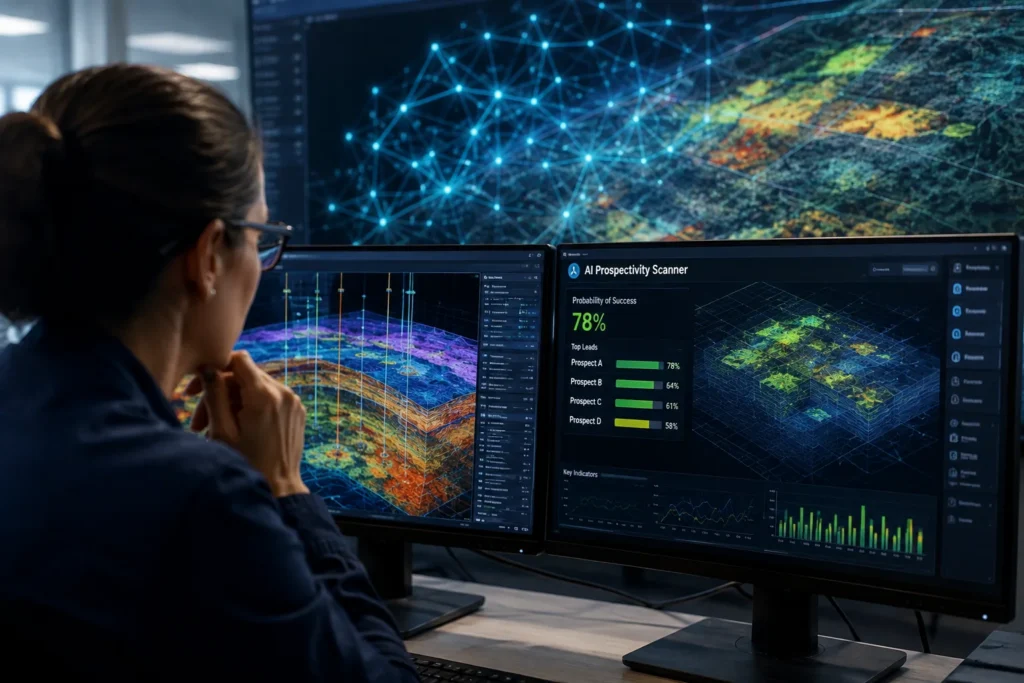
AI in oil exploration adds new capabilities for analyzing this information. Rather than replacing the expertise of geologists or geophysicists, algorithms can be used to process large datasets, identify relationships, and recognize features that must subsequently be interpreted by specialists. When these tools are combined with high-performance computing and advanced seismic processing, the ability to examine different subsurface scenarios increases.
ExxonMobil has been expanding precisely this approach. John Ardill, the company’s Vice President of Exploration, had previously explained that these technologies were being applied to seismic analysis and to the identification of prospects that had historically been more difficult to evaluate.
The four opportunities now identified demonstrate a concrete application of this strategy in Guyana. However, there is a fundamental difference between identifying an exploration opportunity and making a discovery. Data interpretation can indicate where a potentially favorable geological combination exists, but only drilling and subsequent evaluation can confirm the presence, dimensions, and characteristics of a hydrocarbon accumulation.
Can AI in oil exploration detect opportunities that were previously difficult to evaluate?
Not directly. Artificial intelligence can help identify signals and patterns associated with potential petroleum systems, but it does not turn a seismic interpretation into proven reserves. Its value lies primarily in its ability to expand and accelerate analysis.
A basin that has been explored for years contains information from both successful wells and drilling campaigns that failed to encounter commercial accumulations. Both outcomes are valuable because they provide a better understanding of structural geometry, reservoir properties, rock behavior, and the distribution of petroleum systems.
Computational models can use this historical information to search for relationships within new datasets or revisit previous interpretations. In this sense, one of the most interesting opportunities offered by AI is not necessarily discovering something invisible, but extracting new information from data that already existed.
For an operator, AI in oil exploration can help prioritize targets before committing the resources required to drill an offshore well. It does not eliminate geological uncertainty or guarantee exploration success, but it can provide additional information to determine which opportunities justify deeper evaluation.
And that difference has economic consequences. In deepwater environments, every drilling decision involves mobilizing rigs, specialized services, subsea equipment, and an extensive logistics chain. Improving prospect selection before reaching that stage can become an important advantage.
ExxonMobil Keeps Offshore Drilling Active in Guyana
The application of these technologies comes as ExxonMobil continues to advance multiple fronts simultaneously across Stabroek.
Activity includes work associated with the Whiptail development and exploration drilling at Rockhead-1, maintaining in parallel the two dimensions that have characterized Guyana’s oil expansion: converting existing discoveries into production and continuing to search for additional resources.
This simultaneous activity helps explain why accumulated information is becoming increasingly valuable. Each new well generates data that can feed subsequent interpretations. In this way, exploration is no longer a completely independent sequence of drilling operations and begins to function as a process in which previous results contribute to reducing uncertainty in future decisions.
Artificial intelligence can reinforce this cycle by enabling the analysis of datasets whose scale and complexity would make an exclusively manual evaluation more difficult.
Haimara Opens Another Stage for Stabroek Development
Growth in the Stabroek Block is not limited to oil. ExxonMobil has advanced plans for the Haimara gas and condensate development and previously sought environmental authorization for a campaign involving 35 wells between 2028 and 2033.
The proposal introduces a new dimension within a basin whose initial growth was driven primarily by major oil discoveries.
In this context, identifying additional opportunities through advanced subsurface analysis can help build a more comprehensive view of the remaining resources and how they could relate to future infrastructure.
However, the four opportunities identified through AI must still be kept within their proper category: they are potential exploration targets, not resources incorporated into Haimara or volumes that can currently be added to Guyana’s reserves.
Guyana Targets 1.7 Million Barrels per Day by 2030
The production context helps explain why ExxonMobil continues to search for new opportunities even after years of discoveries.
Guyana is targeting approximately 1.3 million barrels per day (bpd) in 2027 and 1.7 million bpd by 2030, consolidating its position as one of the growth centers of global offshore production.
Reaching high production volumes, however, does not eliminate the need to continue exploring. Oil projects have production curves, and resources must progressively be transformed into developments capable of sustaining installed capacity over extended periods. For operators with expanding infrastructure within the same basin, understanding where additional opportunities remain can influence the planning of future investments.
This is where the true potential of AI in oil exploration becomes apparent. The technology does not replace seismic surveys, geological interpretation, or the exploration well that ultimately determines what lies beneath the subsurface. Its potential lies in better connecting these stages: processing more information, identifying relationships within the data, and helping specialists focus attention and capital on the targets considered most promising.
In Stabroek, the four opportunities identified by ExxonMobil will serve as a test of that process. If any of them advance to drilling, it will be the well—not the algorithm—that ultimately determines whether a new discovery exists.
But before a rig begins drilling, the decision about where to drill may increasingly be influenced by artificial intelligence.
Source: World Oil