Africa is gaining decisive weight in global oil and gas exploration after capturing around 50 % of the new country entries registered or considered by upstream companies between the first half of 2025 and the same period in 2026. The move reflects the growing interest of major operators in expanding their portfolios and locating resources capable of sustaining future production.
The analysis by Enverus Intelligence Research (EIR) identified 187 entries or re-entries into countries during both periods. The activity encompasses different companies and geographies, although the African continent clearly stands out compared to other regions.
Behind this behavior lies a strategy to rebuild exploration inventories after several years of moderate investment. Companies are seeking to incorporate new opportunities, offset the gradual reduction in the lifespan of their reserves, and have projects that can be developed over the coming decades.
This makes the region a prime destination for evaluating new oil and gas blocks. However, much of the current activity is still in a preliminary stage, with companies studying the geological potential before committing significant capital.
West Africa attracts deep-sea exploration
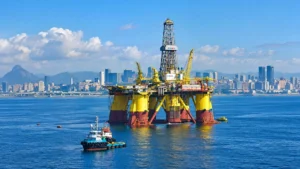
In particular, West Africa is concentrating a significant part of the new interest of oil companies, the deep-water areas located along the Atlantic margin offer opportunities for companies interested in finding accumulations capable of providing long-term resources.
This geographical area encompasses basins that have gained prominence in international exploration programs. The operators’ objective is to analyze large areas and select those positions with the best geological and commercial conditions before proceeding to more costly stages.
Meanwhile, North African markets are once again attracting interest, with government initiatives aimed at attracting foreign investment and new bidding rounds creating opportunities for international companies to consider entering or returning to certain countries.
The context also reflects a transformation in corporate strategies; the shorter lifespan of reserves, contained exploration spending over the last decade, and a more limited supply of suitable assets for acquisitions are driving oil companies to seek resources through organic exploration.
Consequently, early access to new land can provide a strategic advantage; companies gain time to study available information, compare different prospects, and establish priorities before deciding where to make major investments.
Operators secure areas before investing in drilling
However, the increase in new entries upstream this does not yet represent an immediate, massive drilling campaign. EIR believes the current scenario is more like an evaluation and selection cycle. Companies are rebuilding their exploration inventories while trying to maintain enough financial flexibility to decide later which projects deserve capital.
To achieve this, large operators are increasingly resorting to early-stage access agreements, among the instruments used are reconnaissance permits and memoranda of understanding that facilitate the study of large areas without assuming all the obligations associated with a full exploration license from the outset.
This model allows for the review of seismic data, geological characteristics, potential resource dimensions, and commercial conditions before establishing priorities. In this way, a company can compare different blocks within its portfolio and proceed only with those that present the best prospects. This strategy becomes particularly important when offshore projects, and especially deepwater developments, require significant investments.
Jimmy Boulter EIR’s senior regional manager for Sub-Saharan Africa, noted that the true test of exploration appetite will come when major operators must move from securing options to allocating capital. Therefore, one of the next indicators will be determining how many initial agreements ultimately become full licenses. It will also be relevant to understand the associated drilling obligations and the amount of acreage that will eventually return to the market and become available to other companies.
Africa leads the way in high-impact exploratory well plans
Drilling prospects offer another sign of the growing importance of the region, Rystad Energy estimated that the continent would account for around 40 % of the high-impact exploration wells projected worldwide during 2026.
According to information gathered by Rigzone, 42 wells of this category were identified internationally, of that total, 17 are located in Africa. Asia has eight, while South America and Europe each have six. The Middle East and North America each have two, and Oceania has one.
The figures once again place the region ahead of other exploration markets, with the Orange Basin in the south of the continent being among the areas of greatest interest. This area has come onto the industry’s radar due to its potential for hydrocarbon resources. The Gulf of Guinea in West Africa also remains a key area for exploration programs.
Wells considered to have a high impact are of particular importance due to the potential volume of resources, the possibility of opening new plays in emerging or frontier basins, and their strategic relevance to each operator.
Furthermore, the outlook for 2026 comes after an improvement in the overall results of this type of drilling. Rystad indicated that the success rate of high-impact wildcat wells increased from 23 % in 2024 to 38 % in 2025. At the same time, the volumes discovered grew by 53 % year-on-year to reach approximately 2.3 billion barrels of oil equivalent.
These results help explain why companies continue to examine geological opportunities capable of providing large commercial discoveries despite the high capital required for ultra-deep and frontier projects.
African oil production grew by 4.4 % in 2025
This renewed exploration interest is also occurring in a region that maintains a relevant position within the international supply of hydrocarbons according to the Energy Institute’s (EI) Statistical Review of World Energy, the continent produced 7.062 million barrels per day of crude oil and condensate during 2025. The volume represented a year-on-year growth of 4.4 % and approximately 8.2 % of global production.
Nigeria led regional crude oil and condensate supply with 1.643 million barrels per day, a 5.5 % increase year-on-year, representing approximately 1.9 % of the global total. However, the long-term outlook presents a different picture. Between 2015 and 2025, African crude oil and condensate production is projected to decline at an average annual rate of 0.8 %.
This trend provides another element for understanding the search for new resources: incorporating commercially viable discoveries is essential to offset the natural decline of mature fields and sustain future extraction levels. For this reason, the new areas currently under evaluation could become more significant if they progress toward licensing, exploratory drilling, and commercial discoveries.
Natural gas strengthens regional energy potential
On the other hand, the continent produced 240.6 billion cubic meters of natural gas in 2025, according to statistics from the Energy Institute. This volume decreased by 0.4 % compared to the previous year and represented approximately 5.7 % of global production. Despite the year-on-year decline, the decade-long trend shows positive growth: between 2015 and 2025, regional supply of this hydrocarbon increased at an average annual rate of 1.5 %.
Algeria remained Africa’s largest producer with 98 billion cubic meters in 2025, this figure decreased by 1.9 % compared to the previous year, although the country registered an average annual growth of 1.9 % during the period between 2015 and 2025. Oil and gas are thus part of a scenario in which companies seek to balance existing production with future opportunities.
In the short term, the volume of agreements for new areas signals business interest, in the medium term, the most important indicator will be the transformation of these initial positions into funded exploration programs. The next step will depend on each operator’s investment decisions. Converting preliminary memoranda and permits into full licenses, along with the corresponding drilling commitments, will reveal what portion of the current upstream expansion ultimately translates into on-the-ground activity.
If this process materializes, the continent could strengthen its position within the international map of oil and gas exploration as companies seek to replenish reserves and secure resources capable of supporting their portfolios for the coming years.
Source: Rigzone
Photo: Shutterstock