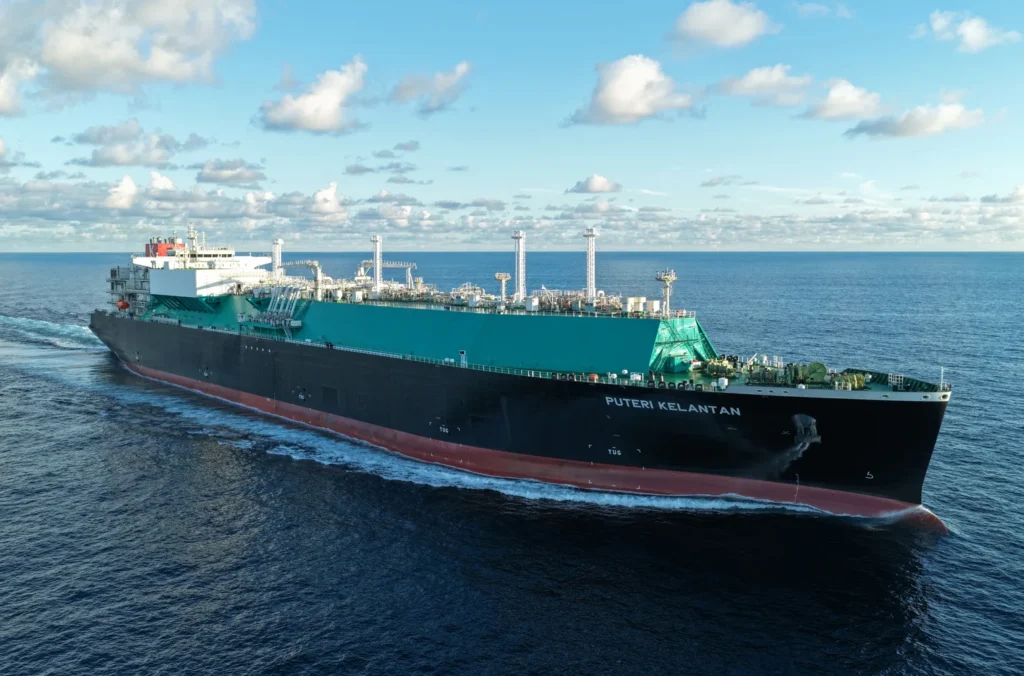
Kawasaki Kisen Kaisha, known as “K” LINE, delivered the Puteri Kelantan, a new LNG carrier built for Petronas LNG Ltd. (PLL) at the Hudong-Zhonghua Shipbuilding yard in China, on September 24, 2026.
The vessel is owned by a joint venture led by K LINE and is part of a sequence of new units intended to strengthen PETRONAS’s maritime capacity to transport LNG to its customers.
The significance of the delivery increases when viewing the complete series. Puteri Kelantan is of the same type as Puteri Johor and Puteri Kedah, delivered in May and June 2026, respectively. A fourth unit, Puteri Negeri Sembilan, was christened alongside Puteri Kelantan and is scheduled for delivery in November. This is not, therefore, an isolated addition, but a coordinated renewal of transport capacity.
Transport is also part of the energy supply chain
In the LNG industry, producing the gas and having liquefaction capacity does not by itself guarantee that the product reaches the consumer. Between both ends exists a logistics chain that includes storage, terminals, LNG carriers, port infrastructure, and supply contract management. The new Puteri Kelantan adds capacity precisely in that maritime segment.
The simultaneous addition of several units also enables structuring a fleet around long-term supply commitments, reducing dependence on spot availability of vessels in the charter market. K LINE notes that its strategy includes expanding long-term contracts and considers the LNG transport business an investment priority.
The project’s financing also shows that a modern LNG carrier is an energy infrastructure asset, not simply a ship. Participants in the christening ceremony included Bank of Communications Financial Leasing, China Merchants Energy Shipping, China Merchants Financial Leasing, K LINE, PETRONAS, and the shipyard. The structure therefore combines shipbuilding, specialized financing, joint ownership, and long-term energy demand.
X-DF: propulsion integrated into the LNG business
From an engineering standpoint, one of the elements worth highlighting is the use of a low-speed X-DF dual-fuel engine. In an LNG carrier, the selection of the propulsion system is closely related to the management of fuel available on board and to the vessel’s operation during long voyages.
The X-DF architecture allows using gas as fuel alongside liquid fuel, integrating propulsion with the operational characteristics inherent to LNG transport. The same configuration is employed on the vessels Puteri Johor and Puteri Kedah, demonstrating technological standardization within this series built for PETRONAS.
For an operator adding several units with similar characteristics, that standardization can also facilitate aspects of operation, maintenance, crew training, and spare parts management. Design repetition turns serial construction into a tool for operational efficiency, in addition to a capacity decision.
SOURCE and PHOTO: https://www.kline.co.jp/