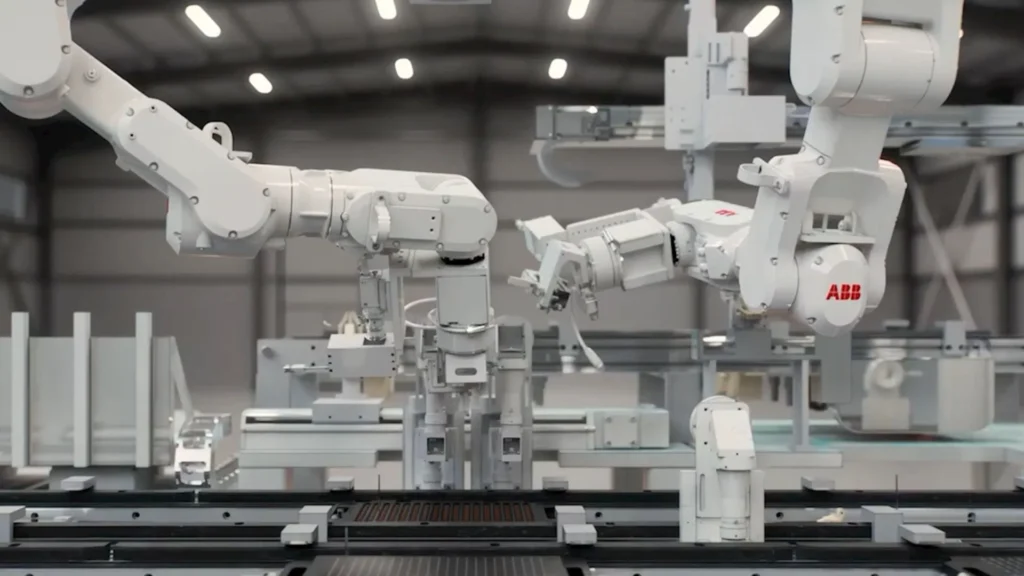
ABB Robotics will integrate NVIDIA Omniverse libraries into RobotStudio to train, validate, and deploy industrial robots through high-precision simulations.
ABB Robotics and NVIDIA announced a collaboration aimed at bringing industrial physical AI to factories of all sizes. The agreement combines RobotStudio, ABB’s programming and simulation platform, with NVIDIA Omniverse libraries to improve the transition from virtual training to real-world operation.
With this integration, manufacturers will be able to design robotic stations, test processes, and generate synthetic data before installing equipment on a production line. The proposal seeks to reduce errors during commissioning and facilitate the deployment of robotics powered by artificial intelligence.
RobotStudio HyperReality Will Close the Sim-to-Real Gap
The new environment will be marketed as RobotStudio HyperReality and will be available during the second half of 2026. The platform will allow the representation of robots, sensors, lighting, materials, and parts within digital twins with advanced physical behavior.
Additionally, ABB’s virtual controller runs the same firmware used by physical robots. This feature allows the simulated performance to approach real-world behavior and achieve a correlation of up to 99%, according to the companies.
Accuracy is also supported by ABB Robotics’ Absolute Accuracy technology. This system can reduce positioning errors from between 8 and 15 millimeters to approximately 0.5 millimeters, a level aimed at industrial operations requiring exact movements.
Likewise, the generation of synthetic data will allow training computer vision models without relying entirely on images taken in real plants. Developers will be able to introduce variations in lighting, materials, and scenarios to prepare systems for broader conditions.
Lower Costs and Faster Deployments
ABB estimates that virtual engineering can reduce setup and commissioning times by up to 80%. The elimination of certain physical prototypes could also decrease implementation costs by up to 40%.
In turn, early process validation would allow accelerating time-to-market by up to 50% for complex products. This benefit is especially relevant in sectors such as consumer electronics, where designs change rapidly and assembly tolerances are tight.
The platform also seeks to create a continuous workflow between the digital environment and the factory. Once robots are installed, operational data can return to the digital twin to adjust models, review failures, and improve system performance.
This approach turns simulation into a permanent engineering tool. Manufacturers can evaluate new products or process changes without initially stopping a physical line.
Foxconn Tests Solution in Electronics Assembly
Foxconn is participating in one of the first pilots of RobotStudio HyperReality for consumer electronics assembly. The company is using synthetic data and virtual training to prepare robots that must handle small parts with high precision.
The process allows testing different product variants before transferring instructions to the plant. In this way, Foxconn seeks to reduce physical adjustments, debugging hours, and engineering resources during the startup of new lines.
Precision is key in these operations because a slight deviation can affect delicate metallic components or alter the assembly sequence. High-fidelity simulation allows reviewing these risks during the design phase.
WORKR Will Bring AI Robotics to Mid-Sized Manufacturers
WORKR will also use the technology to offer robotic systems to small and medium-sized businesses in the United States. Its proposal combines ABB industrial robots with the WorkrCore AI platform to simplify the learning of new tasks.
The company will showcase applications of this technology during NVIDIA GTC 2026. Systems will be trained using synthetic data and can be deployed with less programming knowledge, according to information presented by the companies.
This model targets manufacturers facing labor shortages and needing to automate operations without creating large internal robotics teams. The ability to quickly configure tasks can expand access to solutions previously concentrated in large plants.
ABB Evaluates Edge AI Inference
ABB Robotics is also studying integrating the NVIDIA Jetson platform into its OmniCore controller. The goal is to execute artificial intelligence inference in real-time near the robot and reduce reliance on external data centers.
Edge processing can be useful for computer vision, object detection, and movement adaptation during an operation. It also allows for lower latency responses when the robot works in variable environments.
The collaboration expands a previous relationship between ABB and NVIDIA in autonomous mobile robots, simulation, and artificial intelligence platforms. ABB Robotics has deployed over 500,000 robotic systems and serves sectors such as automotive, electronics, logistics, food, and general manufacturing.
With RobotStudio HyperReality, both companies seek to turn simulation, digital twins, and synthetic data into a practical path to deploy industrial physical AI with greater precision and lower risk.
Source and photo: ABB