Table of Contents
- Industry Has Outgrown the Old Model
- Inspection Data Is Not Paperwork
- The Next Breakthroughs Are Already Somewhere Else
- Robotics Will Change the Role of the Inspector
- The Workforce Problem Is Also a Technology Problem
- Software Is Becoming as Important as the Inspection Method
- The Future Belongs to Hybrid Companies
- Operators Should Demand More
- A Necessary Disruption
- Final Thought
For decades, the non-destructive testing industry has advanced through incremental improvements. Better probes. Better scanners. Better reporting templates. Better access tools.
All of those improvements matter, but they have not fundamentally changed how inspection is planned, performed, analyzed, stored, or used to make decisions. That is where the real problem begins.
The industries we serve, including oil and gas, LNG, petrochemicals, offshore, aerospace, midstream, downstream, tanks, and terminals, are no longer facing incremental challenges. They are facing aging infrastructure, workforce shortages, higher safety expectations, sustainability pressure, data overload, and tighter operating windows, all at the same time.
The industry does not simply need another inspection vendor with another tool. It needs a new operating model. And that model may not come solely from the traditional NDT sector.
Industry Has Outgrown the Old Model
This statement may make some people uncomfortable, but it should not be controversial. Traditional NDT companies were built around labor deployment. Their model is based on providing technicians, equipment, procedures, and reports. That model worked for a long time because the market asked for manpower and compliance.
But the market is changing.
Operators now need integrated data environments, autonomous systems, artificial intelligence, predictive analytics, live dashboards, robotic deployment, sensor fusion, and software that can turn inspection data into operational intelligence.
Many incumbent inspection providers are not structured for that shift. Not because they lack experience, but because they were designed as service companies, not technology companies. That distinction matters.
A service company asks how many technicians are needed on site. A technology company asks why the job still requires that many technicians in the first place. A service company collects data. A technology company structures data so it can be validated, trended, compared, and acted upon. A service company produces a report. A technology company builds a system in which the report is just one output from a much larger intelligence layer.
Inspection Data Is Not Paperwork
For too long, inspection data has been treated like documentation.
A UT reading becomes a number in a table. A radiographic image becomes evidence of compliance. A corrosion map is attached to a report. The job is completed, the report is filed, and the data often disappears into a static PDF, a folder structure, or a disconnected client system.
That approach is outdated. Inspection data should not be treated as paperwork. It should be treated as infrastructure.
Every thickness reading, image, scan, calibration record, location tag, and technician input is part of the long-term story of an asset. When captured properly, that information supports predictive maintenance, risk-based inspection, life extension decisions, sustainability reporting, and capital planning. When captured poorly, it becomes archaeology.
Engineers should not have to dig through old files, inconsistent reports, and disconnected databases to understand the condition of an asset. The information should already be structured, searchable, comparable, and available in context.
This is where the next major leap in NDT will happen. Not just in the sensor. Not just in the scanner. In the system that connects everything together.
The Next Breakthroughs Are Already Somewhere Else
The most important breakthroughs in inspection over the next decade will not come from simply refining conventional NDT methods. They will come from adopting technologies already being developed in adjacent industries.
Robotics. Artificial intelligence. Machine learning. Autonomous navigation. Cloud computing. Edge processing. Gaming engines. Digital twins. Advanced visualization. Aerospace simulation. Sensor fusion. The Internet of Things.
These technologies are already reshaping other sectors. Manufacturing has connected production lines and digital twins. Logistics has real-time tracking and route optimization. Finance has automated risk modeling. Aerospace has highly controlled digital thread environments. Meanwhile, many inspection programs still rely on clipboards, spreadsheets, manually compiled reports, and institutional memory.
That gap is not sustainable. The future of NDT depends on how quickly the industry can adopt the tools, architecture, and mindset of the broader technology sector.
Robotics Will Change the Role of the Inspector
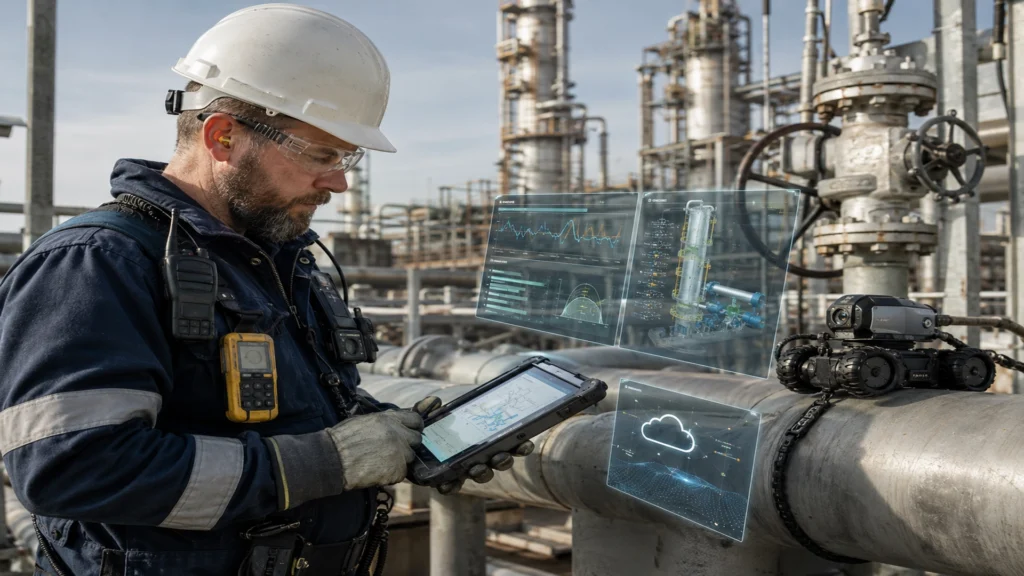
There is still a persistent fear that automation will replace inspectors. That is the wrong conversation. The real opportunity is not replacing qualified people. It is in removing unnecessary risk, reducing repetitive manual work, improving consistency, and allowing skilled inspectors to focus on higher-value decisions. Robotic systems can improve scan consistency, control movement, reduce access requirements, and operate in difficult, hazardous, or inefficient environments for people. Automated platforms can help manage variables that humans struggle to repeat perfectly, such as scan speed, probe pressure, encoded position, and data capture consistency.
The inspector still matters. In fact, the inspector becomes more important. The next generation of NDT professionals will not simply carry gauges and fill out forms. They will operate robotic systems, validate AI-assisted outputs, interpret complex datasets, manage digital inspection environments, and translate field intelligence into asset decisions.
The future technician may look more like a robotics operator, data analyst, and integrity specialist combined. That is not a downgrade of the profession. That is how the profession survives.
The Workforce Problem Is Also a Technology Problem
The inspection industry talks constantly about the workforce shortage. It is real, but the industry often frames it too narrowly. The problem is not just that experienced technicians are retiring. The problem is that many younger people look at the current inspection workflow and see an industry that feels decades behind.
Manual reporting. Slow data transfer. Poor software. Disconnected systems. Repetitive paperwork. Limited career visibility. Inconsistent training pathways. This is not attractive to the next generation.
If we want younger talent to enter NDT, the work needs to look and feel like modern technical work. That means clean interfaces, intelligent tools, connected data, real-time feedback, digital training, remote collaboration, and measurable career progression.
People entering the workforce today already live in a connected digital world. They expect technology to support the job, not slow it down. The companies that understand this will attract talent. The companies that do not will keep wondering why no one wants to join the trade.
Software Is Becoming as Important as the Inspection Method
For decades, NDT companies have competed on method capability. Who performs the best UT? Who has the best talent? Who has the newest equipment? Who has the fastest crew? Those questions still matter, but they are no longer enough.
The more important question is: What happens to the data after the inspection? Can it be integrated into an asset management system? Can it be trended against previous results? Can it trigger inspection intervals? Can it connect to live monitoring sensors? Can it support AI analysis? Can it produce repeatable reporting? Can it help the client make better decisions?
If the answer is no, then the inspection method is only solving part of the problem. The inspection sector has spent years improving how data is collected. It now needs to improve how data is managed, interpreted, shared, and used. That is a software problem as much as an NDT problem.
The Future Belongs to Hybrid Companies
This is why the next era of inspection will likely be led by hybrid companies. Not pure software companies with no understanding of field conditions. Not traditional inspection companies trying to bolt on technology after the fact. The winners will be teams that understand both sides: the realities of industrial inspection and the possibilities of modern technology.
That combination is rare. It takes people who have stood inside tanks, crawled under pipe racks, worked turnarounds, interpreted radiographs, written procedures, trained technicians, and dealt with the consequences of bad data. It also takes people who understand automation, AI, cloud architecture, robotics, cybersecurity, data structures, and scalable product development.
The industry does not need technology built in a vacuum. It needs technology built by people who know exactly where the current process fails.
Operators Should Demand More
Asset owners should no longer accept fragmented workflows as normal. They should not have to accept disconnected reports, inconsistent data formats, manual re-entry, duplicate documentation, or inspection results that cannot be compared reliably over time. They should not have to choose between field experience and technology maturity. They should demand both.
The companies managing critical infrastructure deserve inspection partners that can provide technical execution, digital infrastructure, data continuity, and intelligent reporting. They deserve systems that support safer operations, reduced downtime, better workforce utilization, and more reliable asset decisions.
The old model may still function, but functioning is not the same as advancing.
A Necessary Disruption
Some incumbent providers will adapt. Others will defend the old model until the market moves past them. That is not unique to NDT. Every major industry transformation creates discomfort before it creates progress.
But the direction is clear. NDT is no longer just about finding flaws. It is about building the data infrastructure that helps industries make better decisions about safety, reliability, sustainability, and asset life.
That requires more than technicians and tools. It requires software, automation, intelligence, integration, and a willingness to rethink the business model from the ground up.
Final Thought
The future of NDT will not come from the NDT industry alone. It will come from the collision of inspection experience and advanced technology. It will come from people who understand the field but refuse to accept that the current way of working is the best we can do. It will come from companies willing to challenge the old model, build new infrastructure, and make inspection smarter, safer, faster, and more useful.
For an industry that has waited too long for real change, that collision cannot happen soon enough.
This article was developed by Joshua De Monbrun of SUBSEA NDT & Engineering and published as part of the eighth issue of Inspenet Brief magazine (July 2026), dedicated to technical content from the energy and industrial sectors.