Table of Contents
Offshore robotics is changing the way oil platforms and marine infrastructure are inspected. Its advancement answers a specific need: obtaining reliable data in environments where human access is complex, costly, or hazardous.
For decades, these assessments relied heavily on professional divers, specialized support vessels, and large-scale logistical operations. Today, a growing portion of this work is executed by robotic systems designed to operate under pressure and strong currents.
ROV and AUV vehicles, alongside subsea NDT technologies, examine critical assets without halting production. This capability helps pinpoint corrosion discontinuities, cracks, and wall thickness loss before they escalate into major failures.
This article explores the main technologies in offshore robotics, their applications in oil platforms, the benefits for mechanical integrity management in marine installations, and the standards supporting their implementation.
Why is offshore inspection changing?
The marine environment subjects’ structures to wave action, currents, and thermal variations that accelerate corrosion and fatigue in critical components. For this reason, periodic assessments are essential to sustain safety and reduce unplanned downtime.
For many years, these activities were performed using divers, scaffolding, and support vessels. While still in use, they involve higher costs, prolonged execution times, and significant operational exposure.
The challenge multiplies in deepwater fields. In this context, offshore inspection through robotics has become a strategic tool due to its speed, repeatability, and traceability in asset integrity management.
Limitations of traditional methods
Conventional methods face barriers in submerged structures, confined spaces, and vertical surfaces. Every restriction increases the complexity of offshore inspection.
Sea states and harsh weather often delay campaigns. Each postponement affects maintenance planning, increases logistical costs, and reduces the operational window.
Another issue is the quality of manual data logging. Oil platform operators require consistent, geo-referenced, and repeatable information to make decisions based on the asset’s actual condition.
The response of offshore robotics
Offshore robotics overcomes these limitations through ROV and AUV vehicles, as well as specialized robots that access complex zones without exposing personnel. These platforms integrate cameras, sensors, and NDT equipment.
Their true value emerges when information is integrated into digital platforms. This enables historical result comparisons, deterioration trend identification, and better maintenance planning.
Rather than substituting traditional methods, subsea robotics expands available capabilities. Operators gain solid technical evidence to protect their facilities and reduce uncertainty.
Table 1. Comparison of offshore inspection methods
| Method | Personnel Risk | Data Quality | Operational Impact |
|---|---|---|---|
| Industrial diving | High | Medium | May require shutdowns |
| ROV / AUV | Low | High | Minimal interruption |
| Autonomous operation | Very low | Very high | No interruption |
| Surface robots | Low | High | Reduces hazardous work |
Technologies for autonomous offshore inspection
The evolution of offshore robotics has driven a new generation of systems capable of working where human access is difficult or dangerous. Each solution responds to specific asset needs and depths.
By strategically integrating these tools, autonomous inspection increases data quality, leverages resources better, and reduces field intervention times.
ROV and AUV vehicles
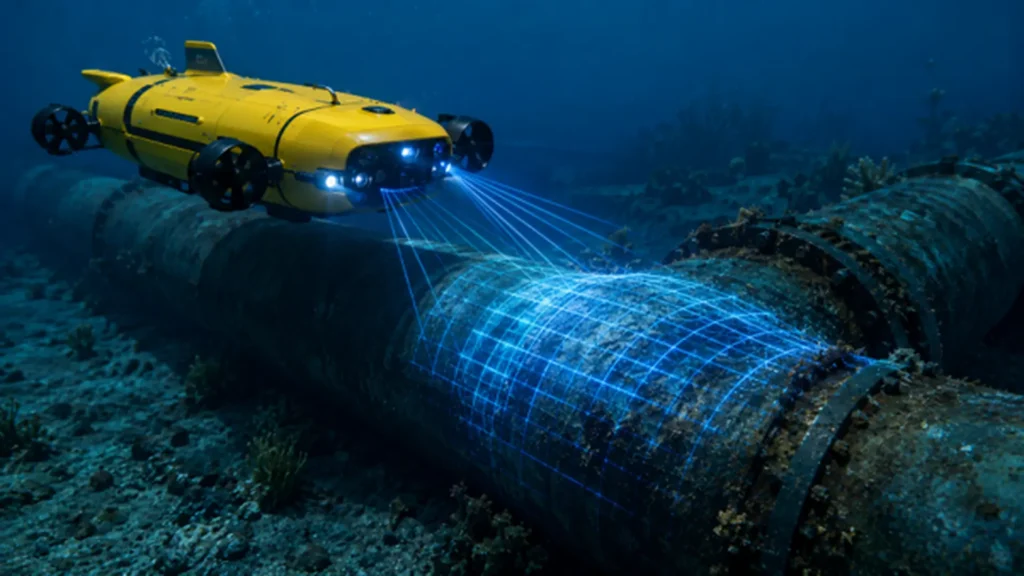
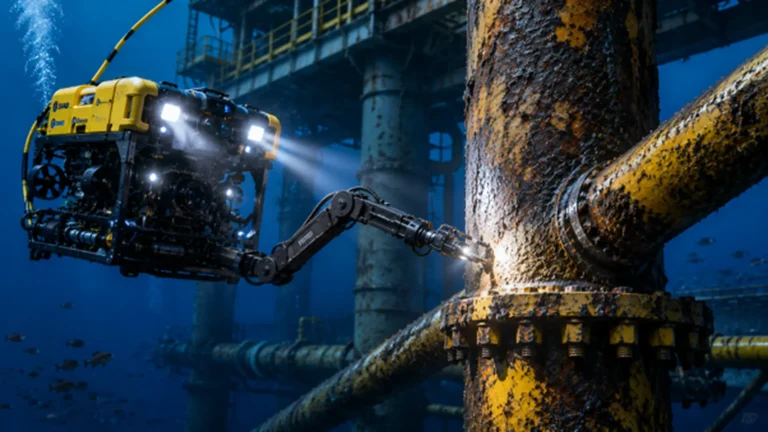
ROV and AUV vehicles represent the pillar of subsea work. ROVs are controlled by an operator via an umbilical cable, examining pipelines, risers, and subsea structures at great depths.
AUVs travel pre-defined routes autonomously without requiring continuous control. This autonomy favors surveying extensive pipeline networks and seabeds in a single trip.
Companies like Oceaneering and its subsea robotics solutions have developed platforms that combine advanced navigation, visual capture, and sensors to support subsea robotics and offshore integrity.
Robots for offshore structures
Not all assessments are performed underwater. Many critical structures above the surface require frequent reviews to determine their operational condition.
Surface robots and crawlers navigate tanks, hulls, and metallic vessels without the need to install scaffolding or expose personnel to working at heights.
Manufacturers like Eddyfi Technologies and its specialized inspection robots design tailored robots that combine magnetic mobility and advanced NDT to elevate the precision of offshore inspection.
Artificial intelligence and data analysis
Artificial intelligence has become a relevant complement to offshore robotics by interpreting data more rapidly. Algorithms automatically identify corrosion patterns, cracks, and thickness loss.
This automated analysis reduces the manual review load, allowing engineers to focus on technical validation and decision-making.
Companies like Fugro and Gecko Robotics integrate AI, predictive analytics, and digital models to strengthen autonomous inspection and operational integrity.
Table 2. Technologies and benefits in offshore inspection
| Technology | Main Application | Operational Benefit |
|---|---|---|
| ROV | Subsea inspection | Reduces risks and expands access |
| AUV | Autonomous surveys | Greater coverage with less intervention |
| Surface robots | Metallic structures | Decreases working at heights |
| Applied AI | Data analysis | Accelerates anomaly detection |
Subsea NDT for critical assets
Offshore robotics reaches its maximum utility level when it integrates subsea NDT technologies. This combination examines the condition of assets without dismantling them or stopping production.
Non-destructive testing reveals information about the internal state of materials and welds, which is essential knowledge for planning interventions based on actual condition.
When working alongside robotic platforms, these techniques gain in repeatability, traceability, and safety for mechanical integrity.
NDT methods used
Visual inspection is usually the first step to locate surface damage. However, evaluating the internal state of oil platforms demands advanced NDT methods.
Conventional Ultrasonic Testing (UT) measures remaining thickness, while Phased Array (PAUT) characterizes internal discontinuities in welds with high-resolution images.
Eddy Current arrays detect surface cracks, and automated ultrasonic corrosion mapping generates degradation profiles to estimate the asset’s lifespan.
Integration with inspection robots
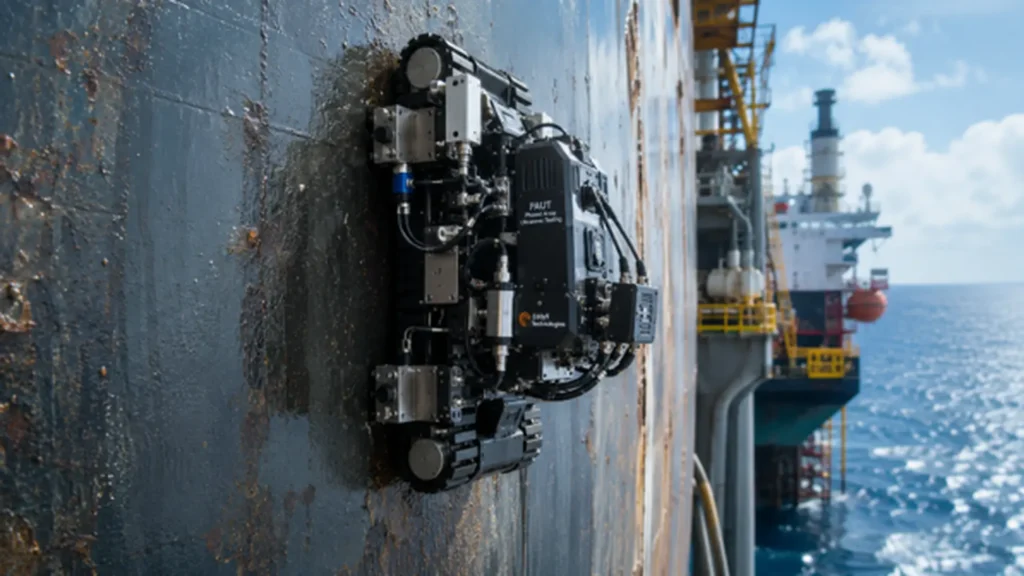
Mounting NDT sensors on mobile robots represents a crucial advance in marine asset evaluation. The equipment moves across hulls and subsea structures recording thicknesses and coordinates.
The data is stored for comparison between campaigns, reducing teardowns and personnel exposure to hazardous environments.
Eddyfi Technologies and its integrated NDT solutions combine subsea robotics with PAUT, Eddy Current Array, and remote visual inspection to offer verifiable assessments.

Benefits for mechanical integrity
The combination of offshore robotics and subsea NDT elevates the quality of the information used to manage mechanical integrity.
It enables the identification of deterioration trends, prioritization of interventions, and reduction of uncertainty in maintenance planning.
Additionally, it decreases the costs associated with conventional campaigns, shortens downtime, and contributes to extending the facilities’ lifespan.
Table 3. NDT methods applied with offshore robotics
| NDT Method | Application | Main Benefit |
|---|---|---|
| Visual inspection | Surface detection | Rapid identification of anomalies |
| Ultrasonic (UT) | Thickness measurement | Evaluates material loss |
| PAUT | Welds and components | Characterizes internal discontinuities |
| Eddy Current | Metallic surfaces | Locates surface cracks |
| Corrosion mapping | Equipment and pipelines | Generates degradation profiles |
Applications of offshore robotics
Offshore robotics is a consolidated part of the integrity programs of operators seeking to reduce risks and increase reliability.
Its versatility facilitates work on oil platforms, subsea pipelines, marine terminals, and wind farms.
Choosing the right solution is fundamental to meeting technical objectives, the required resolution, and the campaign’s scope.
Platforms and marine structures
Oil platforms operate under conditions that accelerate corrosion and structural fatigue. Operators constantly review columns, piles, and submerged joints.
Robots access these points without installing scaffolding or deploying support vessels for long periods, reducing costs and occupational risks.
By combining ROV and AUV vehicles with NDT sensors, campaigns generate precise diagnostics to anticipate failures before they affect production.
Subsea pipelines and systems
Oil pipelines, gas pipelines, risers, and umbilicals constitute the core of offshore transport. Detecting thickness loss and impacts in time guarantees operational continuity.
ROVs inspect specific details while AUVs autonomously and methodically cover large distances of pipelines.
Subsea robotics expands inspection coverage, avoiding unplanned shutdowns and strengthening asset management.
Offshore wind energy
The growth of offshore wind energy drives autonomous inspection. Wind turbines, foundations, and subsea cables require monitoring against wave action and dynamic loads.
Robots facilitate interventions in complex access zones, reducing risks and feeding predictive maintenance programs.
Thus, offshore robotics expands its field of application toward sustainability and energy transition.
Real industry cases
Companies like Shell, Equinor, and Petrobas use robotic solutions to examine subsea structures, reduce diver usage, and optimize maintenance.
These projects confirm that autonomous inspection is a consolidated tool for complex facilities and deepwater operations.
Table 4. Applications of offshore robotics
| Asset | Technology Used | Main Objective |
|---|---|---|
| Oil platforms | ROVs and surface robots | Evaluate structural integrity |
| Subsea pipelines | ROVs and AUVs | Detect corrosion and damage |
| Risers and umbilicals | ROVs with NDT | Verify operational condition |
| Marine terminals | NDT robots | Examine critical structures |
| Offshore wind farms | Drones, ROVs, and robots | Reduce risks and time |

The experience presented in this video reflects how marine engineering, technical planning, and project management complement the use of robotic technologies to execute inspections and operations in highly complex offshore environments.
Standards for offshore robotics
The incorporation of offshore robotics must be supported by recognized technical standards that ensure consistent and traceable evaluations.
Standards guide campaign planning, personnel qualification, method selection, and the criteria for evaluating assets.
Offshore asset integrity
Standards such as API RP 2SIM guide the structural integrity management of oil platforms from commissioning to decommissioning.
API 580 and API 581 complement this framework by establishing the basis for Risk-Based Inspection (RBI) and the evaluation of failure probabilities.
These methodologies help concentrate resources on equipment with the highest operational and environmental risk.
NDT personnel certification
Despite automation, data interpretation requires professionals trained in non-destructive testing.
ISO 9712, ASNT SNT-TC-1A, and ANSI/ASNT CP-189 establish the criteria for the training, qualification, and certification of NDT personnel.
Having certified specialists guarantees that the information gathered by subsea robotics translates into reliable maintenance decisions.
International best practices
Organizations like DNV issue standards on the design and integrity of marine facilities. IMCA develops best practices for ROV and AUV vehicles and subsea operations.
AMPP provides technical documents on corrosion control and materials management in aggressive marine environments.
Table 5. Standards applied to offshore robotics
| Standard / Organization | Scope | Application |
|---|---|---|
| API RP 2SIM | Structural integrity | Offshore platform management |
| API 580 / API 581 | Risk-Based Inspection | RBI planning and risk |
| ISO 9712 / ASNT | NDT certification | Personnel qualification |
| DNV / IMCA / AMPP | Operations and corrosion | Best practices for ROVs and assets |
Offshore robotics trends
Digital transformation drives systems with greater autonomy, connectivity, and analytical capacity. Robots not only capture data but automate its processing.
This evolution facilitates the shift from reactive schemes to predictive maintenance strategies on oil platforms.
Intelligent automation
AI algorithms analyze images and NDT data during the campaign, rapidly detecting anomalies and reducing preliminary evaluation times.
Digital twins and IIoT
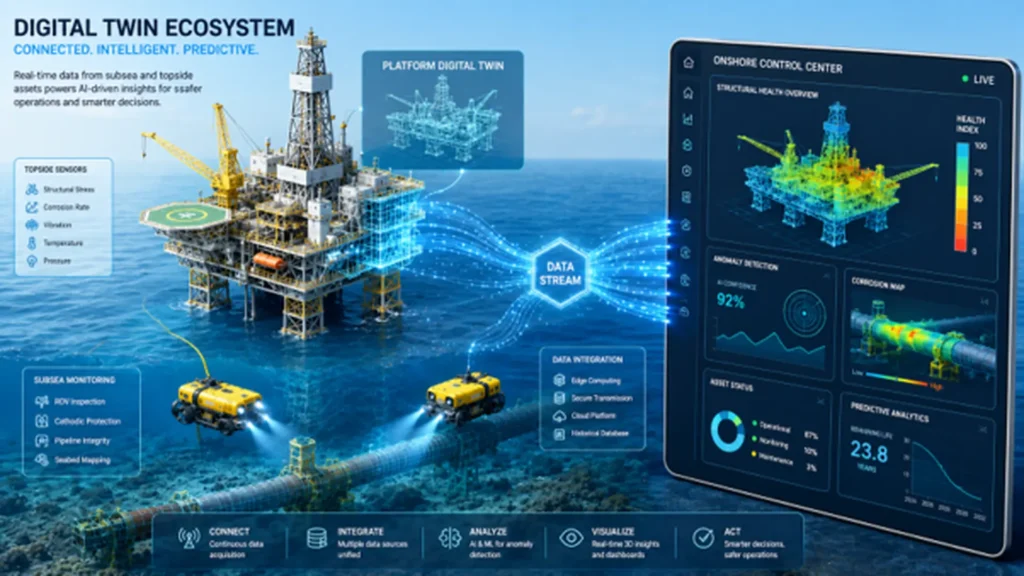
The integration of IIoT sensors, robotic inspection platforms, and digital twins creates a virtual representation of asset condition in near real time, enabling continuous monitoring and the prediction of degradation trends.
Engineering teams can track structural deterioration over time, compare inspection campaigns, and plan maintenance activities with greater accuracy and confidence.
Continuous access to historical inspection data also strengthens evidence-based asset integrity management, supporting more informed decisions throughout the asset lifecycle.
Predictive inspection
Models based on AI and subsea NDT anticipate potential failures, reducing unplanned shutdowns and extending the lifespan of critical infrastructures.
Table 6. Offshore robotics trends
| Trend | Application | Industry Benefit |
|---|---|---|
| Artificial intelligence | Automated analysis | Speed and consistency |
| Digital twins | Asset tracking | Maintenance planning |
| IIoT | Continuous monitoring | Real-time information |
| Predictive maintenance | Condition-based management | Reduction of failures and costs |
Offshore robotics: from tool to strategy
Offshore robotics has consolidated as a strategic tool to increase safety, efficiency, and reliability in the energy industry.
The integration of ROV and AUV vehicles along with subsea NDT provides precise data for well-founded maintenance decisions.
Organizations that adopt this comprehensive approach will be better prepared to manage critical infrastructure with high resilience and regulatory compliance.
References
- American Petroleum Institute. Structural integrity management of fixed offshore structures (API Recommended Practice 2SIM, 1st ed.). API Publishing Services.
- American Petroleum Institute. Risk-based inspection (API Recommended Practice 580, 3rd ed.). API Publishing Services.
- American Petroleum Institute. (2019). Risk-based inspection methodology (API Recommended Practice 581, 3rd ed.). API Publishing Services.
- American Society for Nondestructive Testing. Recommended practice No. SNT-TC-1A: Personnel qualification and certification in nondestructive testing. ASNT.
- International Marine Contractors Association. Code of practice for the safe determination and operation of offshore autonomous underwater vehicles (AUVs) (IMCA M 254). IMCA.
- International Organization for Standardization. Non-destructive testing — Qualification and certification of NDT personnel (ISO Standard No. 9712:2021).
- Association for Materials Protection and Performance. Corrosion control and integrity management in offshore structures (AMPP Report No. TR-2104). AMPP.
- DNV. (2021). Integrity management of subsea production systems (DNV Recommended Practice DNV-RP-F116). DNV GL Group.
- Eddyfi Technologies. (2023). Advanced NDT and robotic inspection for subsea assets and offshore infrastructure [White paper]. Eddyfi Technologies Solutions.
- Oceaneering International. (2022). Subsea robotics, ROV operations, and remote-control centers in offshore energy [Technical report]. Oceaneering Media Library.
- Inspenet. (2026, July 22). Eddyfi redefine la inspección no destructiva con sensores y robótica [Video]. Inspenet TV.
- Inspenet. (2026, July 22). Grupo HB: liderazgo en ingeniería marítima offshore [Video]. Inspenet TV.
Frequently Asked Questions (FAQs)
What is offshore robotics?
It gathers vehicles, robots, and automated systems designed to inspect, monitor, and maintain marine facilities without exposing personnel.
What is the difference between an ROV and an AUV?
An ROV is controlled from the surface via an umbilical cable. An AUV operates autonomously following programmed routes to cover large areas.
What NDT methods do offshore robots use?
They integrate visual inspection, conventional ultrasonic testing, PAUT, Eddy Current, corrosion mapping, and remote visual inspection.
What benefits does offshore robotics provide?
It reduces personnel exposure, expands access, improves data repeatability, shortens downtime, and optimizes maintenance.
What standards support offshore robotic inspection?
It is supported by API RP 2SIM, API 580, API 581, ISO 9712, ASNT SNT-TC-1A, and publications by DNV, IMCA, and AMPP.