Table of Contents
- What is ultrasonic monitoring
- How continuous Ultrasonic Monitoring works
- What does continuous Ultrasonic Monitoring detect?
- Why is it critical in jetty pipelines?
- How it prevents operational losses before failure
- Advantages over conventional periodic inspections
- Guided Ultrasonics: Monitoring Studio as an Integrity Hub
- Conclusions
- Reerences
- FAQs – Frequently Asked Questions for engineers and inspectors
Jetty pipelines, known in the industry as jetty lines or offshore transfer lines, represent one of the most critical and vulnerable assets in hydrocarbon, LNG, refined products, and petrochemical loading terminals, where ultrasonic monitoring stands as a key tool for the continuous assessment of their integrity.
Subjected to internal corrosion from aggressive fluids, temperature variations, load cycles, and constant marine humidity, these lines operate under conditions that accelerate base metal degradation. The question every integrity engineer must answer is always the same: when will it fail, and can we detect it before it happens?
What is ultrasonic monitoring
Continuous ultrasonic monitoring, also known as Guided Wave Permanent Monitoring or Permanent Inspection Monitoring System (gPIMS), has emerged as the most robust technical solution to this challenge.
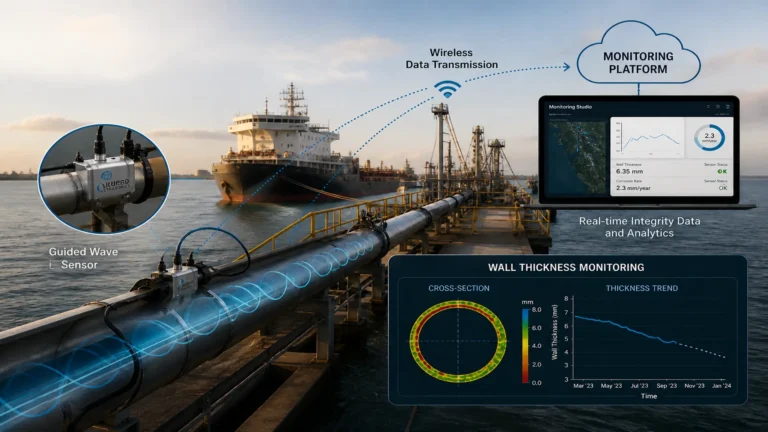
Unlike conventional periodic inspections, this approach installs guided wave sensors permanently at strategic points along the pipeline and continuously or periodically records wall thickness evolution. The data flows in real time to analysis platforms, allowing inspection engineers to act on live data rather than historical snapshots.
How continuous Ultrasonic Monitoring works
Continuous ultrasonic monitoring in pipelines operates on the principle of guided wave propagation along the longitudinal axis of the pipe. Sensors, based on piezoelectric or magnetostrictive technology, are permanently attached to the external surface of the pipe using collars or transducer rings.
When electrically excited, these transducers generate torsional (T) or longitudinal (L) waves that travel through the entire wall thickness, not just the surface. When the wave encounters an anomaly, such as wall loss due to corrosion, pitting, or erosion, part of its energy is reflected back to the sensor, where it is captured and analyzed.
The main advantage lies in coverage: a single sensor ring can inspect tens of meters of pipeline in both directions, including buried sections, coated areas, or physically inaccessible zones such as jetty crossings over water.
This makes the system a continuous volumetric inspection tool rather than a point-based thickness measurement method like conventional pulse-echo ultrasonic testing.
Data acquisition frequency can be configured depending on the operational strategy. In scheduled monitoring mode, a technician periodically connects the portable Wavemaker® instrument to the installed sensor. In automated mode, a field unit powered by battery or solar panel collects and transmits data autonomously via Wi-Fi, cellular network, or wired connection.
Each data pulse is stored in the cloud with timestamp, pipe temperature, and wall thickness diagnostics, building a continuous degradation history of the asset.
What does continuous Ultrasonic Monitoring detect?
The detection capability of continuous ultrasonic monitoring goes beyond simple wall thickness measurement. Guided wave analysis identifies both distributed and localized structural changes within the monitored segment, including:
- Uniform internal corrosion and pitting caused by acidic fluids, saline water, or multiphase mixtures
- Erosion in bends, reducers, and turbulent flow zones, common in jetty lines under alternating loading cycles
- Under-coating corrosion (CUI/CUC), invisible to visual methods and difficult to access with conventional UT
- Galvanic corrosion at material transitions or dissimilar connections, typical in port infrastructures
- Accelerated degradation at supports, anchors, and friction zones where cathodic protection may be compromised
The system continuously measures pipe temperature at the sensor location and applies automatic thermal compensation to thickness data, eliminating one of the main sources of field monitoring error.
This correction is critical in jetty pipelines, where daily temperature variations and tidal effects can induce thermal artifacts that would otherwise mask real wall thickness changes.
Monitoring Studio by Guided Ultrasonics Limited includes both manual and automated corrosion rate analysis tools. In automated mode, platform algorithms calculate wall loss rates and trigger early alerts when trends exceed thresholds defined by the integrity engineer, without requiring manual intervention for each measurement cycle.
Why is it critical in jetty pipelines?
Jetty lines operate in one of the most aggressive environments in the industry: tidal zones, saline marine atmosphere, high humidity, continuous thermal cycling, and direct seawater exposure for submerged pipelines.
The combination of external chloride-induced corrosion and internal corrosion from transported products (crude oil, derivatives, LNG condensate, chemicals) creates accelerated degradation that can compromise structural integrity much faster than traditional time-based inspection plans anticipate.
This issue is compounded by the physical architecture of jetties: pipelines are suspended over water or buried under loading platforms, in areas with restricted access requiring marine vessels, work at height, or full operational shutdown for inspection.
Each traditional inspection involves mobilization costs, marine scaffolding, surface preparation, and downtime, which in high-throughput terminals can result in losses of thousands of dollars per day.
Continuous ultrasonic monitoring structurally solves this challenge: once sensors are installed—without interrupting operations or removing coatings—the pipeline remains under constant surveillance.
The system does not require physical presence for each data cycle, as data is automatically transmitted to Monitoring Studio, accessible via web browser from any device. The integrity engineer receives real-time degradation trends and can make predictive maintenance decisions based on actual data rather than conservative time intervals.
How it prevents operational losses before failure
The greatest threat to terminal profitability is not the cost of planned repairs, but unexpected failures. A rupture in a jetty line during loading operations can lead to:
- Emergency shutdown
- Marine spills with environmental and regulatory consequences
- Third-party damage to vessels or floating platforms
- Cleanup and remediation costs
- Fires or explosions in hydrocarbon or LNG systems
The combined impact can far exceed the investment in years of continuous monitoring.
Ultrasonic monitoring acts as a structured early warning system. By tracking wall thickness evolution and corrosion rates at each monitored point, it enables accurate estimation of remaining life before reaching minimum allowable thickness according to standards such as ASME B31.4, B31.8, or DNV-RP-F101.
With this information, integrity engineers can plan repairs, coatings, spool replacements, or reinforcements during scheduled maintenance windows, avoiding unplanned shutdowns.
In high-throughput terminals, where each hour of operation represents a transfer volume and a significant economic margin, the difference between a planned 8-hour shutdown and an unplanned 72-hour emergency shutdown is directly reflected in the bottom line.
Continuous monitoring transforms jetty line integrity management from a reactive process into a proactive one, shifting decision-making from failure response to early detection of degradation trends.
Advantages over conventional periodic inspections
The comparison between continuous ultrasonic monitoring and conventional periodic inspection methodologies, pulse-echo UT, industrial radiography, TOFD, phased array, is not a matter of absolute technical superiority, but rather of suitability to the risk profile and operational architecture of jetty lines.
Each technology has its domain. However, for jetty pipelines in continuous operation, permanent monitoring offers structural advantages that are difficult to replicate with point-in-time inspections:
Elimination of positional variability: the sensor always measures exactly the same segment from the same position, eliminating errors introduced by coupling differences or location variations between successive inspections.
Continuous data vs. snapshots: while an annual inspection provides a static image of the pipeline condition at a given moment, continuous monitoring reveals degradation dynamics, seasonal acceleration, the impact of changes in the transported fluid, and the effects of chemical treatment interventions.
Access without scaffolding or shutdowns: sensors remain permanently installed, enabling data acquisition at any time without mobilizing inspection equipment to the field.
Full remote coverage: data is transmitted to the analysis platform via telemetry, allowing the integrity engineer to monitor multiple assets across different terminals from a single centralized interface.
Detection of transient events: accelerated corrosion phenomena associated with changes in fluid composition or chemical inhibition system failures are recorded in the asset timeline and correlated with wall thickness evolution.
These advantages do not imply that monitoring completely replaces detailed periodic inspection. The optimal synergy combines both approaches: permanent monitoring as a continuous surveillance and trend detection system, and higher-resolution periodic inspections (TOFD, phased array) for precise characterization of defects identified by the monitoring system.
This integrated strategy is defined by Risk-Based Integrity (RBI) methodologies under regulatory frameworks such as API 580/581.
Comparative table of monitoring functionalities
| Functionality | Main Description | Key Capabilities | Data Type / Output |
|---|---|---|---|
| Geospatial | Map view and navigation | Sensor localization, interactive navigation, direct access to data | Interactive map with sensor layers |
| History | Asset timeline | Document upload, metadata management, automatic alerts | Event timeline, document repository |
| Local | Small area monitoring | Temperature compensation, full circumferential coverage, corrosion rate calculation | Thickness (mm), corrosion rate (mm/year) |
| Zonal | Large area monitoring | Trend visualization, anomaly detection | Trend maps, alerts, time series |
| System | System information | Temperature, battery status, configurable thresholds | Temperature (°C), battery (%), alerts |
Guided Ultrasonics: Monitoring Studio as an Integrity Hub
Guided Ultrasonics Limited (GUL), a company headquartered in London with operational presence in Houston and Kuala Lumpur, is one of the global leaders in guided wave ultrasonic technology for pipeline integrity inspection and monitoring.
With more than 15 years of operational experience in the oil & gas industry, onshore, offshore, in Arctic regions and desert environments, GUL has developed the gPIMS® system (Guided Permanent Inspection Monitoring System) as a comprehensive solution for permanent ultrasonic monitoring.
The gPIMS® system integrates guided wave sensors permanently installed on the pipe with the field instrument, portable or autonomous, and the cloud-based Monitoring Studio platform. This platform, accessible via a web browser, centralizes all data management, analytics, and visualization functions of the monitored assets’ integrity status.
Among its most relevant capabilities for jetty pipeline applications:
- Geospatial map view and navigation: localization of individual sensors on the facility map, with direct access to data from each position.
- Asset timeline: complete historical record of events, report uploads, images, drawings, and any metadata related to the asset, with automatic notifications for new data file uploads.
- Small-area monitoring: wall thickness data compensated by temperature across the full pipe circumference at the sensor location, with manual or automatic corrosion rate calculation.
- Large-area monitoring (automated systems): trend maps that visualize the temporal evolution of data across wide areas, with detection and tracking of significant changes.
- System information: pipe temperature, field equipment battery status, and configurable alert thresholds per sensor for thickness and monitoring area.
For detailed information on the capabilities of the gPIMS® system and Monitoring Studio, visit the Guided Ultrasonics Limited website.
Conclusions
The implementation of permanent monitoring systems significantly reduces uncertainty associated with periodic inspections, optimizes integrity management, and improves decision-making based on real degradation trends rather than isolated assessments.
Continuous ultrasonic monitoring enables real-time evaluation of electrochemical corrosion behavior in jetty pipelines, providing dynamic insight into wall thickness evolution and the progression of degradation mechanisms under highly variable industrial conditions.
The integration of thermodynamic and kinetic principles in corrosion analysis enables a more comprehensive interpretation of the phenomenon, distinguishing between the possibility of corrosion occurrence and its actual degradation rate in complex systems such as jetty lines.
Reerences
- American Petroleum Institute. (2016). API 580: Risk-Based Inspection. API Publishing Services.
- American Society of Mechanical Engineers. (2020). ASME B31.4: Pipeline Transportation Systems for Liquids and Slurries. ASME.
- Det Norske Veritas. (2019). DNV-RP-F101: Corroded Pipelines. DNV GL.
- Rose, J. L. (2014). Ultrasonic guided waves in solid media. Cambridge University Press.
FAQs – Frequently Asked Questions for engineers and inspectors
How to detect early corrosion in jetty pipelines?
Using guided wave sensors permanently installed on the pipe that record wall thickness variations over time. The system compares successive measurements with thermal compensation, calculates the wall loss rate, and issues alerts when predefined thresholds are exceeded.
What advantages does it offer over periodic inspections?
Continuous monitoring eliminates positional variability between measurements, provides dynamic data instead of static snapshots, requires no physical access to the asset for each data cycle, enables remote surveillance of multiple assets from a centralized platform, and detects transient accelerated corrosion events that would remain invisible between conventional inspections.
Why is continuous monitoring critical in jetty pipelines?
Because jetty lines combine a highly aggressive marine environment, restricted access architecture, and continuous operation without frequent inspection windows. Permanent monitoring solves all three challenges simultaneously: it enables surveillance without interrupting operations, reaches physically inaccessible sections, and delivers real-time data to the integrity engineer without the need for field mobilization.
How does it help prevent operational losses in a terminal?
By knowing the actual degradation rate of each monitored segment, the engineer can estimate the remaining time until replacement of the line and schedule interventions during planned maintenance windows.
This eliminates unplanned emergency shutdowns, which in high-throughput terminals can represent losses of tens of thousands of dollars per day, not including environmental and regulatory costs from a potential spill.
What standards apply to jetty pipeline integrity management?
The main regulatory references include ASME B31.4 (liquid pipelines) and B31.8 (gas pipelines) for minimum allowable thickness criteria, DNV-RP-F101 for offshore pipelines with corrosion defects, API 570 for in-service piping inspection, and API 580/581 for Risk-Based Inspection (RBI) methodologies that integrate continuous monitoring as a mitigation tool.