Table of Contents
- What are Offshore Caissons?
- Why Offshore Caissons are difficult to inspect?
- Corrosion risks in Offshore Caissons?
- Offshore field reference case
- Guided waves for detecting hidden corrosion
- Wide coverage from a single location
- What changes with permanently installed sensors?
- How gPIMS improves continuous monitoring?
- Data comparison over time
- When gPIMS outperforms periodic screening?
- What decisions does continuous monitoring improve?
- Conclusion
- References
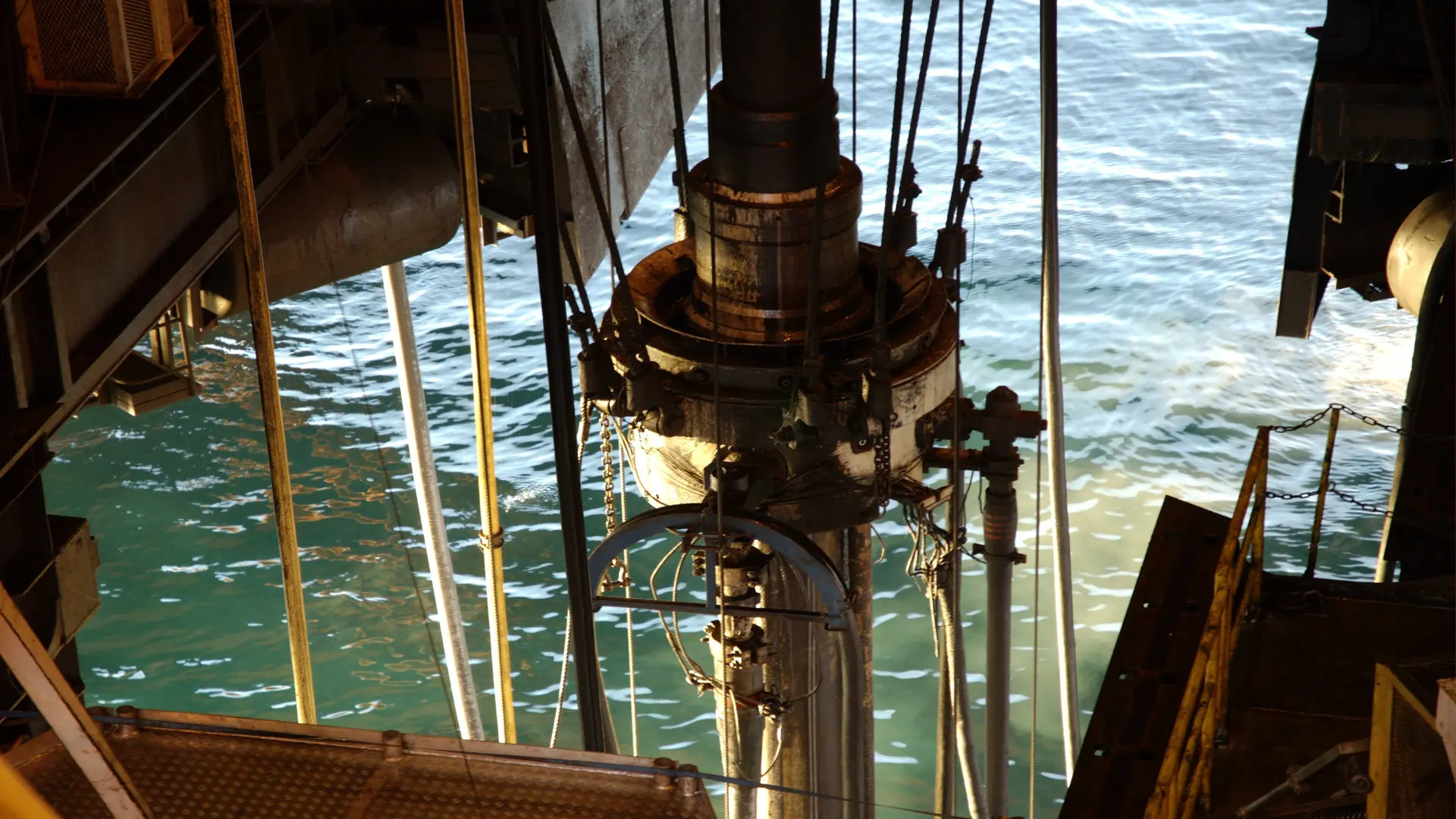
Offshore Caissons are critical components on offshore platforms, but they are also among the assets most exposed to silent deterioration. The combination of saline environments, submerged sections, and difficult access promotes Hidden Corrosion, which in many cases is not detected in time. Facing this challenge, Continuous Monitoring using Guided Waves and systems such as gPIMS is changing the way risk is managed. Several field applications have confirmed its effectiveness on real offshore structures. This article explains how to evaluate these assets and when to move from periodic screening to continuous monitoring.
What are Offshore Caissons?
Offshore Caissons are vertical or inclined pipes installed on offshore structures.
They are commonly used for:
- Seawater intake systems.
- Firewater systems.
- Fluid discharge lines.
- Venting and drainage systems.
- Auxiliary platform services.
In many cases, they operate as Risers or lines connected to essential systems. Due to their location, offshore caissons operate under aggressive conditions that accelerate both internal and external deterioration.
Why Offshore Caissons are difficult to inspect?
Inspecting Offshore Caissons is not straightforward. A large portion of their length is located:
- Above seawater and continuously exposed to splash zones.
- Partially submerged.
- Near congested structural areas.
- In restricted-access locations.
- Under continuous operation.
These conditions make offshore caissons difficult-to-access assets, where conventional inspection may require scaffolding, rope access, vessels, ROVs, or specific operational windows. In addition, many defects develop behind clamps, supports, aged coatings, or non-visible areas, promoting Hidden Corrosion.
Corrosion risks in Offshore Caissons?
The main risk in Offshore Caissons is that wall thickness loss can progress without obvious external indications. Corrosion may develop due to:
- Trapped seawater.
- Coating failures.
- Differential aeration.
- Under-deposit corrosion.
- Intermittently wet zones.
- Seawater-related microbiological activity.
Without Continuous Monitoring, damage may only be identified once leakage, perforation, or severe weakening has already occurred.
Offshore field reference case
A field case study published by Guided Ultrasonics Ltd demonstrated the application of Guided Waves with permanently installed sensors on aging Offshore Caissons. The objective was to control high-risk areas where traditional inspection was expensive and access-limited.
The program enabled:
- Establishment of an initial baseline.
- Repeated periodic readings.
- Historical signal comparison.
- Identification of changes consistent with section loss.
- Prioritization of confirmatory inspections.
The most important outcome was not the brand itself, but the demonstration that permanent monitoring can transform difficult-to-inspect assets into technically manageable systems.
Guided waves for detecting hidden corrosion
Guided Waves represent one of the most effective technologies for evaluating long pipe sections from a single accessible location. In Offshore Caissons, this technique transmits ultrasonic energy through the pipe wall and analyzes reflected echoes generated by geometric changes or metal loss.
Main benefits
- Evaluation of several meters from a single location.
- Reduced need to remove insulation or coatings.
- Early detection of Hidden Corrosion.
- Reduced invasive inspection campaigns.
- Better targeting of confirmatory inspections.
For this reason, guided waves are particularly useful in offshore caissons and Risers where full access is costly or hazardous.
Wide coverage from a single location
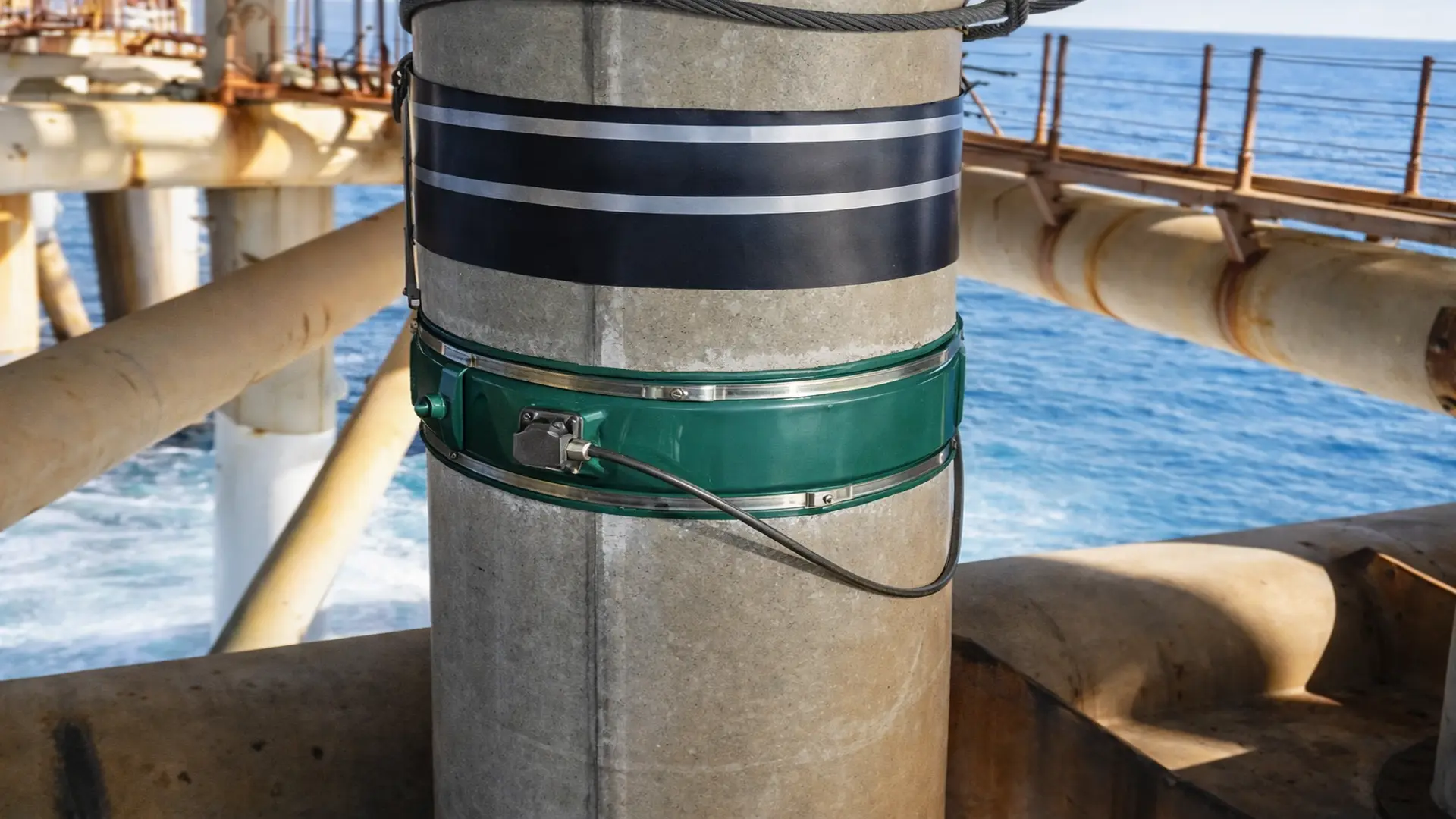
One key advantage of using Guided Waves in Offshore Caissons is the ability to achieve wide coverage from a single point. Unlike conventional ultrasonic testing, which measures localized thickness, this technology can inspect extended pipe sections using a sensor collar installed in an accessible position.
This allows:
- Rapid inspection of upper and lower sections.
- Repeatable evaluations.
- Prioritization of suspicious areas.
- Reduced personnel exposure.
For assets where every offshore hour represents significant cost, wide coverage from a single location improves both technical and economic efficiency.
What changes with permanently installed sensors?
The real advancement occurs when permanently installed sensors are implemented. Instead of mobilizing equipment periodically, Offshore Caissons become prepared for repeatable measurements with high consistency.
Benefits of permanently installed sensors
- Reduced positioning errors.
- Maintenance of a historical baseline.
- Real deterioration trend comparison.
- Early detection of variations.
- Reduced costs associated with repetitive campaigns.
For offshore caissons, this approach strengthens Continuous Monitoring and condition-based decision-making.
How gPIMS improves continuous monitoring?
The gPIMS system integrates Guided Waves with permanently installed sensors and periodic data tracking. In Offshore Caissons, gPIMS provides a robust methodology for monitoring deterioration over time.
Advantages of gPIMS
- Repeatable readings from the same location.
- Comparable trends between inspection campaigns.
- Alarms for significant changes.
- Reduced dependence on long operational windows.
- Greater visibility of Hidden Corrosion.
With gPIMS, Continuous Monitoring becomes a true offshore integrity management program.
Data comparison over time
One of the greatest values of gPIMS in Offshore Caissons is long-term data comparison. Integrity decisions often fail when based on isolated measurements only. Trend analysis makes it possible to determine:
- Whether wall loss is progressing.
- Whether the coating system has stopped protecting the surface.
- Whether an area has shifted from stable to critical condition.
- Whether repair, monitoring, or replacement is the best option.
Long-term data comparison transforms technical information into maintenance strategy.
When gPIMS outperforms periodic screening?
Periodic screening remains useful as an initial assessment tool. However, there are scenarios where gPIMS clearly outperforms this practice in Offshore Caissons.
When migration Is recommended
- Recurrent corrosion history.
- High system criticality.
- Difficult or expensive access.
- Need for life extension.
- Uncertainty regarding deterioration rates.
- Repeated campaigns without clear trending.
In these situations, transitioning from screening to Continuous Monitoring allows better management of resources and operational risk.
What decisions does continuous monitoring improve?
Continuous Monitoring in Offshore Caissons improves both technical and financial decision-making.
Operational decisions
- Continue operation under controlled conditions.
- Schedule repairs during planned shutdowns.
- Reinforce coating systems.
- Install additional protection.
- Adjust inspection frequencies.
Strategic decisions
- Prioritize CAPEX investments.
- Extend safe service life.
- Reduce risk of unexpected failures.
- Justify replacement decisions.
Conclusion
Offshore Caissons present a high risk of Hidden Corrosion due to their severe environment and difficult access conditions. Field experience confirms that Continuous Monitoring using Guided Waves and solutions such as gPIMS enables early detection of changes, trend comparison, and better integrity decisions. When criticality is high or access limits conventional inspection, migrating from periodic screening to continuous monitoring strengthens Offshore Integrity, reduces uncertainty, and protects operational continuity.
References
- American Petroleum Institute. (2016). API Recommended Practice 2SIM: Structural integrity management of fixed offshore structures. API Publishing Services.
- BSI. (2020). BS EN ISO 16828: Non-destructive testing — Ultrasonic testing — Time-of-flight diffraction technique as a method for detection and sizing of discontinuities. British Standards Institution.
- Guided Ultrasonics Ltd. (2019). Caisson monitoring: Case study. Guided Ultrasonics. https://www.guided-ultrasonics.com/wp-content/uploads/2023/02/2019CaseStudy20_rev0.pdf
- International Organization for Standardization. (2017). ISO 17359: Condition monitoring and diagnostics of machines — General guidelines. ISO.
- Abuassal, A., Kang, L., Martinho, L., Kubrusly, A., Dixon, S., Smart, E., Ma, H., & Sanders, D. (2025). A review of recent advances in unidirectional ultrasonic guided wave techniques for nondestructive testing and evaluation. Sensors, 25(4), 1050. https://www.mdpi.com/1424-8220/25/4/1050