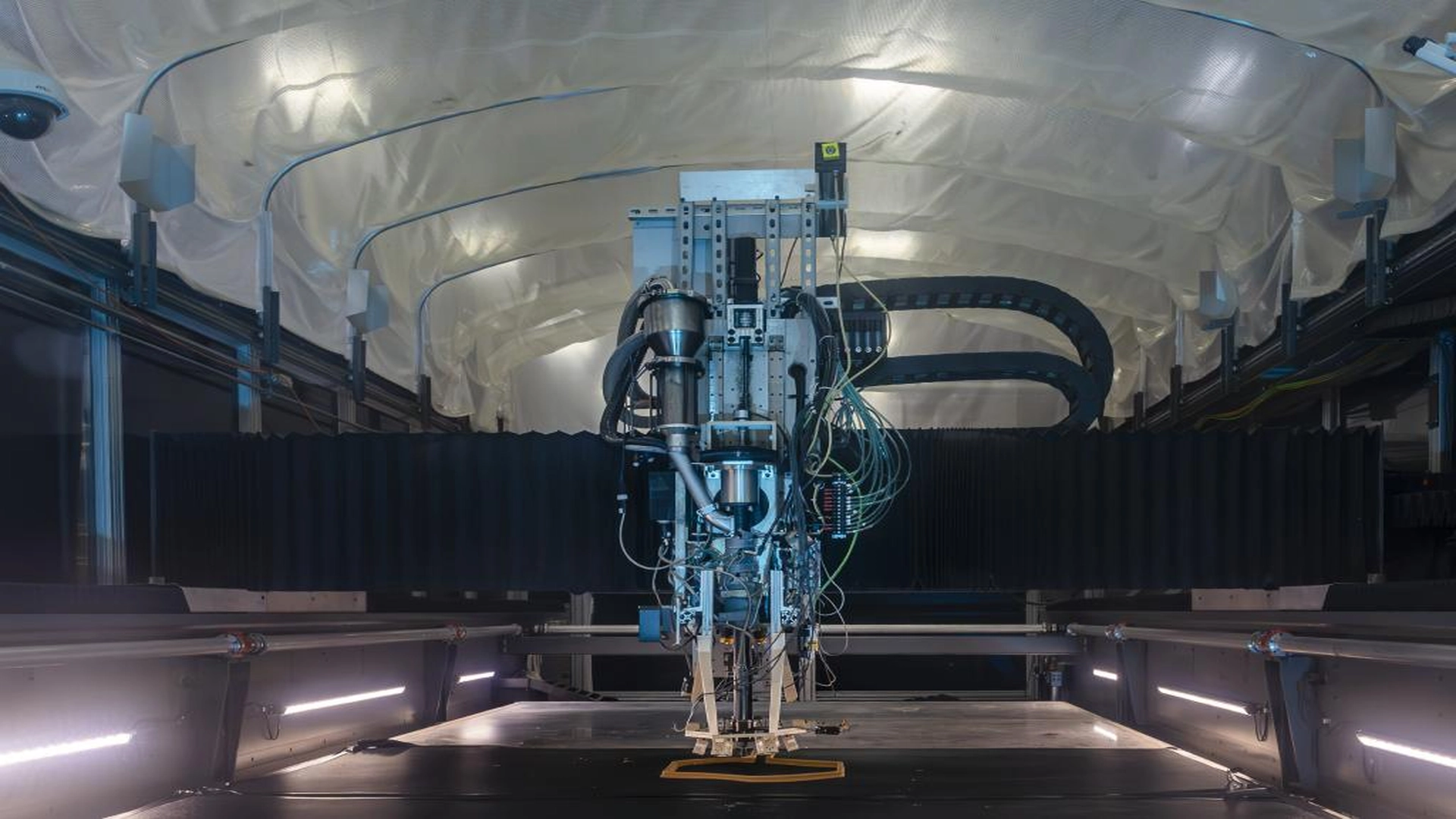
Researchers at ORNL, part of the U.S. Department of Energy, developed an automated system that combines sensors, thermal cameras, machine vision, and digital twins to improve temperature control during large-format additive manufacturing.
The technology is designed to reduce defects, minimize waste, and strengthen industrial production of customized parts for transportation, construction, advanced manufacturing, and infrastructure applications.
Machine vision controls 3D printing
Large-scale 3D printing deposits heated plastic composite material through a robotic nozzle, building large components layer by layer. The process requires precise thermal balance: each layer must remain hot enough to bond properly with the previous one, while cooling enough to preserve the final shape.
The controller developed by ORNL automatically monitors key variables such as nozzle position, printing speed, and the temperature of the deposited material. To support this, the system uses a ring of six low-cost thermal cameras mounted around the robotic nozzle to track the thermal behavior of newly deposited plastic.
Using machine vision, the system interprets thermal images in real time, identifies the location of the hot material, and detects deviations from the target temperature.
Real-time error correction
When the controller detects that a layer is outside the desired thermal range, it automatically adjusts the printing speed. This response allows each layer to reach the right temperature before the next one is added, improving layer bonding and reducing the risk of defects.
During testing, the machine printed a hexagon larger than a truck tire. The process began at an intentionally low printing speed, causing the material to be about 30% cooler than required when the next layer was applied. Once the system detected the deviation, it automatically increased the printing speed to restore the optimal bonding temperature.
According to ORNL, the tool can detect and correct temperature differences of only a few degrees, a critical capability because thermal variations are a common cause of damaged or failed parts.
Digital twins for additive manufacturing
One of the system’s key advantages is that it does not require retraining for every new design, reducing computational demands and increasing industrial flexibility.
The research team used machine learning to create a virtual replica of the physical printing process, known as a digital twin. This model allows engineers to test new shapes, materials, and parameters without risking real parts or generating additional waste.
Unlike monitoring-only systems, ORNL’s approach moves toward closed-loop control, where the machine observes, interprets, and adjusts the manufacturing process while the part is being produced.
Impact on industrial manufacturing
For industry, this technology represents an advance toward smarter large-format printers with less dependence on constant human supervision. Automation could free skilled operators to focus on higher-value tasks, such as optimizing the balance between speed, geometry, and final part strength.
The approach could support broader adoption of additive manufacturing in products such as boat hull molds, refrigerated containers, transportation components, building walls, and customized structural parts.
ORNL noted that the project builds on previous research with Purdue University, the University of Maine, and the University of Tennessee–Knoxville, focused on using thermal imaging and statistical models to detect failures in large-scale 3D printing.
Automation with industrial value
The new tool marks another step in the evolution of additive manufacturing: moving from detecting failures to correcting them during the process. This capability can reduce rework, material waste, and production time, especially in large components where a failed print can represent significant operating costs.
With this development, ORNL strengthens its role in improving the precision, scalability, and competitiveness of industrial 3D printing, bringing large-format additive manufacturing closer to more autonomous, traceable, and reliable production systems.
Source: ORNL