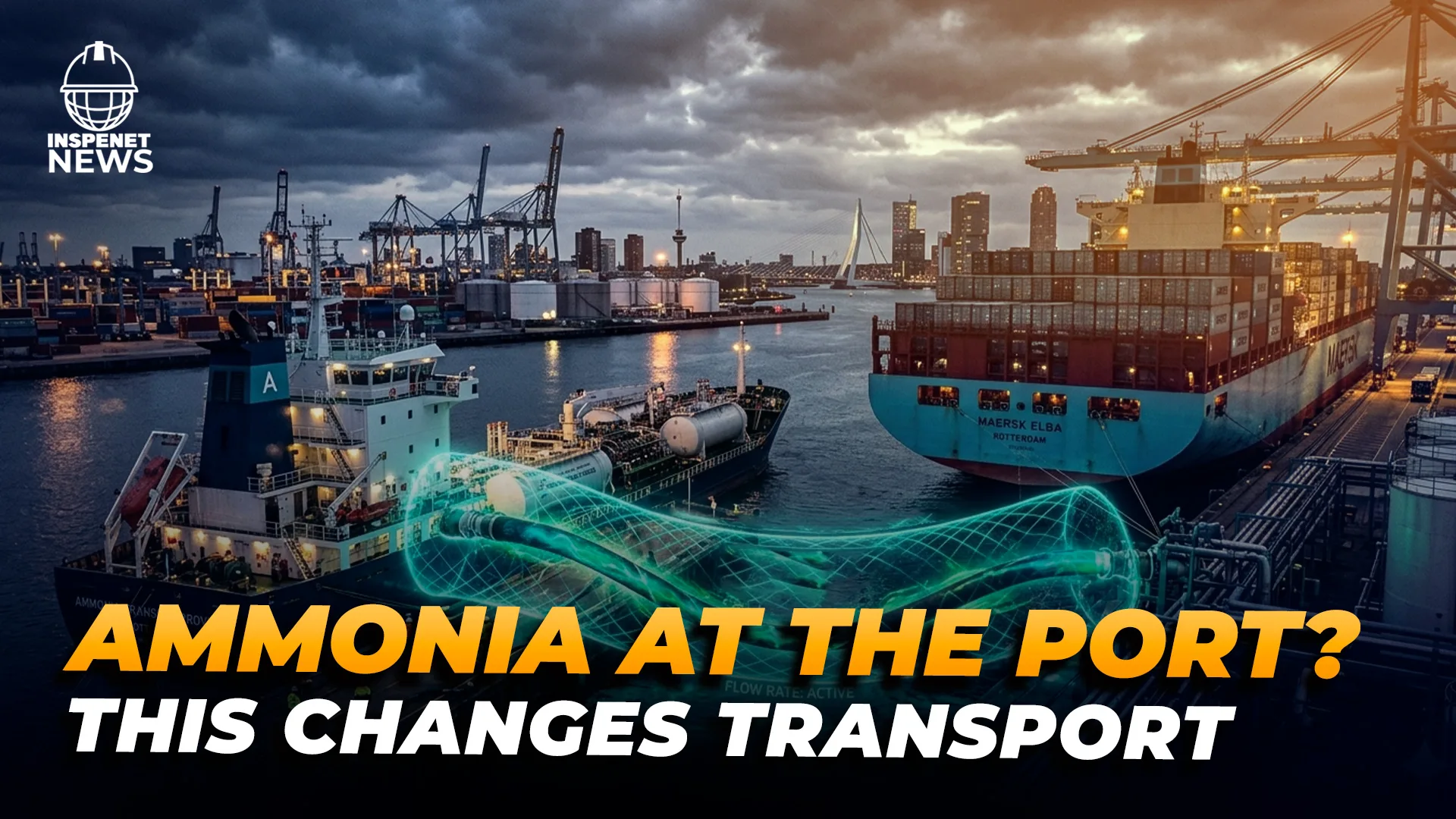
MAGPIE project validates ammonia supply in ports
Ammonia refueling between vessels can now be carried out safely within active commercial ports. This was confirmed by the European MAGPIE project after completing an operational demonstration in the port of Rotterdam, an initiative that seeks to accelerate the transition to lower-emission marine fuels in maritime transport.
Furthermore, the results were compiled in a publicly available technical report that will serve as a reference for port authorities, regulators, and shipping companies interested in incorporating ammonia into their operations.
Rotterdam tests ammonia supply
The simulation was conducted on April 12, 2025, in a real port environment. During the operation, ship-to-ship replenishment procedures, safety protocols, and operational coordination among different actors in the maritime logistics chain were evaluated.
According to those in charge of the project, the test demonstrated that the supply of ammonia can be developed in a controlled manner when there is rigorous planning and a regulatory framework adapted to this type of fuel.
The work was developed within the MAGPIE program, an initiative funded by the European Union focused on the sustainable modernization of ports through digitalization, logistics innovation and emissions reduction.
Ammonia is gaining ground as a marine fuel
Currently, maritime transport faces increasing international pressure to reduce its environmental footprint. In this context, ammonia is emerging as one of the most promising alternatives to replace fossil fuels used by the shipping industry.
However, its implementation presents significant challenges due to its chemical properties and operational risks. This necessitates the development of specific safety standards, specialized equipment, and emergency response systems before its widespread commercial use can be expanded.
Indeed, one of the main contributions of the MAGPIE project was to validate regulatory and operational tools designed to facilitate the adoption of alternative marine fuels.
The report aims to guide ports and regulators
The final report was prepared by the Mærsk McKinney Møller Centre for Zero Carbon Transport in collaboration with the project's technical partners. The document includes practical recommendations, validation processes, and lessons learned during the Rotterdam trial.
Furthermore, the study confirmed the effectiveness of the security framework used by the Dutch port and the Port Readiness Tool promoted by the International Association of Ports and Harbors (IAPH).
According to Bo Cerup-Simonsen, executive director of the Mærsk Mc-Kinney Møller Centre, the results will help build greater confidence in ammonia supply within the maritime industry and will help define future regulatory processes.
European ports accelerate the energy transition
Furthermore, the Port of Rotterdam believes that this type of project will be crucial in building new energy supply chains focused on low-emission fuels.
The initiative also reinforces the role of European ports as strategic hubs for the energy transition of maritime transport, especially in light of the advance of stricter environmental regulations for the global shipping industry.
With the open publication of the results, MAGPIE partners hope that other ports will adopt similar models and accelerate the development of infrastructure compatible with new marine fuels.

News of additional interest
ROSEN transforms pipeline inspection with AI
ROSEN received the Business Innovation Award at the 2026 Gas Industry Awards for its NIPA service, a technology focused on detecting risks and damage in oil pipelines through data analysis and artificial intelligence. The award was presented in London by the Institution of Gas Engineers and Managers, along with the Energy & Utilities Alliance, in recognition of the practical impact of this tool on energy infrastructure safety.
The system combines information obtained from ground-based sensors, drones, and predictive models to identify corrosion and metal loss in complex pipelines where traditional methods have limitations. Rosen explained that NIPA uses data from more than 26,000 inspections conducted worldwide, as well as environmental variables such as soil type, rainfall, roads, and population density, to improve the accuracy of the analyses. By 2025, the technology had already been used on more than 700 kilometers of pipelines and enabled the detection of major faults requiring immediate repair.
RWE accelerates its wind energy expansion in Italy
RWE has begun construction of the Serra Giannina wind farm in the Italian region of Basilicata, with a capacity of 42 MW. The project will feature six wind turbines capable of producing enough electricity for approximately 39,000 homes when it becomes operational in 2027. The initiative is part of the German company's growth plans in the Italian renewable energy market.
The company is also developing three other wind farms in different regions of the country, which will bring the total onshore wind capacity currently under construction in Italy to 200 MW. RWE emphasized that wind power remains one of the most cost-competitive sources of electricity and an important component for strengthening energy security. The company currently operates 17 wind farms and one solar power plant in Italy, with the capacity to supply more than 500,000 homes.
Unity grows with contracts and international expansion
Scottish company Unity strengthened its presence in the energy market after securing over £6 million in new contracts related to the decommissioning and integrity of oil wells. Among the agreements is a multi-million pound project in the North Sea to carry out well plugging and abandonment work alongside a global operator. The company also obtained contract extensions and new framework agreements with major oilfield services firms.
Unity also announced it will invest £1.8 million to expand its technology portfolio focused on well intervention and maintenance tools. Thanks to these capabilities, the company secured a drilling contract for 15 wells, offering comprehensive services from a single provider. To support this growth, Unity announced new executive hires and the expansion of its team this year.