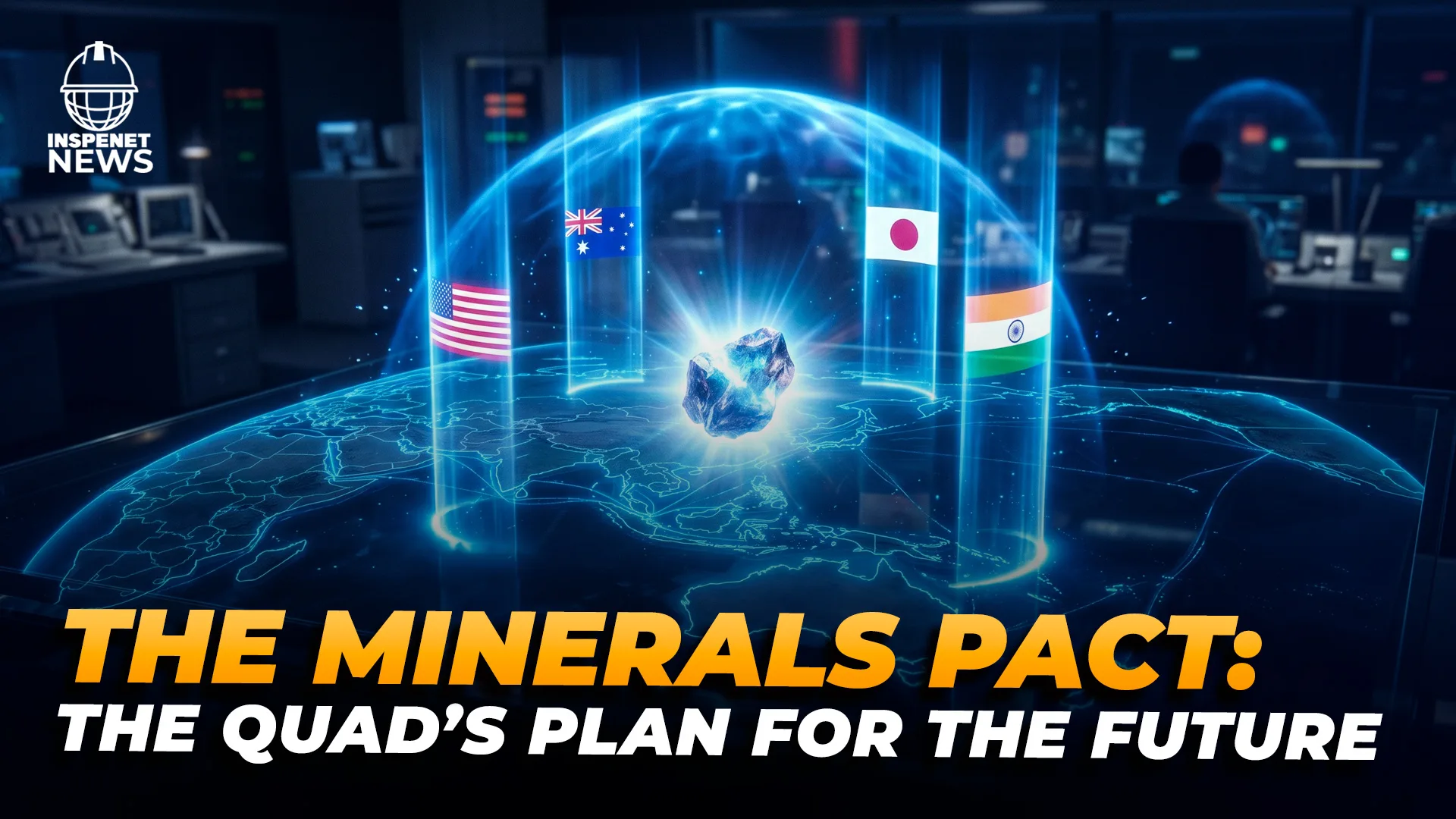
The Quad doubles down on global critical minerals
The race for control of the resources that fuel the global technology economy has just entered a new phase. India, the United States, Japan, and Australia have agreed to move forward with a joint framework to strengthen access to critical minerals and build more diversified supply chains for sectors such as batteries, semiconductors, defense, and energy.
Why are critical minerals strategic for industry?
Critical minerals are currently considered essential for the industrial competitiveness of major economies. These resources include raw materials crucial for manufacturing electric vehicles, energy storage systems, advanced defense equipment, and highly complex technological components.
In addition, rare earth elements occupy a prominent place within this category due to their importance in the production of permanent magnets, electric motors, and electronic devices used in multiple industries.
Therefore, ensuring a stable supply has become a priority for governments and companies seeking to reduce risks associated with disruptions in international trade.
The Quad's new framework to strengthen supply chains
During a meeting held in New Delhi on May 26, 2026, the Quad foreign ministers gave the green light to a new phase of cooperation focused on critical minerals. The initiative envisions investments that could reach $20 billion through the participation of public agencies and private capital.
The group also aims to identify strategic projects linked to the four member countries. These projects may be developed within their territories, managed by companies based there, or geared towards supplying their respective markets.
Similarly, the framework contemplates the use of export credits, insurance, loans, financial guarantees and equity participation to accelerate the development of new industrial capabilities.
Mineral processing gains strategic importance
Although extraction usually attracts the most attention, the real challenge lies in the later stages of the production chain.
Indeed, possessing large mineral reserves does not guarantee industrial autonomy if mineral processing and refining remain concentrated in the hands of a limited number of players. Transforming minerals into inputs suitable for the technology industry represents one of the most valuable and strategic segments of the entire value chain.
For this reason, the Quad initiative places special emphasis on promoting processing, refining and recycling facilities capable of supplying its industries without being overly dependent on external suppliers.
India and the United States expand their cooperation in rare earth elements
Alongside the multilateral announcement, India and the United States signed a bilateral framework aimed at strengthening collaboration in mining, mineral processing , recycling, and investments related to strategic resources.
According to statements released after the meeting, the goal is to develop more resilient and diversified supply chains to cope with potential market disruptions and respond to the growth in global demand.
The cooperation also seeks to facilitate new opportunities for companies involved in the extraction and processing of rare earth elements , a segment that is gaining importance as the electrification of the economy increases.
How does this strategy impact batteries, chips, and defense?
The significance of this movement extends far beyond the mining sector. Critical minerals are integral to virtually all technologies considered essential for economic growth and national security.
On one hand, they are essential for manufacturing batteries used in electric vehicles and energy storage systems. On the other, they are necessary for the production of semiconductors, telecommunications equipment, and advanced military components.
Consequently, securing access to these resources has become a matter of industrial competitiveness and technological capacity for the most developed economies.
The challenges of building an alternative supply chain
Despite the political momentum shown by the Quad members, the development of an alternative supply chain will require sustained investment and extended timeframes.
The construction of new mines, mineral processing plants , recycling centers and logistics infrastructure involves significant technical, financial and regulatory challenges.
Furthermore, projects must demonstrate economic viability in an environment marked by increasing international competition and the volatility of commodity markets.
What might change for the technology and energy industry?
As demand for technologies linked to the energy transition and digitalization increases, access to critical minerals becomes increasingly important.
Therefore, the new framework promoted by the Quad could accelerate investments across the entire value chain and foster the emergence of new industrial capabilities in different markets.
The fundamental issue is no longer solely about who owns the underground resources. The determining factor will be who can extract, process, finance, and transport them efficiently to supply the industries that will define economic growth in the coming decades.
News of additional interest
PipeSense accelerates safety in CO₂ networks
PipeSense has expanded the reach of its leak detection technology to carbon dioxide pipelines after successfully completing a series of tests on infrastructure in South Texas. The company used a dynamic pressure analysis-based system to monitor a 12-mile stretch of pipeline that transports CO₂ under high-pressure conditions, one of the most demanding applications for this type of network.
Tests conducted over several months yielded outstanding results. The system was able to identify leaks in just 2 to 3 minutes and pinpoint their location with an accuracy of less than 20 feet. Furthermore, it registered only one false positive and operated without interruption for five months, even in the face of operational challenges such as changes in fluid conditions and unexpected compressor station shutdowns. The solution employs highly sensitive pressure sensors and machine learning tools to enhance monitoring reliability.
Dajin brings Chinese offshore wind power to Europe
Dajin Heavy Industry announced the development of China's first prototype three-legged jacket structure, certified by DNV and specifically designed for offshore wind projects in the North Sea. The structure is designed to support wind turbines up to 15 MW and was developed to meet some of the most demanding technical standards in the international offshore industry.
The project incorporates DNV NV F36 steel with impact resistance down to -60°C and a double-groove design in the TKY structural joints to enhance performance in extreme conditions. All manufacturing takes place at the Tangshan plant, a specialized offshore wind energy facility that began operations in late 2025 and holds international certifications for quality, safety, and environmental management. Final assembly and validation are scheduled for completion in 2026.
Tampnet and Starboard strengthen underwater surveillance
Tampnet and Starboard Maritime Intelligence unveiled a new technological integration that combines various fiber optic detection systems to enhance the protection of submarine cables and critical infrastructure. The solution integrates signals obtained through distributed acoustic detection and fiber polarization monitoring onto a single platform, enabling operators to identify potential threats more quickly and accurately.
The tool displays both sources of information on a single operational map, along with real-time maritime traffic data. This makes it easier to differentiate between activities near the cable and direct physical contacts that could pose a risk. Furthermore, operators can adjust sensitivity parameters and monitor events without switching between different systems, streamlining analysis and incident response.
Clariant's catalysts increase emissions savings
Clariant reported that its catalyst technologies helped prevent the emission of 45 million tons of CO2 equivalent during 2025, a figure that exceeds the previous year's result by 5 million tons. This performance was made possible by solutions applied in high-emission industrial sectors, including direct reduced iron ore steel production, nitric acid plants, low-emission methanol production, and fuel refining processes.
The company highlighted the progress of projects related to green methanol. Over the past year, two large-scale facilities using its catalysts to transform sustainable raw materials into methanol have become operational. One project uses renewable hydrogen and biogenic carbon dioxide, while the other utilizes agricultural waste as a feedstock. These developments aim to demonstrate that producing fuels and chemicals with a lower environmental impact can be commercially viable.