Table of Contents
- What is environmentally induced cracking?
- Causes of Environmentally Assisted Cracking in steels
- Crack initiation and propagation mechanisms
- Distinguishing HIC and SCC by Strain
- Testing and evaluation methods
- Preventive and mitigation measures
- Service manifestations and critical inspection points
- Innovations and trends
- Standards and references
- Conclusion
- References
In the assessment of the mechanical integrity of industrial equipment, not all damage mechanisms are evidenced by wall thickness loss or visible deformation. Among the most insidious processes is environmentally assisted cracking (EAC), which can develop progressively through the combination of tensile stresses, susceptible materials, and aggressive environments. This phenomenon represents a critical risk in components such as pipelines, pressure vessels, and heat exchangers, where early detection is essential to prevent unexpected failures and ensure system reliability. Understanding its mechanisms and conditions of occurrence is therefore essential for the integrity management of industrial assets.
What is environmentally induced cracking?
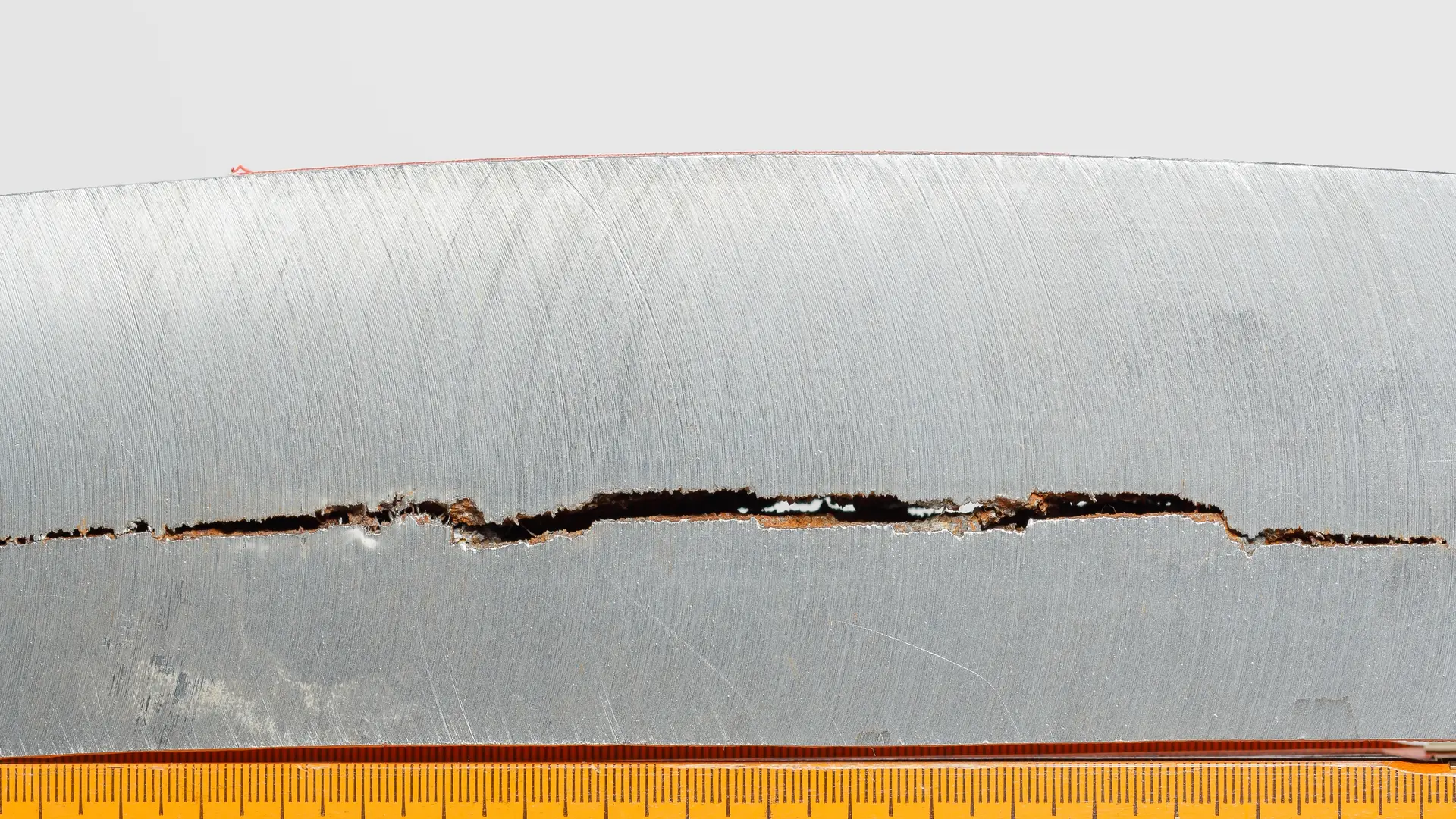
Environmentally induced cracking, comprises a group of mechanisms in which mechanical and environmental factors interact. The most relevant include stress corrosion cracking (SCC), hydrogen embrittlement, which manifests as HIC (Hydrogen Induced Cracking), SOHIC (Stress-Oriented Hydrogen Induced Cracking), and SSC (Sulfide Stress Cracking), as well as corrosion fatigue. These processes can generate internal or surface cracks with a predominantly brittle behavior, making their detection through conventional visual inspection difficult.
Causes of Environmentally Assisted Cracking in steels
The Environmentally Assisted Cracking develops when three fundamental factors coincide: a susceptible material, tensile stress, and an aggressive environment.
Susceptible material: High-strength steels, austenitic stainless steels, and alloys with hydrogen-sensitive microstructures are particularly vulnerable. Hardness, chemical composition, and heat treatments directly influence susceptibility to this phenomenon.
Tensile stress: Operational, residual (especially in welded areas), or stresses induced by vibrations and cyclic loads can activate Fisuración Asistida por el Ambiente, even below the material’s yield strength.
Aggressive environment: The presence of chlorides (marine environments), H₂S and CO₂ (sour crude environments), industrial humidity, and organic or inorganic acids contributes to crack initiation and propagation.
Crack initiation and propagation mechanisms
Environmentally assisted cracking typically originates at microscopic discontinuities, inclusions, or stress concentrators. Crack propagation may be intergranular, following grain boundaries (typical of SCC), or transgranular, crossing through grains (as occurs in hydrogen embrittlement). Particularly critical is SOHIC, which generates stepwise cracks oriented according to the stress field, commonly found near welds or in areas with high mechanical restraint.
Distinguishing HIC and SCC by Strain
Although stress corrosion involves degradation under tensile stress, EAC is a broader concept encompassing SCC, hydrogen embrittlement (HIC, SOHIC, SSC), and corrosion fatigue, presenting a significantly greater risk of brittle failure in critical components.
Video: Difference Between HIC and SCC. Source: Haihao Group
Testing and evaluation methods
The analysis is performed through standardized tests such as ASTM G129 and ISO 7539, which allow the assessment of the susceptibility of metallic materials. Non-destructive testing methods include ultrasonic testing (UT, PAUT, TOFD), eddy current testing, and visual inspection or magnetic particle testing techniques. In particular, hydrogen-related mechanisms such as SOHIC require advanced methods due to their complex internal morphology.
The practical evaluation also includes predictive models and risk-based inspection (RBI) strategies, focusing attention on critical areas such as welds, elbows, and supports. Early detection makes it possible to implement preventive measures before catastrophic failures occur.
Preventive and mitigation measures
The control combines material selection, stress relief, and environmental control. Materials resistant to SCC and hydrogen embrittlement, post-weld heat treatments (PWHT), and the reduction of stress concentrations help minimize risk. Likewise, pH control, the use of corrosion inhibitors, and H₂S removal are complementary strategies.
Cathodic protection can be effective in mitigating mechanisms dominated by anodic dissolution, such as stress corrosion cracking, but it requires caution: overprotection may induce atomic hydrogen, promoting HIC, SOHIC, and SSC. Its application should be evaluated considering the material, environment, and operating conditions, following guidelines established by NACE International.
Service manifestations and critical inspection points
In pipelines transporting H₂S, hydrogen embrittlement and SOHIC are recurrent phenomena, while stainless steel heat exchangers commonly exhibit susceptibility to SCC. Likewise, structures subjected to vibrations or cyclic loads face elevated corrosion-fatigue risks, highlighting the importance of risk-based inspection programs.
Areas requiring special attention include welds, elbows, tees, rigid supports, and locations exposed to vibrations or abrupt section changes. Increasing the initial inspection frequency at these points is recommended to determine crack propagation rates and optimize monitoring and structural integrity strategies.
Innovations and trends
- Online monitoring through stress sensors and advanced ultrasonic technologies.
- Remote inspection using drones or robotic systems in hazardous areas.
- Predictive models based on ASTM G129 and ISO 7539 to estimate component service life.
- Assessment of increasingly aggressive environments due to emerging environmental factors.
Standards and references
Relevant standards assessment and control include ASTM G129, ISO 7539, and NACE MR0175/ISO 15156, complemented by ASM International handbooks on corrosion and materials protection.
Conclusion
Environmentally assisted cracking (EAC) in stressed steels represents a complex challenge for industrial integrity because it combines susceptible materials, tensile stress, and aggressive environments. Mechanisms such as stress corrosion cracking, hydrogen embrittlement (HIC, SOHIC, SSC), and corrosion fatigue require a comprehensive approach based on design, material selection, environmental control, and advanced monitoring to ensure system reliability.
References
- ASTM International. (2016). ASTM G129-16: Standard Practice for Slow Strain Rate Testing to Evaluate the Susceptibility of Metallic Materials to Environmentally Assisted Cracking.
- International Organization for Standardization. (2018a). ISO 7539-1: Corrosion of Metals and Alloys,Stress Corrosion Cracking,Part 1: General Guidance on Testing Procedures. ISO.
- International Organization for Standardization. (2018b). ISO 7539-6: Corrosion of Metals and Alloys,Stress Corrosion Cracking, Part 6: Preparation and Use of Pre Cracked Specimens for Tests Under Constant Load or Constant Displacement. ISO.
- NACE International. (2015). NACE MR0175/ISO 15156: Petroleum and Natural Gas Industries, Materials for Use in H₂S-Containing Environments in Oil and Gas Production. NACE International.