Table of Contents
- Muon tomography: How the image is formed
- Dense structures: where other NDT methods reach their limits
- Inspection without access to the asset interior
- From static imaging to density monitoring
- An industrial vessel observed in operation
- What muography detects and what limits its use
- Muography within an NDT strategy
- Conclusions
- References
- Frequently Asked Questions (FAQs)
Large thicknesses, dense materials, complex geometries, or the inability to access equipment can limit what can be observed without dismantling or intervening in the system. In these applications, muon tomography is gaining attention as an alternative for examining the internal structure of large-volume assets.
The technique uses muons naturally generated in the atmosphere and analyzes how they travel through matter to reconstruct differences in density and internal distribution. Interest in this technology within non-destructive testing is growing because measurements can be performed from outside the asset and, in certain cases, while the asset remains in operation.
Muon tomography: How the image is formed
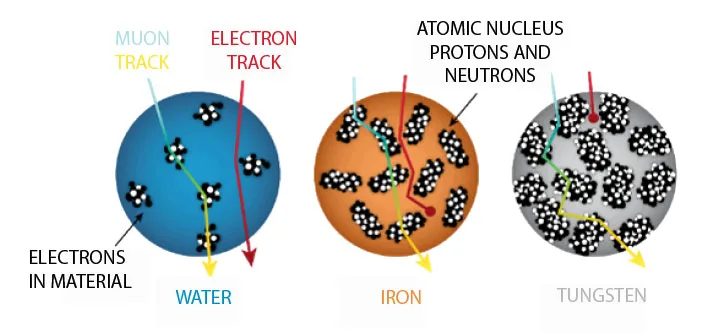
Muons are elementary particles belonging to the lepton family, with a mass approximately 206.77 times greater than that of the electron. They are generated when cosmic rays interact with the atmosphere, producing particle showers capable of reaching the Earth’s surface.
Muography uses these particles mainly through two methods. Transmission imaging analyzes the attenuation of the muon flux after it passes through an object, while muon scattering tomography examines how the muon’s trajectory changes as it interacts with materials.
The latter method involves Multiple Coulomb Scattering (MCS). The measured deflections provide information about material properties and, through reconstruction algorithms, can be converted into representations of the internal material distribution.
Muography, muon radiography, and muon tomography are related, but they are not equivalent terms. Muography is the broader concept, while tomography seeks to reconstruct internal information from numerous muon trajectories and measurement positions.
Dense structures: where other NDT methods reach their limits
Ultrasonic testing, industrial radiography, and computed tomography remain fundamental inspection tools. Each technique, however, operates within specific conditions of access, geometry, thickness, energy, resolution, and asset configuration.
In dense structures or large-volume assets, these variables can complicate data acquisition. Radiography requires suitable geometry between the source, component, and detection system, as well as sufficient energy to penetrate the material thickness. Ultrasonic testing provides high localized sensitivity but requires access conditions and acoustic propagation characteristics compatible with the intended inspection.
Muons operate at a different scale. Their high penetration capability makes it possible to examine large quantities of matter and structures that may fall outside the practical range of other radiographic configurations. The IAEA has published a dedicated technical publication on muon imaging and its emerging applications.
The source is another important difference. Measurements using cosmic-ray muons do not require introducing an artificial radiation source to generate the particles used for imaging. This changes the acquisition logistics compared with certain radiographic methods, although it does not eliminate the need for planning, metrological control, or safety assessment.
Muography is also not a replacement for UT, RT, or CT. Its greatest value appears when large volumes, inaccessible internal structures, or significant density variations need to be investigated and other NDT methods cannot evaluate them efficiently.
Inspection without access to the asset interior
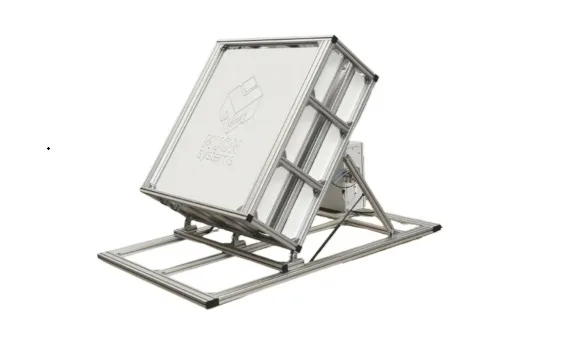
A passive muon imaging system detects particles that naturally pass through the installation. Sensors record their positions and trajectories and accumulate enough events to subsequently reconstruct information about the inspected volume.
The technology is particularly attractive when opening, emptying, or dismantling an asset creates operational difficulties. Industrial applications of muography are not entirely new. A study published in Philosophical Transactions of the Royal Society A investigated muon radiography as an NDT technique for industrial components affected by corrosion.
In that study, a steel pipe with different wall thicknesses was simulated. Under the specific modeled conditions, the methodology was able to distinguish wall-thickness variations of approximately 2 to 4 mm, using a detector with a spatial resolution of 4 mm and simulated exposure times of approximately two hours.
These results were obtained from a simulation and should not be directly extrapolated to every pipeline or industrial configuration.
The technique has also been tested experimentally on reinforced concrete. A study published in the Journal of Nondestructive Evaluation produced images of the interior of a 600 kg reinforced block and successfully identified important features of its internal geometry.
At the same time, the authors reported longer acquisition times and higher noise levels compared with active X-ray technologies.
These studies illustrate where the technology is beginning to find its place: assets where penetration, size, or the inability to access the interior weighs more heavily in the inspection decision than obtaining a very high-resolution image within a few minutes.
From static imaging to density monitoring
A muography inspection can answer a structural question: what distribution of matter exists within a given volume? Observing the same asset over time, however, makes it possible to ask a second question: what is changing inside the asset while it remains in operation?
When the amount or distribution of mass traversed by the muons changes, the detected signal may also change. This creates the possibility of asset monitoring without necessarily seeking to locate a specific crack.
Research presented at NDT 2026 demonstrated this dual function on an industrial asset in service. The authors observed a strong and repeatable temporal modulation of the signal associated with changes in the internal mass distribution during normal operation, while the system continued to provide structural information.
This distinction is important. The technology is no longer limited to producing an image of a condition at a specific point in time and is beginning to demonstrate the ability to track certain variations within an asset over time. The feasibility of such monitoring depends on whether the density change produces a measurable signal and whether enough events are available to resolve it.
An industrial vessel observed in operation
At NDT 2026, the presentation “Passive muon imaging as a dual-purpose inspection and monitoring tool for industrial assets” described an industrial muography application developed by N. Zabari, K. Katrankova, M. Dobrowols, and R. Bożek of Muotech.
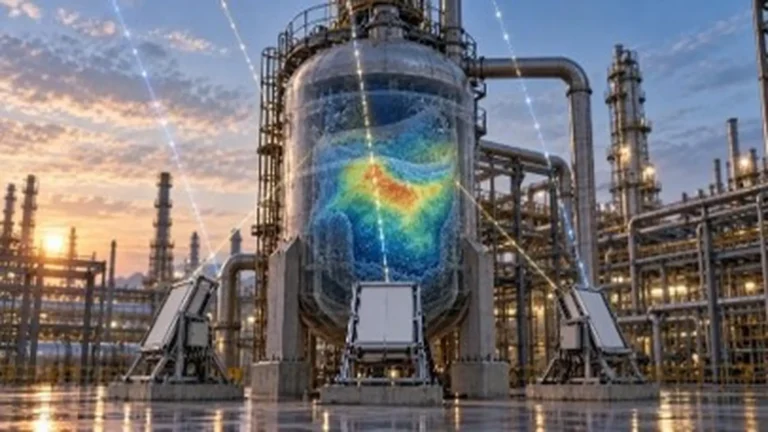
During the measurement campaign, a portable muon tracking system was placed at three positions around a large operating industrial vessel.
More than 30 million muon trajectories were recorded without interrupting operations or requiring access to the asset interior. Measurements acquired from different viewing angles made it possible to resolve internal structural features that could not previously be observed directly.
The most interesting result emerged from the time-dependent analysis. The signal showed repeatable variations caused by changes in the internal mass distribution during routine operation. The abstract does not associate these changes with a specific process, so fluid levels, accumulation, or material movement should not be assumed without additional information.
The authors suggest that this capability could extend the role of industrial muography toward a combination of non-intrusive inspection, structural verification, and operational monitoring using the same measurement system.
What muography detects and what limits its use
The signal obtained using muons is related to the amount, distribution, and properties of the matter traversed. The technique can therefore identify internal structures, sufficiently large voids, density differences, or significant changes in mass.
It should not be interpreted as a method capable of detecting every type of discontinuity. A small crack or localized wall loss may require a level of resolution that another NDT technique can provide more efficiently.
| Variable | What muography can provide | Main limitation |
| Large thicknesses | High penetration capability | The number of useful muons decreases as the amount of matter traversed increases |
| Internal structure | Imaging based on differences in matter and density | Sufficient contrast is required between the regions being evaluated |
| Restricted access | Information can be obtained from outside the asset | Geometry must allow detectors to be installed in useful positions |
| Monitoring | Tracking changes in mass distribution | Temporal resolution depends on the available statistics |
| Localized characterization | Can identify regions for subsequent evaluation | Resolution may be lower than that provided by specialized local NDT methods |
The natural muon flux is continuous but limited. At sea level, a commonly used reference value is approximately one muon per square centimeter per minute, meaning that a useful reconstruction requires the accumulation of a sufficient number of trajectories.
Acquisition time depends on detector size, observed area, asset geometry, the amount of matter traversed, density contrast, and the required resolution. Therefore, there is no single inspection time that applies to every measurement campaign.
Data processing is also evolving. In certain applications, reconstruction algorithms and machine-learning models can help identify regions of interest and improve the interpretation of images obtained with limited statistics.
These tools do not compensate for poor acquisition quality. Final resolution still depends on the number of recorded trajectories, measurement geometry, and the contrast present within the asset.
Muography within an NDT strategy
A new inspection technology provides value when it answers a question that available methods cannot address efficiently, rather than simply because it can produce a different type of image.
For massive assets, one possible sequence is to use muography to identify large-scale structures or anomalies and subsequently apply NDT methods with higher localized resolution once access to the region of interest becomes available.
For example, a volumetric indication identified using muons could lead to a subsequent evaluation using ultrasonic testing, PAUT, digital radiography, or another suitable technique. The final selection will depend on the damage mechanism, material, geometry, and type of information required.
This complementarity can also strengthen mechanical integrity decisions. Muography does not need to compete with every established NDT method to provide value. It can fill the gaps where scale, density, or access make conventional inspection particularly difficult.
This is precisely where the distinctive value of muon tomography emerges: observing large structures from the outside and tracking certain internal changes while the asset remains in operation.
Conclusions
When the interior of an asset is difficult to evaluate because of thickness, density, geometry, or limited access, obtaining information without dismantling or intervening in the equipment can expand inspection possibilities.
Muon tomography can examine large volumes and density differences from outside the asset. In certain applications, it can also track internal changes while the equipment remains in operation.
Its usefulness depends on geometry, density contrast, required resolution, and acquisition time. It should therefore be understood as a complementary technology within NDT rather than a replacement for established methods.
References
- British Institute of Non-Destructive Testing. Passive muon imaging as a dual-purpose inspection and monitoring tool for industrial assets. NDT 2026.
- International Atomic Energy Agency. Muon Imaging: Present Status and Emerging Applications. IAEA-TECDOC-2012.
- National Institute of Standards and Technology. Fundamental Physical Constants: Muon-Electron Mass Ratio.
- Recent research progress on cosmic ray muon imaging technology. Nuclear Engineering and Technology, 2026.
- Martínez Ruiz-del Arbol, P. et al. Non-destructive testing of industrial equipment using muon radiography. Philosophical Transactions of the Royal Society A.
- Niederleithinger, E. et al. Muon Tomography of the Interior of a Reinforced Concrete Block: First Experimental Proof of Concept. Journal of Nondestructive Evaluation.
Frequently Asked Questions (FAQs)
Is muon tomography a non-destructive testing method?
Yes. It can provide information about internal structures without sectioning or destroying the component and is currently being studied as an emerging technology within the NDT field.
Does it require an artificial radiation source?
Not to generate the muons used for measurement. It uses particles produced naturally through the interaction of cosmic rays with the atmosphere.
Can it replace ultrasonic testing or radiography?
Not in general. Its main value lies in examining large volumes, dense materials, and inaccessible structures, while other NDT methods provide advantages for characterizing localized discontinuities.
Can it be used while the asset is in operation?
In certain applications, yes. The case presented at NDT 2026 recorded more than 30 million muon trajectories around an operating industrial vessel without requiring access to its interior.