Table of Contents
- What is acoustic emission and how does it work?
- Historical evolution of the technology
- Operating principles and system components
- Advantages over other NDT methods
- Acoustic Emission vs. PAUT and Advanced Ultrasonic Testing
- Industrial applications of Acoustic Emission
- Acoustic Emission in asset integrity management
- International standards and codes
- Success stories and real-worldindustrial applications
- Acoustic Emission and industry 4.0
- Limitations and challenges of the technology
- The future of Acoustic Emission in critical assets
- Conclusions
- Reerences
- Frequently Asked Questions (FAQs)
- What is the difference between Acoustic Emission and conventional Ultrasonic Testing?
- Can Acoustic Emission replace other Non-Destructive Testing methods?
- What types of defects can be detected using Acoustic Emission?
- Is permanent monitoring with Acoustic Emission possible?
- What benefits do Acoustic Emission provide for Mechanical Integrity programs?
Modern industrial asset management is rapidly evolving from periodic inspection-based approaches toward continuous monitoring strategies. This evolution reflects the growing role of asset management as a strategic discipline aimed at maximizing reliability, availability, and operational performance. In industries such as Oil & Gas, petrochemicals, power generation, and industrial storage, where operational reliability directly impacts safety and profitability, the ability to identify degradation mechanisms before they develop into critical failures has become a strategic priority.
In this context, Acoustic Emission (AE) has emerged as one of the most valuable Non-Destructive Testing (NDT) technologies for structural integrity assessment and in-service asset monitoring. Unlike conventional inspection methods, AE enables the detection of damage activity as it occurs, providing early insight into processes such as crack propagation, active corrosion, plastic deformation, and leakage without interrupting asset operation.
Thanks to these capabilities, the technique has gained increasing relevance within mechanical integrity programs, predictive maintenance strategies, and risk-based asset management frameworks. This article explores the fundamentals of acoustic emission technology, the principles of Acoustic Emission Testing, its primary industrial applications, the standards governing its implementation, representative industry use cases, and the technological trends driving its evolution toward the future of intelligent inspection and asset integrity management.
What is acoustic emission and how does it work?
Acoustic Emission (AE) is an advanced Non-Destructive Testing (NDT) technique and one of the most widely recognized forms of Acoustic Emission Testing, based on the detection and analysis of transient elastic waves generated by the sudden release of energy within a material subjected to mechanical, thermal, or chemical stresses. These waves are produced when active degradation mechanisms occur, such as crack propagation, plastic deformation, corrosion, erosion, impacts, or pressurized leaks, making AE a unique tool for evaluating the dynamic behavior of materials and structures.
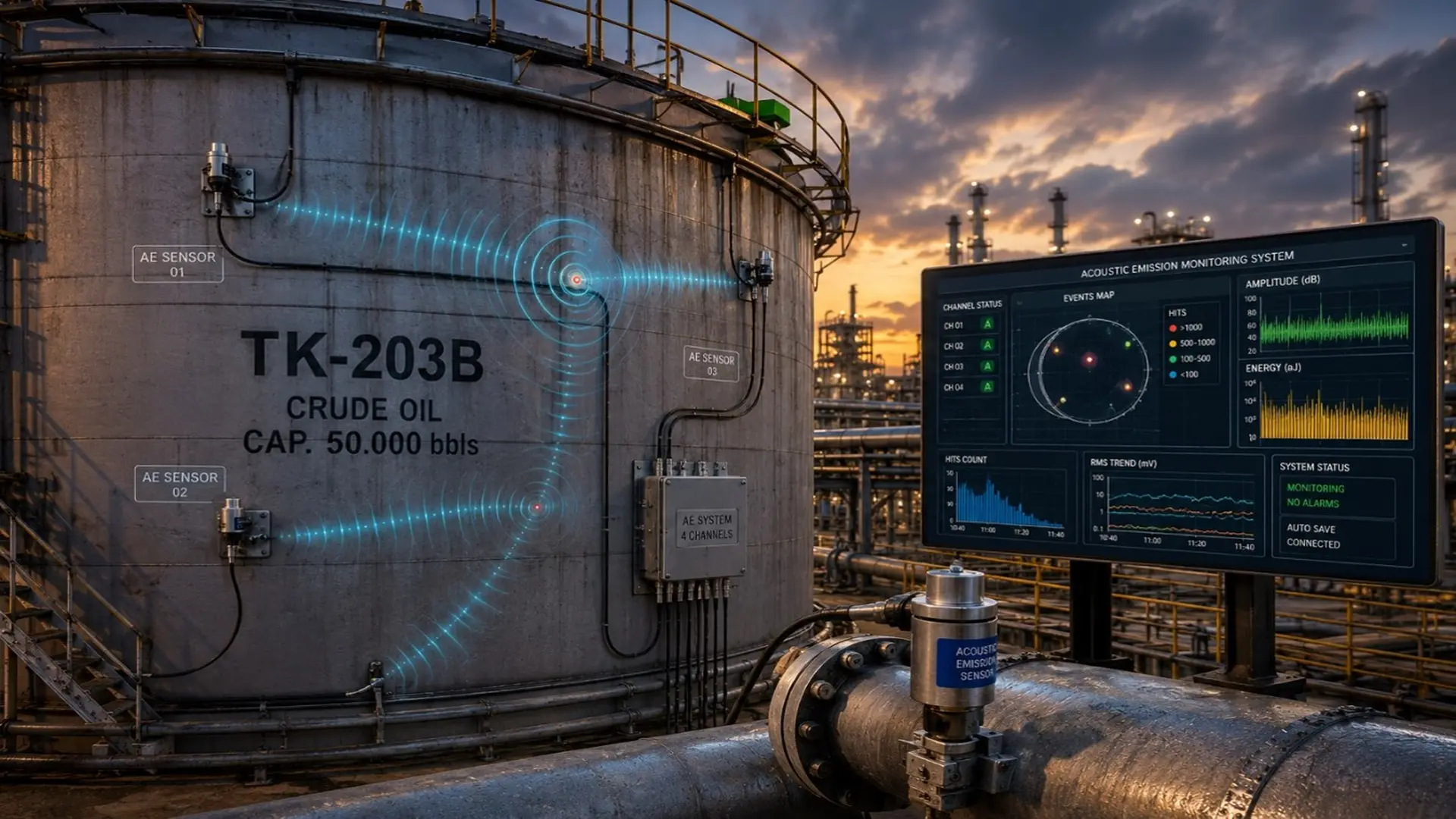
When a damage source releases energy, acoustic waves propagate through the material. The interpretation of these acoustic waves enables the identification of the location and potential severity of active degradation mechanisms. AE sensors convert these mechanical vibrations into electrical signals, which are subsequently amplified, processed, and analyzed using specialized data acquisition systems.
One of the main differences between acoustic emission and other NDT methods is that the technique is not solely intended to identify the presence or geometry of an existing flaw. Its true value lies in detecting damage activity in real time, determining whether a degradation mechanism is actively evolving during the assessment.
This capability makes AE a dynamic structural monitoring method capable of providing critical information about the operating condition of industrial assets, supporting more informed decision-making within mechanical integrity programs, risk management strategies, and condition-based maintenance initiatives.
Historical evolution of the technology
Although Acoustic Emission (AE) is currently recognized as an advanced structural monitoring technique, its origins can be traced back to empirical observations made thousands of years ago. The earliest records come from ceramic manufacturers who assessed the quality of their products by listening to the sounds generated during the cooling process. Later, craftsmen and metallurgists observed similar phenomena in metals subjected to deformation, particularly tin and wrought iron.
The scientific development of the technique began in the mid-twentieth century through the work of German researcher Joseph Kaiser, who demonstrated that materials under load generate acoustic emissions associated with internal structural changes. His research led to the discovery of the well-known Kaiser Effect, a fundamental principle stating that a material does not produce significant new acoustic emissions until its previously reached maximum stress level is exceeded.
The first industrial applications emerged during the 1960s in aerospace and military programs aimed at monitoring the integrity of highly loaded components. Since then, the technology has evolved rapidly from analog systems based on oscilloscopes and basic sensors to sophisticated digital platforms capable of processing millions of data points in real time.
Today, AE is an integral part of advanced structural health monitoring, mechanical integrity, and predictive maintenance strategies, establishing itself as a key technology within the digital transformation of the energy and process industries.
Operating principles and system components
Acoustic Emission (AE) is the detection of transient elastic waves generated by the sudden release of energy within a stressed material. When an active degradation mechanism occurs, such as crack growth, plastic deformation, localized corrosion, impact, or a pressurized leak, mechanical waves are generated and propagate throughout the structure, where they can be detected remotely using specialized sensors.
The acquisition process begins with piezoelectric sensors installed on the asset’s surface, designed to capture acoustic waves generated by internal degradation processes. These devices convert the mechanical vibrations produced by the acoustic waves into very low-amplitude electrical signals. Because these signals are often extremely weak, preamplifiers are used to increase signal strength and reduce the influence of environmental noise before processing.
The signals are then transmitted through specialized cables to data acquisition units, where electronic filters are applied to eliminate interference and improve the quality of the recorded information. Modern systems incorporate advanced software capable of processing, classifying, and visualizing large volumes of data in real time.
Among the most commonly used parameters for characterizing acoustic emission signals are amplitude, energy, counts, signal duration, and arrival time. The combined analysis of these variables enables the identification of both the intensity and nature of active damage mechanisms occurring within the structure.
When multiple sensors are strategically distributed across an asset, triangulation techniques can be applied to accurately locate the source of acoustic emissions. This capability makes AE particularly valuable for the assessment of large structures, allowing critical areas to be detected and located without invasive inspections or interruptions to normal operations
Advantages over other NDT methods
Acoustic Emission (AE) possesses characteristics that clearly differentiate it from conventional Non-Destructive Testing (NDT) methods. Among the wide range of NDT techniques used for integrity assessment, few are capable of detecting damage activity in real time. While methods such as Ultrasonic Testing (UT), Phased Array Ultrasonic Testing (PAUT), Industrial Radiography (RT), Magnetic Flux Leakage (MFL), and Guided Wave Testing (GWT) are primarily designed to detect and size existing discontinuities, AE can identify active damage mechanisms as they occur.
One of its greatest advantages is the ability to provide a global assessment of an asset. Rather than inspecting isolated areas, AE can simultaneously monitor large portions of a structure through a network of strategically positioned sensors. This enables the detection of events associated with crack growth, active corrosion, leakage, or plastic deformation without the need to examine every section of the asset individually.
Another significant benefit is that many AE applications can be performed while equipment remains in service or during scheduled pressure testing, reducing downtime and inspection-related costs. This capability makes the technique particularly valuable for mechanical integrity programs and continuous monitoring strategies.
However, AE is not intended to replace other NDT methods. Its primary strength lies in identifying where active degradation is occurring, whereas techniques such as UT, PAUT, and RT remain necessary to characterize defect geometry, determine flaw dimensions, and assess criticality. For this reason, the most effective inspection strategies integrate acoustic emission with complementary technologies as part of a risk-based asset integrity management approach.
Table 1. General comparison between acoustic emission and other NDT methods.
| Technique | Primary Function | Coverage | In Service Asset | Detect active damage |
| Acoustic Emission (AE) | Active damage monitoring | Global | Yes | Yes |
| Conventional UT | Thickness measurement and flaw sizing | Local | Generally yes | No |
| PAUT | Advanced defect characterization | Local | Yes | No |
| RT | Internal visualization of discontinuities | Local | Limited | No |
| MFL | Corrosion-related wall loss detection | Local or semi-global | Variable | No |
| Guided Wave Testing (GWT) | Remote detection of anomalies | Extensive | Yes | No |
Acoustic Emission vs. PAUT and Advanced Ultrasonic Testing
Although Acoustic Emission (AE) and Phased Array Ultrasonic Testing (PAUT) are complementary techniques, each provides different types of information for integrity assessment. While acoustic emission enables the detection of active damage mechanisms in real time and allows large areas of an asset to be monitored simultaneously, PAUT provides detailed geometric characterization of previously identified discontinuities. Within advanced mechanical integrity programs, the combination of PAUT and Acoustic Emission helps optimize inspection resources, prioritize critical areas, and enhance risk-based decision-making. The integration of PAUT with continuous monitoring strategies represents one of the most effective approaches for evaluating complex industrial assets and supporting long-term asset integrity management.
Industrial applications of Acoustic Emission
The versatility of Acoustic Emission (AE) and modern Acoustic Emission Testing systems has enabled its adoption across a wide range of industrial sectors where structural integrity, operational reliability, and early failure detection are critical requirements. Its ability to monitor large areas from a limited number of inspection points makes it particularly valuable for assets that are difficult to access or associated with high shutdown costs.
In storage tanks built in accordance with API 650 and inspected under API 653 requirements, AE is used to detect active corrosion processes, identify potential leaks, and assess overall structural conditions without requiring the asset to be completely removed from service. This application is particularly attractive for hydrocarbon and chemical storage facilities.
Pressure vessels represent another well-established application of the technology. During hydrostatic or pneumatic testing, acoustic emission can detect defect growth, stress concentration zones, and active degradation mechanisms that may compromise equipment integrity.
In piping systems and pipelines, AE is used to locate leaks, monitor crack propagation, and detect corrosion processes under actual operating conditions. Similarly, it is widely applied to storage spheres to evaluate structural integrity during pressure testing and risk based inspection programs.
Offshore platforms constitute another important field of application due to the need to monitor structures subjected to cyclic loading, vibration, and highly corrosive environments. In these assets, AE contributes to the early detection of phenomena associated with structural fatigue and progressive degradation.
The technique has also demonstrated significant effectiveness in industrial valves and process systems, where it can identify internal or external leaks that are difficult to detect using conventional methods. In the power sector, AE is used to monitor partial discharges in power transformers, helping prevent catastrophic failures and reliability losses.
More recently, acoustic emission has been incorporated into the monitoring of bridges, civil structures, tunnels, dams, and other critical infrastructure assets, establishing itself as a Structural Health Monitoring (SHM) technology capable of providing continuous insight into the behavior of assets operating under complex service conditions.
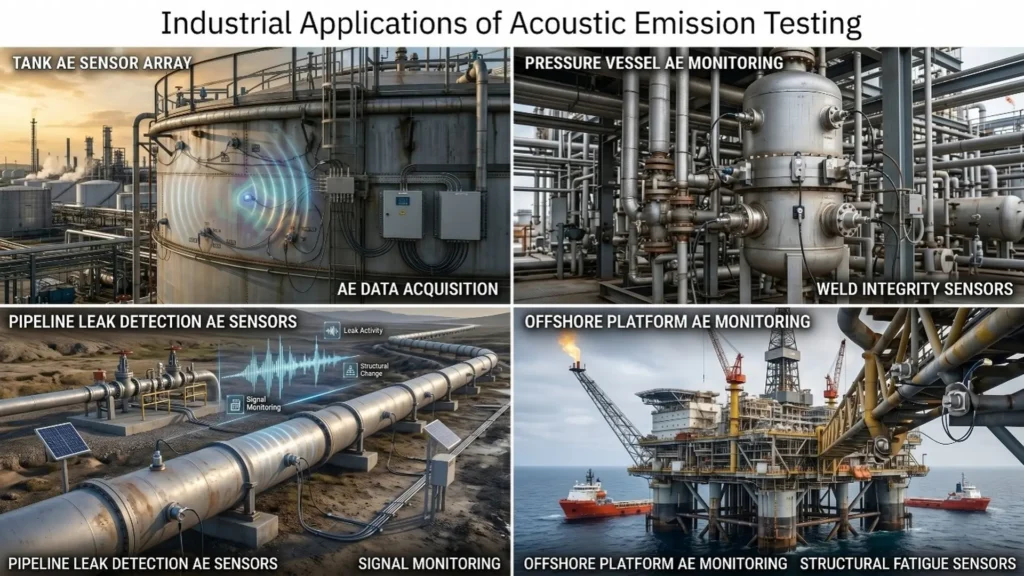
Table 2. Summary of the main industrial applications of Acoustic Emission
| Industry Sector | Primary Application |
| Oil & Gas | Storage tanks, pressure vessels, pipelines, and storage spheres |
| Offshore | Fatigue monitoring and offshore structural integrity assessment |
| Petrochemical | Pressure equipment and process systems |
| Power Generation and Electrical Utilities | Partial discharge monitoring in power transformers |
| Civil Infrastructure | Bridges, tunnels, and structural health monitoring (SHM) |
| Fluid Transportation | Leak detection and active corrosion monitoring |
| Asset Integrity Management | Continuous monitoring and risk-based assessment |
Acoustic Emission in asset integrity management
Modern asset integrity management has evolved from reactive approaches toward predictive, risk-based strategies, where the ability to identify active degradation mechanisms has become a key factor in decision-making. In this context, Acoustic Emission (AE) occupies a strategic position by providing real-time information about the structural behavior of critical equipment while it remains in operation.
Within Mechanical Integrity programs, AE enables the detection of active phenomena such as crack growth, localized corrosion, plastic deformation, and leaks before they evolve into critical conditions. This capability complements conventional inspection methods by providing insight into damage activity rather than solely the geometric condition of a defect.
Its integration with Risk Based Inspection (RBI) methodologies established in API 580 and API 581 allows organizations to optimize inspection prioritization and focus resources on assets exhibiting evidence of active degradation. As a result, companies can reduce inspection costs, improve risk management, and enhance operational reliability.
The information generated by AE can also complement Fitness-For-Service (FFS) assessments while supporting Predictive Maintenance initiatives focused on reducing the probability of unexpected failures, conducted in accordance with API 579-1/ASME FFS-1, providing additional evidence regarding the stability of detected discontinuities and their behavior under actual operating conditions. This capability is particularly valuable when making decisions related to equipment life extension, repair, or replacement.
Beyond conventional inspection, acoustic emission contributes directly to operational continuity by enabling the monitoring of critical assets without significant process interruptions. Its ability to identify failure mechanisms at an early stage helps minimize operational risks, optimize asset availability, and strengthen industrial safety within comprehensive Asset Integrity Management programs.
International standards and codes
The effective application of Acoustic Emission (AE) requires compliance with international standards and codes that establish criteria for the acquisition, interpretation, and validation of data obtained during an evaluation. These references ensure the reliability of results and promote the standardization of procedures across different industrial sectors.
Among ASTM standards, ASTM E1316 provides the standard terminology used in Non-Destructive Testing (NDT), including definitions related to Acoustic Emission. ASTM E650 establishes guidelines for the installation and performance verification of acoustic emission sensors, while ASTM E1118 addresses the evaluation of fiber-reinforced vessels using AE techniques.
ASTM E1419 provides criteria for the evaluation of structures and components subjected to controlled loading through acoustic emission monitoring. In addition, ASTM E2374 offers guidance for the application of the technique to metallic structures and structural monitoring programs.
International ISO standards also play a fundamental role. ISO 12713 establishes procedures for the calibration and validation of Acoustic Emission systems, while ISO 12714 and ISO 12715 address aspects related to sensors, equipment performance, and measurement verification. Likewise, ISO 18081 provides specific guidelines for leak detection and leak location applications using Acoustic Emission technology.
However, compliance with standards alone does not guarantee reliable results. The quality of an assessment also depends on technically validated procedures, clearly defined acceptance criteria, and properly trained personnel capable of accurately interpreting recorded signals. As technology continues to evolve toward more sophisticated applications within continuous monitoring and mechanical integrity programs, the technical competence of specialists remains a determining factor in the success of any Acoustic Emission-based project
Table 3. Major standards applicable to Acoustic Emission testing
| Standard | Primary Scope |
| ASTM E1316 | Standard terminology for Non-Destructive Testing (NDT) |
| ASTM E650 | Installation and performance verification of acoustic emission sensors |
| ASTM E1118 | Evaluation of fiber-reinforced vessels and structures |
| ASTM E1419 | Acoustic emission monitoring during controlled loading |
| ASTM E2374 | Applications for metallic structures and structural monitoring |
| ISO 12713 | Calibration and validation of acoustic emission systems |
| ISO 12714 | Requirements for acoustic emission sensors |
| ISO 12715 | Verification of equipment performance |
| ISO 18081 | Leak detection and leak location using acoustic emission |
Success stories and real-worldindustrial applications
Over the past several decades, Acoustic Emission (AE) has evolved from a specialized research tool into a widely adopted technology for the integrity assessment of critical assets across industries such as Oil & Gas, petrochemicals, power generation, transportation, and industrial storage. Its ability to detect active degradation mechanisms while equipment remains in service has enabled organizations to optimize inspection strategies and significantly reduce costs associated with unplanned shutdowns.
One of the most recognized international references in the application of this technology is MISTRAS Group, a company specializing in Asset Protection and advanced monitoring solutions. Through numerous industrial projects, the company has implemented Acoustic Emission assessment programs on storage tanks, pressure vessels, piping systems, and critical structures, using the technique to identify damage activity, monitor structural integrity, and prioritize follow-up inspections using complementary inspection methods.
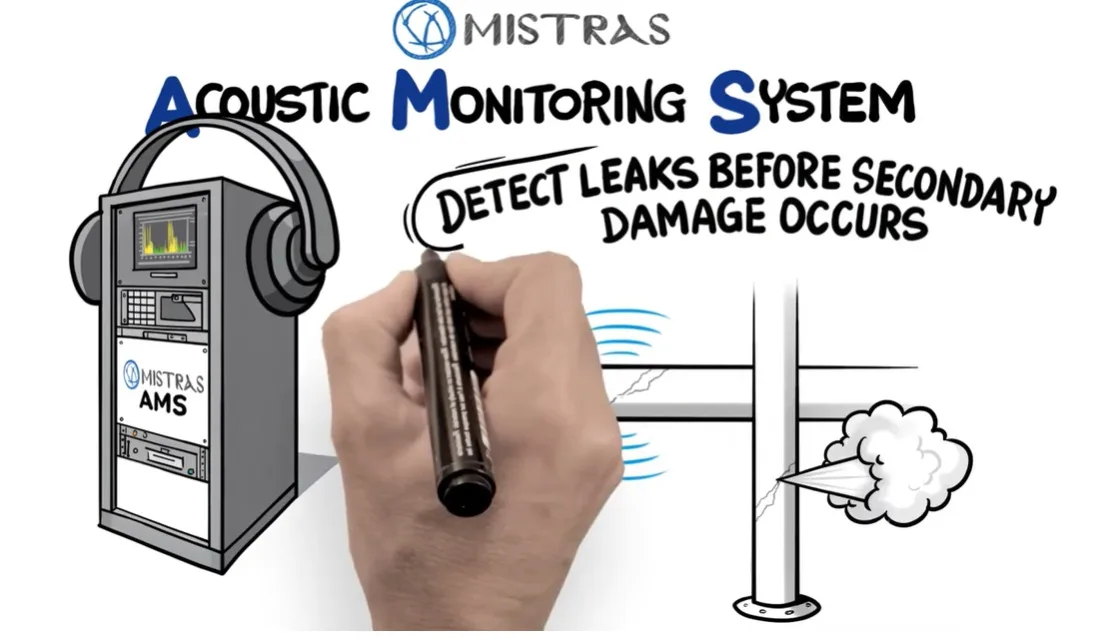
The following video, courtesy of Mistras Group, shows how Acoustic Emission technology can be used to detect active leaks in critical equipment while it remains in operation. The Acoustic Monitoring System (AMS) developed by MISTRAS uses 24/7 acoustic monitoring to identify changes in the normal behavior of boiler tubes, making it possible to anticipate failures, reduce secondary damage, and optimize maintenance planning and scheduled outages.
In hydrocarbon storage facilities, for example, AE has been used to identify areas with potential active corrosion or structural degradation, allowing internal inspections to focus only on the most critical locations. In pressure vessels and storage spheres, the technology has proven particularly valuable during pressure testing, where defect growth can be detected before reaching critical conditions.
Likewise, operators of energy infrastructure have incorporated acoustic emission into continuous monitoring programs to evaluate pipelines, offshore platforms, and structures subjected to cyclic loading or highly corrosive environments. These approaches improve decision-making, reduce unnecessary interventions, and optimize resource allocation within risk-based mechanical integrity programs.
Rather than replacing other inspection technologies, successful applications demonstrate that the primary strength of AE lies in its ability to identify where damage activity exists and where more detailed evaluation efforts should be concentrated.
Acoustic Emission and industry 4.0
Digital transformation is redefining the way organizations manage asset integrity and strengthen data-driven asset management strategies based on real-time operational information. What traditionally required periodic inspection campaigns is now evolving toward continuous monitoring systems capable of generating real-time insights to support operational and maintenance decision-making.
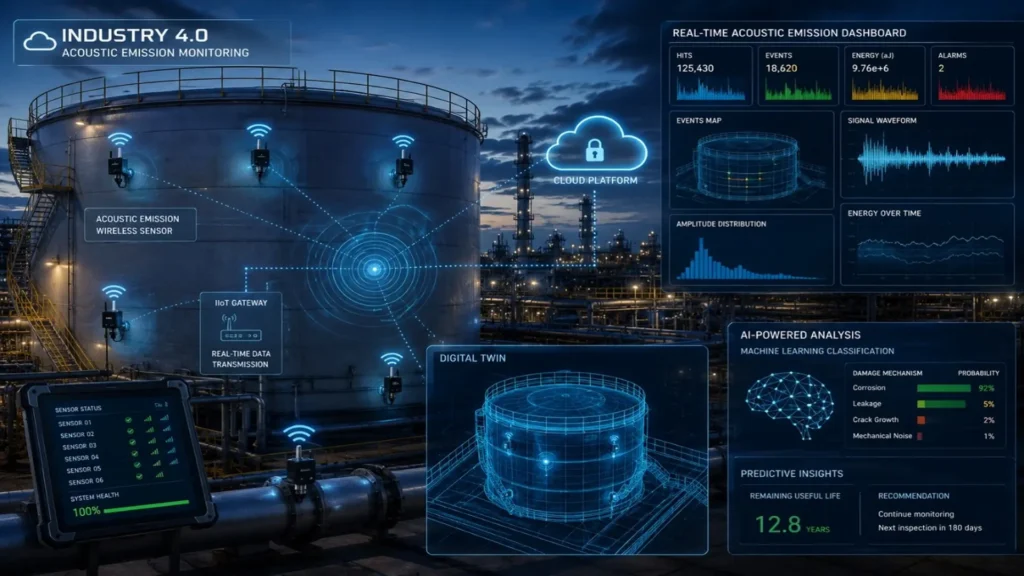
The integration of smart sensors, Industrial Internet of Things (IIoT) networks, and wireless communication technologies enables the deployment of permanent acoustic monitoring systems on pipelines, storage tanks, pressure vessels, and critical structures. These sensors can continuously transmit information to remote monitoring platforms, eliminating many of the limitations associated with conventional inspection approaches.
The use of edge computing architecture allows large volumes of data to be processed directly at the point of acquisition, reducing response times and improving the early detection of relevant events. The information can then be transmitted to cloud analytics platforms where trends, condition indicators, and historical performance analyses are consolidated.
The incorporation of digital twin models is further expanding the capabilities of Acoustic Emission technology and modern Structural Health Monitoring platforms. By combining real monitoring data with digital representations of assets, operators can evaluate operational scenarios, predict future behavior, and optimize condition-based maintenance strategies.
At the same time, advances in machine learning are enabling the automatic classification of complex acoustic signals, distinguishing events associated with corrosion, crack growth, impacts, and leaks. When integrated with integrity dashboards, Computerized Maintenance Management Systems (CMMS), and Asset Integrity Management platforms, these capabilities transform Acoustic Emission into a strategic technology for the advancement of predictive maintenance and intelligent industrial asset management
Limitations and challenges of the technology
Despite its numerous advantages, Acoustic Emission (AE) is not without technical and operational limitations that must be considered to ensure reliable results. As with any Non-Destructive Testing (NDT) method, the effectiveness of the technique depends on proper planning, correct sensor installation, and expert interpretation of the acquired data.
One of the primary challenges is the presence of operational noise generated by mechanical vibrations, fluid turbulence, electrical interference, or routine industrial process activities. These signals can complicate the identification of relevant events if appropriate filtering and analysis strategies are not implemented.
In addition, the technique requires the presence of an active emission source associated with a degradation mechanism or that the asset be subjected to some form of stimulus or loading capable of generating detectable energy release. For this reason, the absence of acoustic signals does not necessarily indicate the absence of defects.
Another important consideration is the attenuation of acoustic waves, which can vary depending on the material, geometry, thickness, and operating conditions of the asset. This may affect system sensitivity and require application-specific configurations to achieve optimal performance.
Furthermore, AE does not directly provide detailed information regarding the geometry, size, or morphology of a defect. Its primary strength lies in identifying damage activity, which means it is typically complemented by techniques such as Ultrasonic Testing (UT), Phased Array Ultrasonic Testing (PAUT), or Radiographic Testing (RT) to characterize the detected discontinuity. Consequently, the success of an evaluation depends not only on the technology itself but also on the expertise of the personnel responsible for its implementation and interpretation
The future of Acoustic Emission in critical assets
The growing complexity of energy infrastructure is driving new applications for Acoustic Emission (AE) in sectors where the early detection of degradation mechanisms is essential to ensuring safety, reliability, and operational continuity. In this environment, the technology is emerging as a key tool for addressing the challenges associated with the energy transition and the management of next-generation critical assets.
The development of hydrogen-related projects and Carbon Capture, Utilization, and Storage (CCUS) initiatives represents one of the most promising growth areas for AE technology. These systems operate under demanding pressure, temperature, and material compatibility conditions that require advanced monitoring capabilities to detect phenomena such as embrittlement, leakage, and accelerated degradation.
The expansion of offshore wind farms and the increasing operation of subsea infrastructure are also creating new opportunities for structural monitoring through Acoustic Emission. The ability to monitor components exposed to cyclic loading, fatigue, and highly corrosive environments makes AE particularly attractive for marine and offshore applications.
Similarly, thousands of miles of aging pipelines continue to operate worldwide, increasing the need for solutions capable of detecting active damage before significant failures occur. As a result, the industry is moving toward permanent monitoring systems capable of delivering continuous information on asset condition and performance.
The integration of artificial intelligence and machine learning algorithms will further enhance the automatic classification of acoustic signals and acoustic wave patterns associated with different damage mechanisms. More than simply inspection technology, Acoustic Emission is evolving into an essential component of intelligent asset management ecosystems and next-generation Structural Health Monitoring programs, supporting predictive integrity strategies, continuous monitoring, and the digital transformation of critical infrastructure.
Conclusions
Acoustic Emission (AE) has undergone a remarkable evolution from its earliest experimental applications to becoming a strategic technology for the integrity assessment of industrial assets. Its primary differentiator lies in its ability to detect damage activity in real time, providing valuable insight into degradation processes that are actively occurring while equipment remains in operation.
This capability makes AE an invaluable tool for industries where operational reliability, safety, and service continuity are critical requirements. From storage tanks and pressure vessels to pipelines, offshore platforms, and complex energy systems, AE enhances decision-making by enabling the early identification of potential risks before they develop into critical failures.
The incorporation of international standards, asset integrity management methodologies, digital platforms, and continuous monitoring systems has significantly expanded the scope and capabilities of this technology. Its integration with Mechanical Integrity programs, Risk Based Inspection (RBI) strategies, and predictive maintenance initiatives demonstrate that its role extends far beyond conventional inspection. As asset integrity programs continue to evolve toward predictive and condition-based models, Acoustic Emission is increasingly positioned as a key technology for informed, data-driven decision-making.
Although it does not replace other Non-Destructive Testing (NDT) methods, Acoustic Emission testing is transforming the way organizations monitor active risk within their infrastructure. Its ability to combine continuous monitoring, advanced analytics, and early degradation detection positions it as one of the most promising technologies for the future of mechanical integrity and intelligent industrial asset management.
Reerences
- ASTM International. (2026). ASTM E1316-26a: Standard terminology for nondestructive examinations. ASTM International.
- ASTM International. (s.f.). ASTM E650: Standard guide for mounting piezoelectric acoustic emission sensors. ASTM International.
- American Society for Nondestructive Testing (ASNT). (2023). Learn the basics of acoustic emission analysis for field testing. ASNT.
- International Organization for Standardization (ISO). (2024). ISO 18081: Non-destructive testing, Acoustic emission testing (AT), Leak detection by means of acoustic emission. ISO.
- National Board of Boiler and Pressure Vessel Inspectors. (s.f.). Acoustic emission examination of metal pressure vessels. National Board.
- API. (2016). API Recommended Practice 580: Risk-Based Inspection. American Petroleum Institute.
Frequently Asked Questions (FAQs)
What is the difference between Acoustic Emission and conventional Ultrasonic Testing?
The main difference lies in the origin of the signal. In conventional Ultrasonic Testing (UT), the inspector introduces energy into the material to detect discontinuities. In Acoustic Emission (AE), the signals are generated by the material itself when an active degradation mechanism occurs, such as crack growth, corrosion, or leakage. This enables the detection of active damage in real time while the asset remains in operation.
Can Acoustic Emission replace other Non-Destructive Testing methods?
No. Acoustic Emission is a complementary technique within a comprehensive inspection strategy. Its primary strength is the identification of damage activity and the location of critical areas, while methods such as UT, PAUT, and RT are required to characterize, size, and assess the criticality of detected defects.
What types of defects can be detected using Acoustic Emission?
The technique can detect phenomena associated with crack growth, active corrosion, fatigue, plastic deformation, delamination in composite materials, leaks, and other mechanisms that generate a sudden release of energy within a structure.
Is permanent monitoring with Acoustic Emission possible?
Yes. Permanent monitoring systems are currently available using acoustic sensors connected to IIoT platforms, enabling Predictive Maintenance strategies based on real-time condition monitoring, cloud-based analytics, and artificial intelligence technologies. These systems can continuously monitor critical assets and detect changes in their operating condition in real time.
What benefits do Acoustic Emission provide for Mechanical Integrity programs?
Acoustic Emission enables the detection of active degradation, supports inspection prioritization, optimizes maintenance resources, enhances Risk Based Inspection (RBI) strategies, and allows in-service asset monitoring. These capabilities contribute to improved operational reliability and reduced risks associated with unexpected failures.