Table of Contents
- What Is a post earthquake inspection and why is it critical?
- Structural damage that requires a post-earthquake inspection
- Methodology for a post-earthquake structural evaluation
- Non Destructive Testing for post earthquak estructural evaluation
- Engineering best practice
- Technology trend
- Engineer's recommendation
- Evaluation of critical infrastructure following an earthquake
- Post earthquake inspection of oil and gas industrial facilities
- International standards for post earthquake inspections
- Technologies transforming post earthquake inspection
- Post earthquake inspection checklist
- Case study: Applying a post-earthquake inspection following a recent seismic event
- Future challenges for seismic infrastructure resilience
- Conclusions
- References
- Frequently Asked Questions (FAQs)
- How soon should a post-earthquake inspection be performed after a seismic event?
- Which Non-Destructive Testing (NDT) Method Is Most Effective for Post-Earthquake Structural Assessments?
- Can Industrial Facilities Continue Operating After an Earthquake?
- How Do Digital Twins and Artificial Intelligence Improve Post-Earthquake Inspections?
- What International Standards Should Engineers Follow During Post-Earthquake Inspections?
- Who Is Qualified to Perform a Post-Earthquake Structural Inspection?
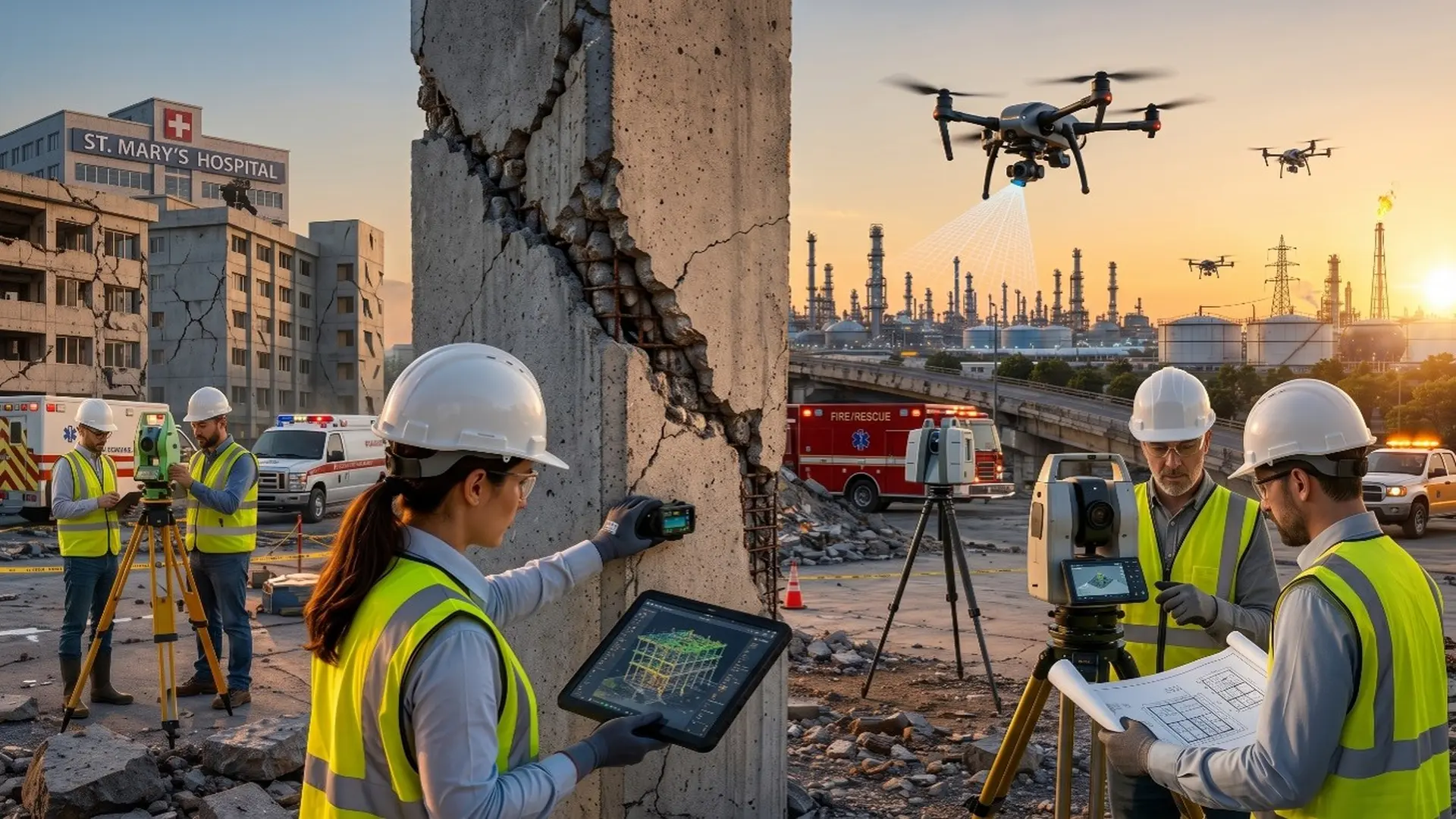
An earthquake does not end when the ground stops shaking. In fact, the period immediately following a seismic event often represents one of the most critical phases for protecting human life and restoring operational continuity. Although visible damage can reveal certain failures immediately, many structural defects remain hidden and can only be identified through a post earthquake inspection performed under rigorous engineering criteria.
Determining whether a structure can remain in service, requires operational restrictions, or demands immediate intervention is a responsibility that requires expertise in structural engineering, a thorough understanding of seismic behavior in construction materials, and evaluation methodologies supported by internationally recognized standards.
In this context, structural evaluation becomes the primary tool for determining the actual condition of buildings, bridges, hospitals, industrial facilities, refineries, port terminals, and other forms of critical infrastructure, where an incorrect engineering decision may result in loss of life, environmental impacts, operational disruptions, and substantial economic consequences. To achieve reliable assessments, visual inspection must be complemented by Non Destructive Testing (NDT), structural monitoring technologies, and specialized engineering analyses capable of identifying internal damage without compromising the integrity of the asset.
This article examines the engineering principles of post earthquake inspection, the primary damage mechanisms associated with seismic events, the structural evaluation methodologies used in modern engineering practice, the role of non destructive testing in identifying hidden damage, the international standards that support these inspection procedures, and the emerging technologies that are transforming the evaluation of critical infrastructure following an earthquake.
What Is a post earthquake inspection and why is it critical?
A post earthquake inspection is a systematic engineering process designed to determine the structural and functional condition of a building or infrastructure asset following a seismic event. Its primary objective is to identify damage that could compromise structural stability, determine whether the asset can safely remain in service, and establish the actions required for repair, rehabilitation, or operational restrictions. Rather than being a simple visual assessment, it represents the first stage of post earthquake evaluation, aimed at reducing risks to the public and restoring the safe operation of strategic assets.
From an engineering perspective, a post earthquake inspection serves several critical objectives simultaneously. It protects human life, prevents secondary collapses, estimates the extent of structural damage, prioritizes engineering interventions, and provides reliable technical information to support informed decision making. These principles are equally essential for residential buildings, hospitals, bridges, airports, industrial facilities, refineries, and other forms of critical infrastructure, where continued operation is fundamental to emergency response and post disaster recovery.
It is important to distinguish between an emergency inspection and a detailed structural evaluation. The emergency inspection is performed immediately after the earthquake and focuses on identifying obvious hazardous conditions using methodologies such as Rapid Visual Screening (RVS), which enables engineers to classify buildings according to the observed level of risk rapidly. A detailed structural evaluation, on the other hand, involves a more comprehensive seismic assessment supported by structural analysis, specialized instrumentation, and non destructive testing (NDT) to determine the actual extent of damage, including defects that may not be visible during a surface inspection.
The results of this evaluation make it possible to classify the level of structural damage, determine whether buildings remain safe for occupancy, and establish whether the infrastructure can continue operating, requires temporary restrictions, or must remain out of service until additional investigations have been completed. In situations where thousands of structures may be affected simultaneously, post earthquake inspection also becomes an essential engineering tool for prioritizing technical and financial resources, ensuring that evaluation efforts are focused on the facilities whose failure would have the greatest impact on public safety, operational continuity, and the long term resilience of communities.
Structural damage that requires a post-earthquake inspection
Structural damage following an earthquake may be immediately visible or remain concealed within load bearing elements. For this reason, a post earthquake inspection should not be limited to identifying surface cracks. Instead, it must evaluate the overall structural behavior and determine whether the structure has experienced a loss of load carrying capacity. In buildings, bridges, and industrial facilities, damage mechanisms depend on the structural system, construction quality, seismic intensity, soil conditions, and the pre existing condition of the asset.
Among the most common forms of damage are flexural cracks, which typically develop in beams, slabs, or columns subjected to tensile stresses generated by bending moments. Although some of these cracks may be repairable, their location, width, orientation, and progression provide valuable information about whether the structural member has retained its load carrying capacity. More critical are shear cracks, which are generally diagonal and associated with brittle failure mechanisms and sudden strength loss, particularly in columns, structural walls, and reinforced concrete beams.
Torsional effects also represent a significant concern when a structure exhibits geometric irregularities, asymmetric mass distribution, or unbalanced stiffness. These conditions can generate stress concentrations in localized areas, leading to severe damage in structural connections, perimeter columns, or floor diaphragms. In addition, differential settlement and soil liquefaction are major geotechnical hazards capable of causing structural tilting, extensive cracking, loss of foundation support, and permanent displacement of foundations and structures built on susceptible soils.
Column failures are particularly critical because columns form part of the primary vertical load resisting system. Concrete crushing, reinforcing bar buckling, cover spalling, or loss of confinement may compromise the overall stability of the structure. Damage to beams, structural connections, and joints can also disrupt load transfer mechanisms and reduce the structure’s ability to dissipate seismic energy during aftershocks.
A comprehensive engineering evaluation must distinguish between visible damage, such as cracks, spalling, deformation, or excessive inclination, and hidden damage, including internal bond deterioration, microcracking, accelerated corrosion, weakened welds, or degradation of structural connections. The greatest risks arise when these hidden defects remain undetected while the structure continues in service. Under such conditions, permanent deformations, progressive stiffness degradation, loss of structural capacity, and even progressive collapse may occur during aftershocks, normal service loads, or future dynamic events.
Methodology for a post-earthquake structural evaluation
A post earthquake structural evaluation should follow a systematic sequence that progressively advances from an initial safety assessment to a reliable engineering diagnosis. The post earthquake evaluation methodology begins by securing the affected area. Before entering any structure, the engineering team must identify immediate hazards such as falling debris, gas leaks, electrical failures, unstable façades, visible structural deformation, or suspended elements. The purpose of this initial phase is to protect inspection personnel and prevent a premature assessment from increasing the overall level of risk.
The second stage consists of the initial visual inspection. During this phase, engineers document cracks, deformation, displacement, damage to columns, beams, walls, structural connections, supports, foundations, and non structural components. Findings should be recorded using photographs, field sketches, precise damage locations, crack orientation, crack width measurements, and comparisons with existing engineering drawings whenever available. This inspection provides the information required to establish an initial classification of structural damage.
The structure is then classified according to its operational condition. In general terms, it may be considered safe for occupancy, subject to restricted use, suitable for occupancy only after repairs, or unsafe until additional engineering investigations have been completed. This decision should never rely solely on the visual appearance of the damage, but rather on its location within the structural load resisting system and the potential consequences of failure. Minor damage affecting a secondary component does not carry the same level of risk as a diagonal crack in a primary structural column or a permanent deformation in a bridge support.
When a visual inspection alone is insufficient, specialized instrumentation and structural monitoring technologies are incorporated into the evaluation process. Accelerometers, crack gauges, inclinometers, total stations, displacement sensors, and Structural Health Monitoring (SHM) systems make it possible to detect residual movement, stiffness degradation, and crack propagation. At the same time, non destructive testing (NDT) provides critical information about hidden damage without compromising the integrity of the structure.
The next stage involves structural modeling and engineering analysis. Using numerical models, seismic analysis, structural capacity assessments, and comparisons with applicable design standards, engineers can estimate the residual safety of the structure. Based on these results, decisions are made regarding repair, strengthening, rehabilitation, partial demolition, or a controlled return to service.
Finally, a post earthquake structural inspection does not end with the initial report. Critical infrastructure should remain under continuous monitoring, particularly when aftershocks occur, residual deformation is detected, or repaired damage requires long term verification. Engineering decisions must prioritize human safety, operational continuity, the level of uncertainty, the criticality of the asset, and the potential for progressive deterioration. A properly executed structural evaluation not only identifies damage, but also provides the technical basis for making engineering decisions that are proportional to the actual level of risk.
Non Destructive Testing for post earthquak estructural evaluation
Following an earthquake, a visual inspection represents only the first level of structural assessment. Although it can identify cracks, spalling, deformation, and other obvious signs of damage, many structural defects remain hidden within concrete, steel, or structural connections. For this reason, non destructive testing (NDT) is an essential component of any post earthquake structural evaluation, as it provides valuable information about the internal condition of materials without compromising the integrity of the asset.
Selecting the most appropriate inspection technique depends on the type of structure, the construction material, the expected damage mechanisms, and the objectives of the evaluation. In practice, no single method can provide a complete diagnosis. Instead, combining multiple technologies enables engineers to develop a more reliable assessment while reducing uncertainty during the decision making process.
Visual Testing (VT) is the starting point for every post earthquake inspection. Its fundamental principle is the systematic examination of structural components to identify cracks, deformation, spalling, visible corrosion, displacement, or failures in structural connections. Its primary advantages are speed, simplicity, and low cost. However, its effectiveness is limited to surface damage and depends significantly on the experience and expertise of the inspector.
When the internal condition of concrete or metallic components must be evaluated, Conventional Ultrasonic Testing (UT) is used to detect internal discontinuities, voids, delaminations, and loss of material continuity through the propagation of ultrasonic waves. In steel structures, UT is particularly valuable for assessing critical welds that may have been affected by seismic loading.
Phased Array Ultrasonic Testing (PAUT) represents an evolution of conventional ultrasonic testing and has become one of the most advanced technologies for the characterization of internal discontinuities. Although its historical application focused on the inspection of welds, pressure vessels, and pipelines within the Oil and Gas, petrochemical, and aerospace industries, the technology has been successfully adapted in recent years for evaluating concrete and reinforced concrete structures subjected to seismic events.
Unlike conventional ultrasonic testing, which uses a single transducer with a fixed beam, PAUT employs a probe composed of multiple electronically controlled piezoelectric elements. By applying programmed time delays to the activation of each element, a process known as phasing, the system can steer, focus, and electronically scan the ultrasonic beam at different depths and angles without physically moving the probe. This capability provides significantly greater coverage while producing high resolution B Scan, C Scan, and even three dimensional reconstructions that facilitate data interpretation and defect characterization.
When applied to concrete structures, PAUT operates at considerably lower frequencies, typically between 50 kHz and 200 kHz, to compensate for the high attenuation and heterogeneous nature of the material. These lower frequencies enable ultrasonic waves to penetrate thick concrete sections and provide reliable information about their internal condition.
During a post earthquake inspection, PAUT can be used to determine the thickness of slabs and walls, locate reinforcing steel, embedded conduits, and pipelines, as well as detect internal cracks, voids, honeycombing, delaminations, porous concrete zones, and loss of structural continuity that cannot be identified through surface examination alone. In metallic structures, PAUT remains one of the most accurate techniques for evaluating welds, structural joints, and components subjected to seismic loading.
Among its primary advantages are the rapid inspection of large areas, the ability to generate highly interpretable imaging, and its completely non intrusive nature. However, successful application requires specialized equipment, highly qualified personnel, and calibration procedures specifically adapted to each type of structure and material. For these reasons, PAUT is commonly integrated with other non destructive testing (NDT) techniques as part of a comprehensive structural evaluation strategy capable of providing a complete engineering assessment following an earthquake.
Below is a video on the use of non destructive testing on concrete and steel to detect internal damage following seismic events.
Engineering best practice
No single non destructive testing (NDT) method, by itself, is capable of fully characterizing earthquake induced damage. For critical infrastructure, international engineering best practices recommend integrating complementary techniques such as PAUT, TOFD, Ground Penetrating Radar (GPR), and LiDAR to achieve a more comprehensive diagnosis, reduce uncertainty during the evaluation process, and support technically sound decisions regarding repair, rehabilitation, or the safe return to service.
The interpretation of images generated by PAUT must take into account the heterogeneous nature of concrete, the presence of coarse aggregates, moisture content, and the geometry of the inspected element, as these factors directly influence the propagation and attenuation of ultrasonic waves.
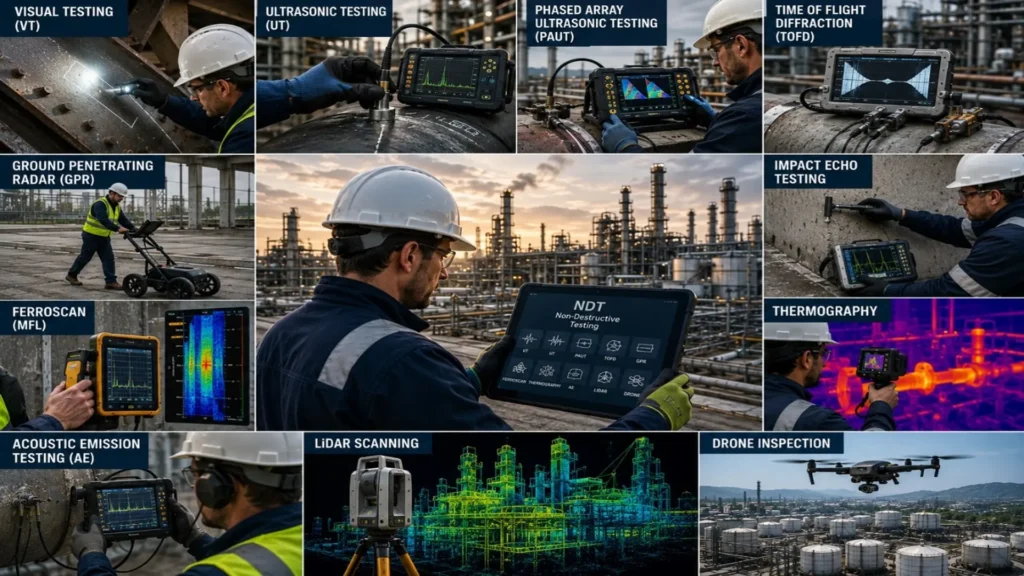
Time of Flight Diffraction (TOFD) is another complementary technique that provides exceptional accuracy for measuring the depth and height of cracks by analyzing the diffraction time of ultrasonic waves. Its primary strength lies in the precise sizing and characterization of critical discontinuities. However, TOFD is typically used in combination with Phased Array Ultrasonic Testing (PAUT) to achieve a more comprehensive assessment of structural defects.
For reinforced concrete structures, Ground Penetrating Radar (GPR) employs high frequency electromagnetic waves to locate reinforcing steel, embedded conduits, internal voids, deteriorated areas, and variations within the concrete. Its non intrusive nature enables the rapid inspection of large surfaces. However, its depth of penetration decreases in materials with high moisture content or elevated electrical conductivity.
Another widely used technique is Impact Echo, which is based on the generation and analysis of stress waves produced by a mechanical impact to detect delaminations, internal voids, debonding, and variations in the thickness of concrete elements. It is particularly effective for evaluating slabs, bridge decks, structural walls, and foundations affected by seismic events.
The Rebound Hammer, also known as the Schmidt Hammer, provides an indirect estimate of the surface hardness and uniformity of concrete by measuring the rebound of a spring driven impact mass. Although it cannot independently determine the structural strength of concrete, it is a valuable tool for comparing areas with different levels of deterioration and identifying locations that require more detailed investigation.
Ferroscan uses electromagnetic fields to locate reinforcing steel, determine concrete cover thickness, and estimate the diameter of reinforcing bars. This information is essential when verifying whether seismic displacement has affected the reinforcement layout or when planning repair activities without disturbing existing structural elements.
Acoustic Emission Testing (AE) is one of the most advanced techniques available for monitoring structures under load. Its operating principle is based on detecting the elastic waves generated by active degradation processes such as crack propagation, fracture, or plastic deformation. Unlike many other inspection methods, Acoustic Emission Testing not only identifies the presence of a defect but also determines whether the damage continues to evolve during the structural evaluation
Technical Note: The absence of indications detected by Acoustic Emission Testing (AE) does not necessarily guarantee that a structure is free of defects. This technology detects active energy release mechanisms associated with damage progression. Therefore, its results should always be interpreted in conjunction with the asset’s operating condition, service history, and other complementary inspection techniques.
Infrared Thermography detects variations in surface temperature that may reveal delaminations, debonding, moisture intrusion, loss of adhesion, or hidden defects. Its primary advantage is the ability to inspect large areas rapidly without physical contact. However, the reliability of the results may be influenced by environmental conditions and solar exposure.
Geometric data acquisition technologies have become increasingly important in post earthquake structural evaluation. LiDAR systems generate millions of three dimensional measurement points using laser pulses, enabling highly accurate quantification of displacement, deformation, and structural inclination. Complementing this capability, 3D laser scanning produces high resolution digital models that facilitate comparisons between the original geometry of a structure and its post earthquake condition, supporting structural analysis, Building Information Modeling (BIM) workflows, and rehabilitation planning.
Industrial Radiographic Testing (RT) uses X-rays or gamma radiation to produce images of the internal condition of materials by exploiting differences in radiation absorption. Although its application to large post-earthquake concrete structures is limited due to the material’s thickness and high attenuation, it remains a valuable technique for evaluating precast concrete elements, structural connections, thin concrete sections, and components containing embedded metallic elements. It can also detect internal voids, honeycombing, consolidation defects, and verify the location of ducts or reinforcing steel in specific applications. Because of radiation safety requirements and operational constraints, Radiographic Testing is typically used as a complementary inspection method alongside Ground Penetrating Radar (GPR), Ultrasonic Testing (UT), and Impact Echo.
Technology trend
Three dimensional models generated through LiDAR and 3D laser scanning are increasingly being integrated with Building Information Modeling (BIM) platforms, Digital Twins, and Artificial Intelligence (AI) to automatically compare the geometry of a structure before and after a seismic event. This integration significantly reduces evaluation time while improving inspection traceability and the reliability of engineering assessments.
Finally, Unmanned Aerial Vehicles (UAVs), commonly known as drones, have transformed post earthquake inspections by providing safe access to roofs, façades, bridges, towers, stacks, and other difficult to reach locations. Equipped with high resolution cameras, thermal sensors, or LiDAR systems, drones capture detailed inspection data without exposing personnel to hazardous conditions, reducing inspection time while improving the coverage of large or complex structures.
Rather than functioning as independent technologies, non destructive testing (NDT) methods form a complementary ecosystem of inspection tools. When integrated into a comprehensive structural evaluation methodology, they provide critical information for determining the residual condition of a structure, prioritizing repair activities, validating structural behavior models, and supporting technically sound decisions regarding the continued operation of infrastructure following a seismic event.
Because every non destructive testing method has specific capabilities and limitations, selecting the most appropriate technique depends on the type of structure, the construction material, the expected damage mechanism, and the objectives of the engineering evaluation. The following table summarizes the primary applications of the NDT methods used during a post earthquake inspection, providing a practical reference for selecting the most appropriate inspection technique for each scenario.
Engineer’s recommendation
The selection of a non destructive testing (NDT) method should never be based solely on equipment availability. Before defining a post earthquake inspection methodology, it is essential to consider the type of structure, the construction material, the expected damage mechanism, accessibility, the criticality of the asset, and the objectives of the engineering evaluation. An appropriate combination of inspection techniques generally provides significantly more reliable results than relying on a single method alone.
Comparative Table of Non Destructive Testing methods for post earthquake structural evaluation
| NDT Method | Primary Application | Detectable Damage | Application in Post Earthquake Inspection | Limitations |
| Visual Testing (VT) | Initial structural assessment | Surface cracks, spalling, deformation, and structural inclination | Rapid damage classification and inspection prioritization | Cannot detect internal damage and depends heavily on inspector experience |
| Conventional Ultrasonic Testing (UT) | Concrete and steel structures | Internal cracks, voids, delaminations, and material discontinuities | Localized evaluation of structural members and welds | Limited inspection coverage and requires proper acoustic coupling |
| Phased Array Ultrasonic Testing (PAUT) | Reinforced concrete, welds, and steel structures | Cracks, voids, delaminations, honeycombing, and weld defects | Advanced characterization of internal damage using B Scan and C Scan imaging | Requires specialized equipment, higher cost, and highly qualified personnel |
| Time of Flight Diffraction (TOFD) | Welds and metallic components | High accuracy crack detection and depth sizing | Quantitative assessment of critical discontinuities in steel structures | Typically used in combination with PAUT |
| Ground Penetrating Radar (GPR) | Reinforced concrete | Reinforcing steel, embedded conduits, voids, delaminations, and internal variations | Rapid inspection of large areas without destructive intervention | Reduced penetration in wet or highly conductive materials |
| Impact Echo | Concrete structural elements | Delaminations, internal voids, debonding, and thickness variations | Evaluation of slabs, bridge decks, walls, and foundations | Requires specialized interpretation and is sensitive to element geometry |
| Rebound Hammer (Schmidt Hammer) | Concrete | Variations in surface hardness and material uniformity | Preliminary evaluation of concrete condition | Does not directly determine structural strength |
| Ferroscan | Reinforced concrete | Reinforcing steel location, concrete cover, and rebar diameter | Verification of reinforcement before repair or strengthening activities | Limited detection depth |
| Acoustic Emission Testing (AE) | Structural health monitoring | Active crack propagation, plastic deformation, and other evolving damage mechanisms | Real time monitoring of structures under load or during seismic aftershocks | Requires active damage mechanisms to generate detectable signals |
| Infrared Thermography | Buildings and infrastructure | Moisture intrusion, delaminations, loss of adhesion, and thermal anomalies | Rapid non contact inspection of large surfaces | Results are influenced by environmental conditions and surface temperature |
| LiDAR | Civil infrastructure | Structural displacement, deformation, and geometric inclination | High precision three dimensional surveying for post earthquake analysis | High equipment cost and intensive data processing requirements |
| 3D Laser Scanning | Structural modeling | Deformation, displacement, and geometric changes | Comparison of structural geometry before and after the seismic event | Requires specialized software and trained personnel |
| Unmanned Aerial Vehicles (UAVs) / Drones | Difficult to access infrastructure | Visible damage to roofs, façades, bridges, towers, and stacks | Rapid and safe inspections in high risk areas | Cannot detect internal damage without complementary sensors |
Evaluation of critical infrastructure following an earthquake
Following an earthquake, not all structures require the same level of priority during the evaluation process. The allocation of technical, human, and financial resources must be based on criteria such as criticality, risk, and the potential consequences of structural failure. In this context, critical infrastructure includes assets whose loss of functionality could directly affect public safety, the continuity of essential services, energy supply, or the economic stability of a region. Consequently, an effective structural evaluation must prioritize facilities whose operation is essential during the emergency response and recovery phases.
Hospitals are among the first facilities that should undergo inspection because their continued operation is vital for treating injured individuals and supporting emergency medical services. The evaluation should extend beyond the primary structure to include electrical systems, medical gas networks, critical equipment, emergency power generators, and non structural components whose failure could compromise healthcare delivery.
Bridges and tunnels represent another high priority category because of their essential role in evacuation routes, emergency response logistics, and the transportation of supplies. In these structures, the structural evaluation should include bearings, expansion joints, piers, abutments, foundations, and any permanent displacement or deformation that could reduce load carrying capacity or compromise public safety.
Airports, seaports, and logistics terminals also require early inspection because they serve as strategic hubs for receiving humanitarian assistance, specialized equipment, and materials needed during disaster recovery. The operational continuity of these facilities directly influences how quickly a region can restore economic activity and respond effectively to the emergency.
From an industrial perspective, refineries, petrochemical plants, Liquefied Natural Gas (LNG) terminals, API storage tanks, oil pipelines, natural gas pipelines, and power generation facilities demand immediate attention because of the significant risks associated with hazardous material releases, fires, explosions, and prolonged disruptions to the energy supply. For these assets, the evaluation must address not only structural integrity but also the condition of pressure vessels, piping systems, structural supports, fire protection systems, instrumentation, and rotating equipment.
Dams and other hydraulic structures also require specialized inspections because structural failure could have catastrophic consequences. Evaluating deformation, seepage, displacement, expansion joints, and geotechnical conditions is essential for ensuring the continued stability and safe operation of these critical assets.
Prioritizing critical infrastructure should not be based solely on the extent of visible damage but also on the societal and economic consequences associated with the loss of functionality. A risk based structural evaluation enables engineering teams to focus resources where they provide the greatest benefit, optimize the use of available assets, and accelerate the restoration of essential services. Ultimately, the speed and technical rigor with which these facilities are inspected determine a community’s ability to restore operational continuity and strengthen it
Matriz de priorización de infraestructura crítica tras un terremoto
| Infrastructure | Risk to Human Life | Operational Impact | Priority |
| Hospitals | Very High | Very High | Immediate |
| Power Generation Facilities | Very High | Very High | Immediate |
| Refineries | Very High | Very High | Immediate |
| LNG Terminals | Very High | Very High | Immediate |
| Major Bridges | Very High | High | Immediate |
| Seaports | High | Very High | High |
| Airports | High | Very High | High |
| Natural Gas Pipelines | High | Very High | High |
| Oil Pipelines | High | High | High |
| API Storage Tanks | High | High | High |
Post earthquake inspection of oil and gas industrial facilities
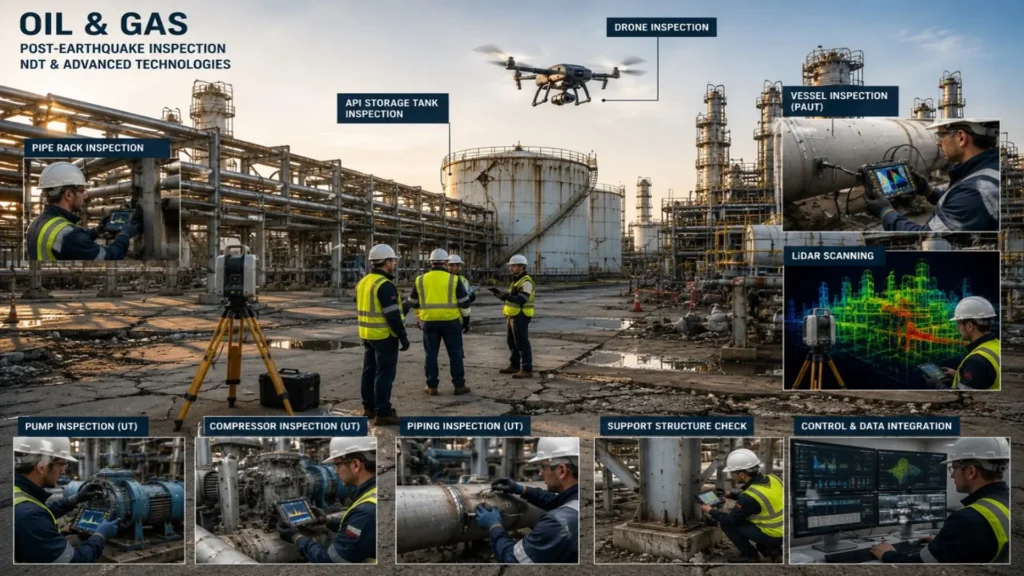
Oil and Gas facilities present significantly different challenges from those encountered in conventional infrastructure following an earthquake. While the primary objective in a building is to determine whether it remains safe for occupancy, the priority in a process plant is to ensure the integrity of equipment containing hazardous fluids, prevent loss of containment, and minimize the risk of fires, explosions, or releases of toxic substances. In this context, a post earthquake inspection is an essential component of Mechanical Integrity programs, verifying that critical assets continue to operate within their original design safety limits.
The evaluation should begin with API 650 storage tanks, paying particular attention to bottom plate and shell deformation, differential settlement, weld integrity, nozzles, reinforcing rings, floating roofs, and secondary containment systems. Subsequent inspections performed in accordance with API 653 determine whether the tank can remain in service, requires repairs, or should be temporarily removed from operation.
Pressure vessels also require a comprehensive evaluation because they may be subjected to significant dynamic loading during a seismic event. The inspection should verify the condition of supports, skirts, nozzles, structural connections, anchor bolts, and critical welds, while incorporating non destructive testing (NDT) whenever deformation or localized damage is suspected. When significant discontinuities are identified, the Fitness For Service (FFS) assessment methodologies established in API 579-1/ASME FFS-1 provide the engineering basis for determining whether the equipment can continue operating safely.
Process piping, evaluated in accordance with API 570, should be inspected for displacement, excessive loading on supports, relative movement between interconnected equipment, deformation, flange joint damage, potential leakage, and loss of alignment. Likewise, pipe racks, structural supports, and anchorage systems must be examined to verify that they continue to transfer design loads without compromising the stability of the piping network.
Rotating equipment, such as pumps and compressors, may also experience misalignment, foundation displacement, or additional stresses transmitted through connected piping systems. Although these machines rarely suffer direct structural damage during an earthquake, loss of alignment or deterioration of their support systems can lead to mechanical failures during plant restart.
Spherical storage vessels and Liquefied Natural Gas (LNG) terminals require even more rigorous inspection protocols because of the high levels of stored energy and the potentially severe consequences of a loss of containment. These inspections should include cryogenic vessels, transfer lines, structural supports, insulation systems, piping connections, and pressure relief devices to verify that the seismic event has not compromised the integrity of the overall system.
Finally, fire protection systems must be verified before restarting plant operations. Firewater distribution networks, jockey pumps, main fire pumps, hydrants, monitors, isolation valves, and foam suppression systems represent critical layers of protection whose operational readiness should be confirmed through functional inspections and performance testing.
Rather than simply confirming the absence of visible damage, a post earthquake inspection of industrial facilities seeks to verify that every system within a Mechanical Integrity program continues to operate at an acceptable level of reliability. Integrating the requirements of API 570, API 653, API 579-1/ASME FFS-1, and other applicable standards enables engineers to make technically sound decisions regarding repair, continued operation, or a safe return to service, thereby reducing the risk of secondary failures and strengthening the resilience of industrial assets against future seismic events.
Post earthquake inspection checklist for oil and gas facilities
| Asset | What Should Be Inspected? | Potential Damage | Applicable Standard / Reference | Recommended Action |
| API 650 Storage Tanks | Bottom, shell, welds, nozzles, roof, anchor bolts | Differential settlement, buckling, cracking, leaks | API 650 / API 653 | Perform structural evaluation and NDT before returning to service |
| Pressure Vessels | Supports, skirts, nozzles, welds, structural connections | Deformation, cracking, loss of alignment | API 510 / API 579-1/ASME FFS-1 | Perform NDT and Fitness For Service (FFS) assessment |
| Process Piping | Welds, supports, flanges, valves, expansion joints | Misalignment, leaks, excessive stresses | API 570 | Complete inspection before repressurization |
| Pipe Racks | Columns, beams, structural connections, anchor bolts | Deformation, displacement, loss of stiffness | ASCE / AISC | Verify structural stability |
| Pumps | Baseplate, alignment, couplings, connected piping | Misalignment, vibration, induced stresses | API 610 | Realign before startup |
| Compressors | Foundation, alignment, supports, piping connections | Vibration, displacement | API 617 | Verify alignment and mechanical condition |
| Spherical Storage Vessels | Supports, columns, welds, nozzles | Stress concentration, deformation | API 510 | Perform NDT and Fitness For Service (FFS) assessment |
| LNG Terminals | Cryogenic tanks, transfer lines, supports, loading arms | Loss of containment, deformation | NFPA 59A / API | Conduct a comprehensive inspection before restart |
| Fire Protection Systems | Fire pumps, hydrants, valves, piping | Leaks, pressure loss, damaged supports | NFPA 25 | Perform complete functional testing |
| Electrical Substations | Transformers, circuit breakers, support structures | Misalignment, fractured insulators | IEEE / IEC | Perform electrical inspection before re energization |
International standards for post earthquake inspections
A structural evaluation performed after an earthquake should be based on internationally recognized methodologies capable of providing technically reliable and consistent engineering assessments. Although no single standard covers every stage of a post earthquake inspection, numerous organizations have developed technical documents that guide the evaluation of buildings, critical infrastructure, and industrial facilities from different perspectives, including structural performance, rehabilitation, non destructive testing, and Mechanical Integrity.
Among the most important references are the technical documents developed by the Federal Emergency Management Agency (FEMA) in the United States. FEMA P-2055 establishes principles for evaluating existing buildings and managing seismic risk, serving as a framework for resilience planning and the prioritization of mitigation strategies. Likewise, FEMA 306, FEMA 307, and FEMA 308 specifically address the evaluation, repair, and rehabilitation of earthquake damaged masonry structures, providing engineering criteria to identify failure mechanisms, estimate residual structural capacity, and develop appropriate recovery strategies.
For reinforced concrete, steel, and other structural systems, ASCE 41, Seismic Evaluation and Retrofit of Existing Buildings, is widely recognized as one of the most comprehensive references for assessing the seismic performance of existing structures. It is particularly valuable when a post earthquake inspection must determine whether a building can remain in service, requires structural strengthening, or should remain restricted until rehabilitation has been completed.
For rehabilitation projects, ACI 562, Code Requirements for Assessment, Repair, and Rehabilitation of Existing Concrete Structures, establishes specific engineering requirements for evaluating, repairing, and strengthening existing concrete structures. This standard complements the structural assessment process by defining repair procedures that are compatible with the actual condition of the inspected element.
ASTM International standards also play a fundamental role by establishing procedures for numerous non destructive testing (NDT) methods, including ultrasonic testing, visual testing, acoustic emission testing, infrared thermography, and other inspection techniques commonly employed during post earthquake investigations. Complementing these standards, several ISO standards govern asset management, inspection practices, structural monitoring, and quality assurance, providing an internationally recognized framework for conducting and documenting engineering evaluations.
Within the industrial sector, American Petroleum Institute (API) standards play a critical role in evaluating the critical infrastructure associated with the energy industry following a seismic event. Documents such as API 570 for in service piping inspection, API 653 for aboveground storage tank evaluation, and API 579-1/ASME FFS-1 for Fitness For Service (FFS) assessments provide internationally recognized methodologies for determining whether these assets remain fit for continued operation or require repair, strengthening, operational derating, or temporary removal from service.
More recently, the publication of API Recommended Practice 1187, Pipeline Integrity Management of Landslide Hazards, has expanded this approach by incorporating the management of geological hazards capable of affecting the integrity of oil pipelines, natural gas pipelines, and other fluid transportation systems following an earthquake. This recommended practice establishes engineering guidelines for identifying, evaluating, monitoring, and mitigating risks associated with landslides, ground subsidence, permanent ground deformation, and other geotechnical hazards that may compromise the structural integrity of pipeline systems.
Its inclusion represents a significant step toward a more comprehensive approach to risk management, where ground conditions become just as important as the condition of the asset itself.
These evaluations are typically complemented by the design, construction, and inspection codes developed by ASME, particularly when assessing pressure vessels, piping systems, and equipment operating under critical service conditions. Together, these standards provide the engineering basis for technically sound assessments that support the safe return to service of industrial facilities following a seismic event.
Rather than applying a single standard in isolation, a high reliability post earthquake inspection integrates the guidance provided by these documents according to the type of infrastructure being evaluated. Combining structural assessment criteria, inspection procedures, non destructive testing (NDT) methods, and asset integrity methodologies reduces uncertainty during the decision making process and helps ensure that critical infrastructure can safely return to service under acceptable operating and safety conditions.
Key regulations and standards applicable to post-earthquake inspections
| Standard / Document | Primary Application | Infrastructure Type |
| FEMA P-2055 | Seismic risk management and evaluation of existing buildings | Buildings and urban infrastructure |
| FEMA 306 | Technical evaluation of earthquake damaged masonry structures | Masonry buildings |
| FEMA 307 | Repair and rehabilitation of masonry structures | Existing buildings |
| FEMA 308 | Evaluation of residual structural capacity and rehabilitation criteria | Existing buildings |
| ASCE 41 | Seismic evaluation and retrofit of existing structures | Reinforced concrete, steel, and composite buildings |
| ACI 562 | Assessment, repair, and rehabilitation of existing concrete structures | Reinforced concrete infrastructure |
| ASTM Standards | Procedures for non destructive testing, material characterization, and inspection | Civil and industrial infrastructure |
| ISO Standards | Asset management, structural monitoring, quality management, and inspection | Critical infrastructure and industrial facilities |
| API 570 | Inspection of in service piping following operational or environmental events | Industrial piping systems |
| API 653 | Inspection, repair, alteration, and reconstruction of aboveground storage tanks | API 650 storage tanks |
| API 579-1/ASME FFS-1 | Fitness For Service (FFS) assessment to determine continued serviceability | Pressure vessels, piping systems, and static equipment |
| API RP 1187 | Management of geological hazards, landslides, and permanent ground deformation affecting pipelines | Oil pipelines, natural gas pipelines, and onshore CO₂ pipelines |
| ASME Codes | Design, inspection, and evaluation of pressure vessels and piping systems | Pressure equipment and industrial infrastructure |
Technologies transforming post earthquake inspection
The evolution of structural engineering and the rapid advancement of digital technologies are redefining how post earthquake inspections are performed. What traditionally relied on visual inspections, manual field surveys, and subsequent engineering analyses is evolving into intelligent ecosystems capable of collecting, processing, and interpreting large volumes of data in near real time. These technologies not only improve the accuracy of engineering assessments but also reduce response times and strengthen decision making during the critical stages of disaster recovery.
Artificial Intelligence (AI) and Machine Learning algorithms have become valuable tools for analyzing inspection imagery, identifying damage patterns, and automatically classifying cracks, deformation, and structural anomalies. By leveraging models trained on thousands of historical datasets, these systems can prioritize structures with the highest probability of failure, optimize the allocation of inspection resources, and reduce subjectivity during the initial stages of structural evaluation.
Autonomous Unmanned Aerial Vehicles (UAVs) further enhance these capabilities by inspecting façades, bridges, towers, stacks, dams, and other difficult to access areas without exposing personnel to hazardous conditions. Equipped with high resolution cameras, thermal sensors, and LiDAR systems, drones generate highly accurate three dimensional models capable of identifying displacement, deformation, and surface damage in a fraction of the time required by conventional inspection methods.
Another technology gaining increasing importance is the Digital Twin. These virtual representations of physical infrastructure integrate three dimensional models with data collected from sensors installed throughout the structure, allowing engineers to compare expected structural behavior with the actual condition observed after a seismic event. This capability supports scenario simulation, residual structural capacity assessment, and repair planning with a higher level of confidence.
The implementation of Internet of Things (IoT) networks and smart sensors is also driving the development of permanent Structural Health Monitoring (SHM) systems. Accelerometers, inclinometers, strain gauges, displacement sensors, and other strategically distributed monitoring devices continuously record vibration, displacement, structural inclination, and dynamic response during and after an earthquake, providing real time information about the condition of critical assets.
Another significant technological advancement is the local processing of this information through Edge Computing. By analyzing data directly at the point of acquisition, organizations can minimize latency, generate immediate alerts, and maintain monitoring system functionality even when communication with cloud based platforms is disrupted by emergency conditions.
The convergence of Artificial Intelligence, continuous structural monitoring, Digital Twins, smart sensors, and connected digital platforms is transforming post earthquake inspection into an increasingly predictive, automated, and data driven engineering process. Within the framework of Industry 4.0, these technologies enable organizations to move beyond reactive assessments toward intelligent asset management strategies, strengthening the resilience of critical infrastructure while enhancing preparedness and response capabilities for future seismic events.
The following video courtesy of FARO Technologies demonstrates how modern 3D laser scanning technology is transforming structural inspections by enabling engineers to capture highly accurate digital representations of buildings and infrastructure. These reality capture solutions support post-earthquake assessments, Digital Twin development, and data-driven decision-making for critical infrastructure.
Post earthquake inspection checklist
Critical infrastructure post earthquake inspection checklist
| Asset | Key Inspection Items | Priority |
| Buildings | ☐ Columns ☐ Beams ☐ Slabs ☐ Walls ☐ Stairways ☐ Façades | High |
| Hospitals | ☐ Structural system ☐ Medical gas systems ☐ Emergency power generators ☐ Critical equipment | Very High |
| Bridges | ☐ Piers ☐ Abutments ☐ Bearings ☐ Expansion joints ☐ Bridge deck | Very High |
| Refineries | ☐ Pressure vessels ☐ Piping ☐ Pipe racks ☐ Instrumentation ☐ Safety systems | Very High |
| API Storage Tanks | ☐ Bottom ☐ Shell ☐ Welds ☐ Roof ☐ Nozzles ☐ Anchor bolts | Very High |
| Pipelines | ☐ Supports ☐ Welds ☐ Flanges ☐ Valves ☐ Leaks | High |
| Electrical Substations | ☐ Transformers ☐ Circuit breakers ☐ Busbars ☐ Insulators | Very High |
| Airports | ☐ Runways ☐ Terminal buildings ☐ Control tower ☐ Fuel systems | High |
| Seaports | ☐ Wharves ☐ Cranes ☐ Storage tanks ☐ Cargo handling systems | High |
Case study: Applying a post-earthquake inspection following a recent seismic event
Major earthquakes that have occurred in recent years in countries such as Türkiye, Syria, Japan, and, more recently, Venezuela, have demonstrated that the seismic event itself marks only the beginning of a much more complex emergency. Once the ground shaking stops, a critical phase begins in which engineering decisions can determine whether recovery proceeds in an organized manner or whether additional risks emerge for the affected population. From an engineering perspective, a post earthquake inspection is not limited to identifying visible damage. Its primary purpose is to provide objective technical information that helps protect human life, stabilize damaged infrastructure, and support the safe restoration of normal operations.
Using the recent earthquake in Venezuela as a reference, the engineering response should follow a clearly defined sequence of priorities. The first phase must focus exclusively on protecting human life by supporting search and rescue operations through the identification of buildings at imminent risk of collapse, the establishment of exclusion zones, and the assessment of structures whose failure could worsen the emergency or endanger rescue personnel, healthcare workers, and the civilian population. During this stage, rapid structural evaluation becomes an essential tool for supporting decision making by civil protection agencies and Urban Search and Rescue (USAR) teams.
Once immediate hazards have been controlled and the emergency has been stabilized, attention should shift toward the critical infrastructure required to maintain essential services. Hospitals, healthcare facilities, strategic bridges, tunnels, airports, seaports, electrical substations, water treatment plants, and telecommunications networks should receive priority inspections to restore the country’s emergency response capability and facilitate the movement of personnel, equipment, and emergency supplies.
The inspection program can then be expanded to include highly critical industrial facilities such as refineries, Liquefied Natural Gas (LNG) terminals, petrochemical plants, storage tanks, oil pipelines, and natural gas pipelines. For these assets, the inspection methodology should combine specialized visual examination with non destructive testing (NDT) techniques selected according to the expected damage mechanisms. Technologies such as Conventional Ultrasonic Testing (UT), Phased Array Ultrasonic Testing (PAUT), Ground Penetrating Radar (GPR), Acoustic Emission Testing (AE), Infrared Thermography, LiDAR, and three dimensional laser scanning enable engineers to identify internal damage, deformation, misalignment, and active deterioration mechanisms that cannot be detected through surface inspection alone.
These evaluations should be complemented by Mechanical Integrity programs, Fitness For Service (FFS) assessments in accordance with API 579-1/ASME FFS-1, and the requirements established in API 570, API 653, and API Recommended Practice 1187, particularly when permanent ground deformation or geological hazards may compromise the integrity of pipeline systems.
The information obtained from these engineering evaluations must be translated into technically sound decisions. Each structure should be classified according to its operational condition, determining whether it can remain in service, requires operational restrictions, needs repair, or must remain out of operation until additional investigations have been completed. This process should consider not only the observed level of damage but also the strategic importance of the asset, the possibility of aftershocks, the level of risk to the public, and the potential economic and environmental consequences of structural failure.
The most important lesson learned from recent earthquakes is that an effective post earthquake inspection prioritizes people before infrastructure. Structural engineering and Mechanical Integrity exist to protect public safety. Their first objective is to help save lives, followed by reducing the risk of secondary collapses, and ultimately providing the technical foundation required to safely restore critical infrastructure and reestablish the operational continuity of society after future seismic events.
The following video presents engineering perspectives gathered directly from post-earthquake field investigations. It illustrates how structural engineers assess damaged infrastructure, prioritize inspections, and support technical decision-making during the recovery process. Although each seismic event presents unique challenges, the engineering principles discussed closely align with the methodologies described throughout this article.
The following video provides valuable educational insights into post-earthquake structural assessment, field investigations, and engineering decision-making following major seismic events. Although the scenarios presented may differ from those discussed in this article, the engineering principles, inspection methodologies, and lessons learned closely align with the concepts of post-earthquake inspection, structural evaluation, and infrastructure resilience covered throughout this publication.
This educational video is shared courtesy of the SECED Channel and with acknowledgment to all the engineering experts and speakers who contributed their knowledge and professional experience throughout the presentation.
Future challenges for seismic infrastructure resilience
Rapid urbanization, aging infrastructure, and increasing exposure to natural hazards are transforming the way engineering approaches seismic risk management. For decades, structural inspections were conducted reactively, beginning only after an earthquake had occurred. Today, however, technological advancements are driving a transition toward preventive models in which data collected before, during, and after a seismic event enables faster, more accurate, and better informed engineering decisions.
Smart Cities will play a defining role in this transformation. The integration of distributed sensor networks, continuous monitoring systems, and advanced communication platforms will enable the real time monitoring of buildings, bridges, hospitals, tunnels, and other forms of critical infrastructure, providing immediate information on potential structural damage while improving the coordination of emergency response activities.
The development of predictive maintenance strategies will also reshape the way infrastructure assets are managed. Instead of intervening only after visible damage appears, organizations will be able to anticipate deterioration processes through the continuous analysis of data collected from Structural Health Monitoring (SHM) systems, smart sensors, and interconnected infrastructure operating within Internet of Things (IoT) architectures.
The integration of Artificial Intelligence (AI) and Machine Learning algorithms will make it possible to process massive volumes of information in order to identify damage patterns, predict structural behavior, and automatically prioritize post earthquake inspections. These capabilities will be further enhanced through the implementation of Digital Twins, which combine virtual engineering models with real time operational data to simulate different scenarios, evaluate residual structural capacity, and optimize recovery strategies.
At the same time, one of the greatest engineering challenges will be managing an increasingly aging infrastructure. Thousands of bridges, buildings, dams, refineries, pipelines, and industrial facilities continue operating well beyond their original design life, increasing the need for advanced asset management programs capable of integrating inspection, continuous monitoring, and risk based analysis.
In this evolving landscape, resilience will no longer depend solely on the original seismic design of a structure. Instead, it will become the result of intelligent asset management throughout the entire life cycle of the infrastructure. The convergence of structural engineering, digital monitoring, Industry 4.0, Artificial Intelligence, and connected technologies will enable the development of infrastructure that is safer, more adaptable, and better prepared to withstand the seismic challenges of the future.
Conclusions
Earthquakes will continue to be among the natural phenomena with the greatest potential to affect people, communities, and infrastructure. Although their occurrence cannot be prevented, their consequences can be significantly reduced through proper planning and a post earthquake inspection carried out under sound engineering principles. More than a simple assessment activity, post earthquake inspection is a strategic tool for protecting human life, preserving critical infrastructure, and supporting engineering decisions that enable a safe and orderly recovery.
As demonstrated throughout this article, an effective evaluation requires far more than a visual inspection. The integration of structural evaluation methodologies, non destructive testing (NDT), structural monitoring, internationally recognized standards, and Mechanical Integrity programs makes it possible to identify both visible and hidden damage, estimate the residual load carrying capacity of structures, and determine with greater confidence whether an asset can remain in operation or requires repair, rehabilitation, or structural strengthening.
The incorporation of Artificial Intelligence (AI), Digital Twins, smart sensors, and continuous monitoring systems is transforming the way engineering manages seismic risk. These technologies enable the transition from reactive inspection models to predictive, data driven asset management strategies, strengthening the resilience of cities, industrial facilities, and critical infrastructure.
Ultimately, the true value of a post earthquake inspection lies not only in detecting damage, but in providing reliable engineering information to protect people, minimize risk, and accelerate the safe restoration of essential services. In a world where seismic events will remain an inherent part of the Earth’s geological reality, the combination of technical expertise, innovation, and intelligent asset management will form the foundation for building infrastructure that is more resilient, sustainable, and better prepared to meet the challenges of the future.
The resilience of infrastructure is measured not only by its ability to withstand an earthquake, but also by the speed and engineering rigor with which it can be evaluated, rehabilitated, and safely returned to service.
References
- American Concrete Institute. (2021). ACI 562-21: Code requirements for assessment, repair, and rehabilitation of existing concrete structures. American Concrete Institute.
- American Petroleum Institute. (2021). API 579-1/ASME FFS-1: Fitness-for-service (3rd ed.). American Petroleum Institute & American Society of Mechanical Engineers.
- American Petroleum Institute. (2024). API Recommended Practice 1187: Pipeline seismic design and assessment. American Petroleum Institute.
- American Society of Civil Engineers. (2023). ASCE/SEI 41-23: Seismic evaluation and retrofit of existing buildings. American Society of Civil Engineers.
- Federal Emergency Management Agency. (2019). FEMA P-2055: Post-disaster building safety evaluation guidance. U.S. Department of Homeland Security. https://www.fema.gov/sites/default/files/2020-07/fema_p-2055_post-disaster_buildingsafety_evaluation_2019.pdf
- National Institute of Standards and Technology. (2021). NIST Special Publication 1254: Recommended options for improving the built environment for post-earthquake reoccupancy and functional recovery. U.S. Department of Commerce. https://nvlpubs.nist.gov/nistpubs/SpecialPublications/NIST.SP.1254.pdf
- ASTM International. (2023). Annual book of ASTM standards: Section 03 – Concrete and aggregates; Section 04 – Construction; Section 15 – General products, chemical specialties, and end use products. ASTM International.
- American Society for Nondestructive Testing. (2024). Nondestructive Testing Handbook (3rd ed.). ASNT Press.
- International Organization for Standardization. (2022). ISO 9712:2021—Non-destructive testing—Qualification and certification of NDT personnel. ISO.
Frequently Asked Questions (FAQs)
How soon should a post-earthquake inspection be performed after a seismic event?
A post-earthquake inspection should begin as soon as emergency response operations allow safe access to the affected area. Initial assessments focus on identifying structures at risk of collapse, determining building habitability, and supporting search and rescue activities. Once immediate life-safety hazards have been mitigated, detailed structural evaluations should be carried out using Non-Destructive Testing (NDT) techniques, structural monitoring systems, drones, LiDAR, and engineering analysis. The timing of these inspections depends on the earthquake’s magnitude, aftershock activity, accessibility, and the criticality of the infrastructure involved. Early engineering assessments are essential to reduce uncertainty, prevent secondary failures, and support informed decisions regarding occupancy, repairs, or continued operation.
Which Non-Destructive Testing (NDT) Method Is Most Effective for Post-Earthquake Structural Assessments?
There is no single Non-Destructive Testing (NDT) technique capable of identifying every type of earthquake-induced damage. The most effective inspection strategy combines multiple methods based on the structural material, expected damage mechanisms, accessibility, and engineering objectives. Visual Testing (VT) is typically the first step, followed by advanced techniques such as Ultrasonic Testing (UT), Phased Array Ultrasonic Testing (PAUT), Radiographic Testing (RT), Ground Penetrating Radar (GPR), Impact Echo, Acoustic Emission Testing (AE), Infrared Thermography, LiDAR, and 3D Laser Scanning. Using complementary inspection methods enables engineers to identify hidden defects, evaluate structural integrity, and make more reliable decisions regarding repair, rehabilitation, or continued service.
Can Industrial Facilities Continue Operating After an Earthquake?
Not every industrial facility requires an immediate shutdown following a seismic event. However, critical assets such as pipelines, pressure vessels, storage tanks, LNG terminals, refineries, petrochemical plants, and process piping systems should undergo detailed engineering evaluations before resuming normal operations. Decisions should be supported by Mechanical Integrity programs, Fitness-for-Service (API 579-1/ASME FFS-1) assessments, inspections performed in accordance with API 570, API 653, and API RP 1187, as well as appropriate Non-Destructive Testing techniques. Engineering decisions must be based on structural condition, residual strength, operational risk, and the potential consequences of failure rather than on visual observations alone.
How Do Digital Twins and Artificial Intelligence Improve Post-Earthquake Inspections?
Digital Twins and Artificial Intelligence (AI) are transforming post-earthquake structural assessments by enabling engineers to combine inspection data, sensor information, structural models, and historical asset records into a single digital environment. When integrated with LiDAR, 3D Laser Scanning, drones, Structural Health Monitoring (SHM) systems, and Machine Learning algorithms, these technologies can rapidly identify damaged areas, prioritize inspections, estimate structural performance, and support predictive maintenance strategies. This digital approach improves engineering decision-making, accelerates recovery efforts, reduces inspection time, and enhances the resilience of critical infrastructure throughout its service life.
What International Standards Should Engineers Follow During Post-Earthquake Inspections?
Post-earthquake structural evaluations should follow internationally recognized standards and engineering guidelines appropriate for the infrastructure being assessed. For buildings and civil infrastructure, key references include FEMA P-2055, ASCE/SEI 41, and ACI 562, which provide procedures for safety evaluations, seismic assessment, and structural rehabilitation. Industrial facilities should also comply with standards such as API 570, API 653, API 579-1/ASME FFS-1, and API Recommended Practice 1187 for pipelines and facilities exposed to seismic hazards. Applying these standards ensures consistent engineering criteria, reliable structural evaluations, and technically sound decisions that prioritize public safety, infrastructure resilience, and operational continuity.
Who Is Qualified to Perform a Post-Earthquake Structural Inspection?
post-earthquake structural inspection must be conducted by structural, civil, and geotechnical engineers with experience in seismic assessment. At industrial facilities (such as refineries, LNG terminals, pipelines, and storage tanks), the team must include specialists in Mechanical Integrity and Non-Destructive Testing (NDT) who are qualified in Fitness-For-Service assessments (API 579/ASME FFS-1) and API standards (570, 653, RP 1187).
Unlike quick visual inspections conducted by civil protection agencies, this comprehensive technical assessment provides the evidence needed to determine whether an asset can remain in service, be repaired, or be taken out of service, thereby ensuring public safety and the resilience of the infrastructure.
Translated with DeepL.com (free version)