Table of Contents
- What are quantum sensors in NDT inspection?
- How quantum sensors work in NDT
- What are quantum sensors in NDT?
- NV sensors in diamond for industrial NDT (BINDT 2025 integration)
- Differences between conventional NDT and quantum sensing
- Applications of subsurface quantum detection
- Advantages of quantum sensing for internal defects
- How quantum sensors could transform NDT
- Challenges in bringing quantum sensors to the industrial setting
- Conclusions
- References
The evolution of industrial inspection is entering a phase where measurement sensitivity is becoming critical to ensuring the integrity of critical assets. In this context, quantum sensors represent an emerging technology capable of detecting extremely small variations in physical fields, opening up new possibilities for subsurface defect detection. Although still under development, their integration with Inspection 5.0 and advanced NDT points to a significant shift in how the condition of industrial materials and structures is assessed.
What are quantum sensors in NDT inspection?
Quantum sensors are devices that use principles of quantum mechanics to measure physical quantities with a sensitivity far greater than that of conventional sensors. These systems can detect minute changes in magnetic, electric, gravitational, or thermal fields, making them potential tools for high-precision non-destructive testing.
In the field of NDT, quantum sensors make it possible to identify signals associated with internal defects, even when these are not yet visible using traditional techniques such as ultrasound or X-rays. This capability places them within the field of advanced defectology and quantum metrology, where measurement resolution reaches nanometer or subnanometer scales under experimental conditions.
How quantum sensors work in NDT
Quantum sensing works through the controlled interaction of quantum systems with their physical environment. Among the most significant technologies are:
- Nitrogen vacancy (NV) centers in diamond
- High-sensitivity atomic magnetometers
- Sensors based on quantum interferometry
- Quantum Well Hall Effect (QWHE) devices
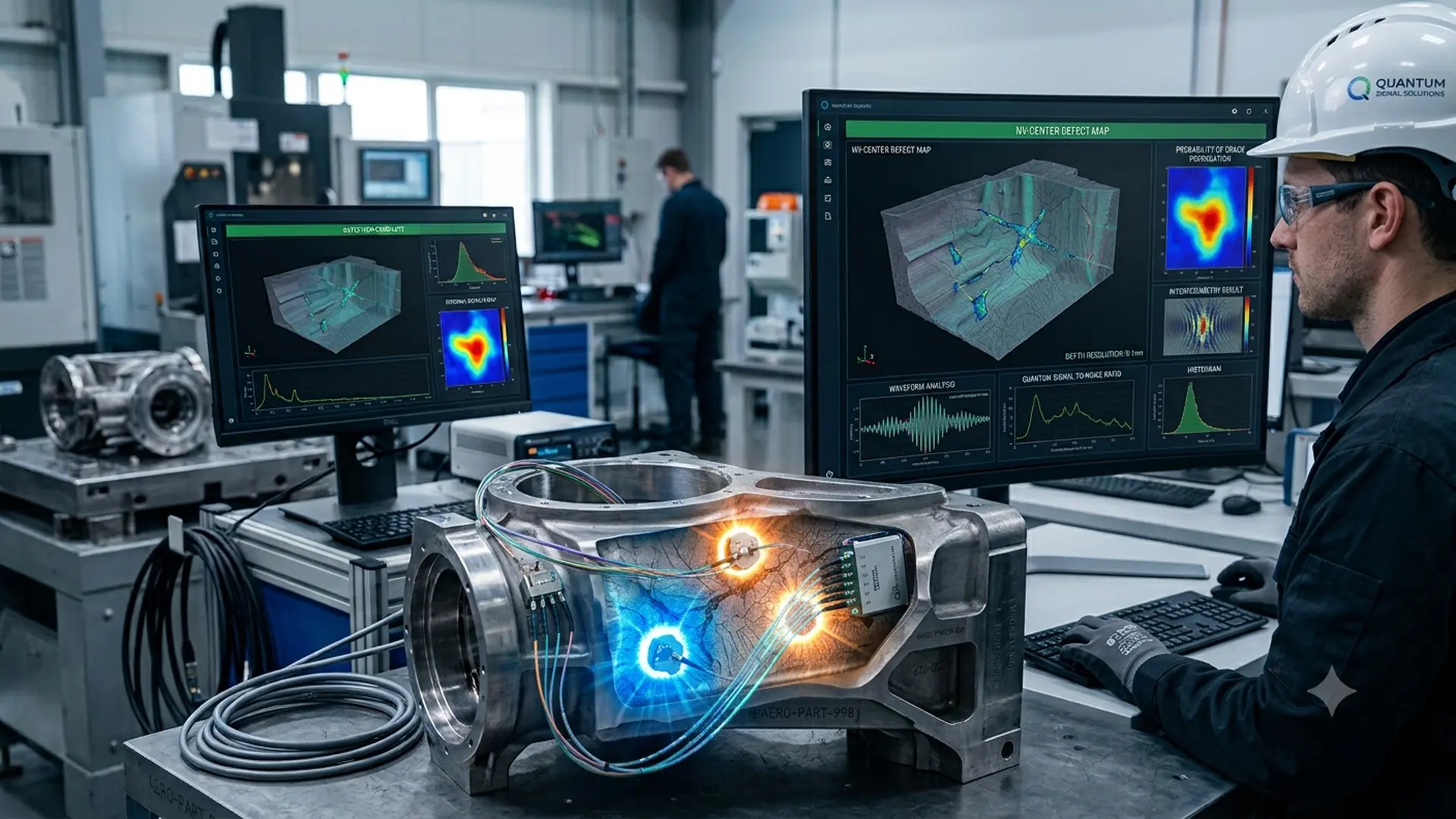
NV centers, for example, respond to variations in magnetic fields generated by internal discontinuities in metallic materials. These variations are converted into measurable optical signals, enabling a highly sensitive form of subsurface detection.
At the same time, quantum magnetometers can detect extremely weak magnetic fields associated with microcracks or localized corrosion, thereby expanding the capabilities of advanced NDT in complex industrial applications.
What are quantum sensors in NDT?
In practical terms, quantum sensors in NDT can be defined as measurement technologies that enable the assessment of a material’s integrity by detecting quantum-amplified physical disturbances.
Its potential uses include:
- Early detection of internal defects
- Detection of subsurface microcracks
- Assessment of microstructural degradation
- Continuous integrity monitoring
This positions them as complementary tools in non-destructive testing, especially in situations where the sensitivity of conventional methods is limited.
NV sensors in diamond for industrial NDT (BINDT 2025 integration)
Among the most promising technologies are diamond NV sensors, considered one of the most advanced applications of quantum sensing. These quantum sensors use nitrogen vacancy centers to detect magnetic fields with high sensitivity and high spatial resolution.
According to Vindolet et al. (BINDT, 2025), diamond NV sensors can enhance traditional nondestructive testing techniques, including magnetic flux leakage (MFL), eddy current testing (ECT), and Barkhausen noise analysis. Thanks to these capabilities, diamond-based quantum sensors could significantly expand the scope of subsurface detection in industrial applications.
Differences between conventional NDT and quantum sensing
Traditional NDT methods such as ultrasonics, industrial radiography, magnetic particles, and eddy currents have been highly effective for decades. However, they have limitations in terms of resolution, geometric access, and early detection.
Quantum sensing introduces significant differences:
- Greater sensitivity to minimal physical disturbances
- Ability to detect incipient defects early
- Potential for inspection without direct contact
- Integration with advanced digital systems
However, conventional END remains the industry standard under regulations such as ASME Section V and ISO 9712, while quantum sensors are still at an intermediate stage of technological maturity in this area.
Applications of subsurface quantum detection
Applications of subsurface detection using quantum sensors focus on industrial problems where conventional inspection has limitations.
Corrosion Under Insulation (CUI)
CUI is one of the most critical forms of damage in the oil and petrochemical industries. Quantum sensors could detect magnetic changes associated with loss of thickness without the need to remove thermal insulation, thereby reducing inspection times.
Critical weld inspection
Welds in pressurized equipment may contain defects such as lack of fusion, porosity, or internal cracks. Quantum sensing could improve the detection of these discontinuities by analyzing microscopic magnetic variations.
Integrity of pipelines and pressure vessels
In hydrocarbon transportation systems, early detection of corrosion and fatigue is essential. Quantum sensors could complement MFL and ACFM techniques, providing higher resolution in hard-to-reach areas.
Composite Materials
In the aerospace and energy sectors, composite materials exhibit defects such as delamination and internal voids. Advanced defect detection based on quantum sensors could improve the identification of internal damage that is not easily detectable by conventional ultrasound.
Aerospace components
The stringent safety requirements for aircraft necessitate the early detection of microcracks. Quantum sensors could contribute to structural assessment with greater sensitivity and less intervention.
Advantages of quantum sensing for internal defects
The main advantages of quantum sensing include:
- Extreme sensitivity to weak physical fields
- Enhanced early detection capabilities
- Potential for continuous monitoring
- Reduction in invasive procedures
- Integration with artificial intelligence and digital twins
- Improved reliability in Inspection 5.0
These advantages make it a strategic technology for the evolution of NDT toward predictive systems.
How quantum sensors could transform NDT
The incorporation of quantum sensors into industry could transform NDT into a more predictive and continuous model. Instead of periodic inspections, assets could be monitored in real time using advanced sensor networks.
This would allow for:
- Reduction of unexpected failures
- Optimization of condition-based maintenance
- Improvement of mechanical integrity management
- Integration with industrial digital platforms
The result would be a transition to Inspection 5.0 models, where real-time data drives operational decisions.
The following video discusses the applications of quantum sensors in NDT and their impact on mechanical integrity management.

Challenges in bringing quantum sensors to the industrial setting
Despite its potential, there are significant challenges:
- Technological maturity: Many developments are still in experimental or industrial pilot phases.
- Operating conditions: Industrial environments are subject to electromagnetic noise, vibrations, and extreme temperatures.
- Costs: The implementation of quantum technologies remains expensive compared to conventional NDT.
- Standardization: There are currently no specific standards in ASME Section V or ISO dedicated to quantum sensors.
- Training: Advanced training in applied physics, metrology, and signal analysis is required.
Conclusions
Quantum sensors are emerging as a technology with great potential to improve subsurface detection and complement conventional nondestructive testing techniques. Recent advances, such as NV sensors in diamond, demonstrate their ability to provide high-sensitivity, high-resolution measurements in complex industrial applications.
Within the framework of Inspection 5.0, these systems could be integrated with artificial intelligence, real-time monitoring, and digital twins to strengthen asset integrity management. Although challenges related to standardization and industrial adoption remain, quantum sensing is shaping a new generation of tools for advanced NDT.
References
- American Society of Mechanical Engineers. (2025). ASME Boiler and Pressure Vessel Code, Section V: Nondestructive Examination. ASME International.
- International Organization for Standardization. (2021). ISO 9712:2021. Non-destructive testing — Qualification and certification of NDT personnel. ISO.
- ASTM International. (2024). ASTM E1316-24a, Standard Terminology for Nondestructive Examinations. ASTM International.
- International Organization for Standardization. (2022). ISO/IEC 17025:2017. General requirements for the competence of testing and calibration laboratories. ISO.
- DeMille, D., Hutzler, N. R., Rey, A. M., & Zelevinsky, T. (2024). Quantum sensing and metrology for fundamental physics with molecules. Nature Physics, 20, 741–749 https://www.nature.com/articles/s41567-024-02499-9