Table of Contents
- Why control corrosion in the oil industry?
- What is corrosion?
- How is corrosion classified?
- How does electrochemical corrosion occur?
- Most frequent corrosion mechanisms in oil & gas
- How does carbon dioxide (co₂) corrosion occur?
- Why does h₂s represent a risk to assets?
- Influence of oxygen in the corrosion of industrial equipment
- Microbiologically influenced corrosion (MIC)
- Corrosion under insulation (CUI)
- How can corrosion be controlled?
- Material selection
- Anti-corrosion coatings
- Cathodic protection
- Corrosion inhibitors
- What technologies are transforming corrosion control?
- Conclusions
- Frequently Asked Questions (FAQ)
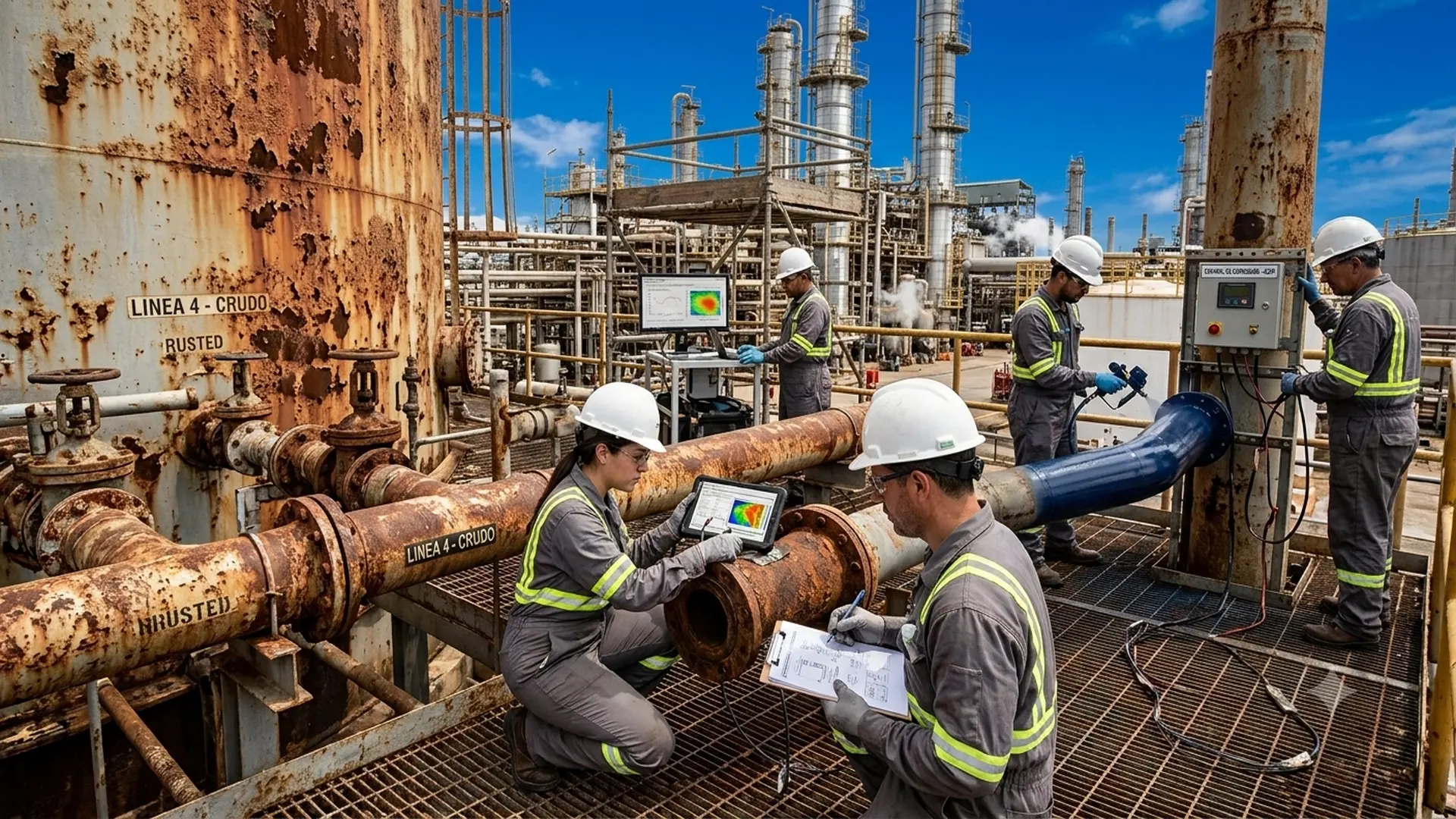
Corrosion control is a fundamental element to preserve the integrity of pipelines, pressure vessels, storage tanks, and process equipment in the oil and gas industry. Inadequate management of this phenomenon can compromise operational safety, increase maintenance costs, reduce asset reliability, and generate production losses or environmental incidents.
Although corrosion is a natural and inevitable process, its rate can be significantly reduced through proper material selection, protective coatings, corrosion inhibitors, cathodic protection, and inspection and monitoring programs. Understanding the mechanisms that cause this deterioration is the first step in selecting the most effective mitigation strategy for each service condition.
Why control corrosion in the oil industry?
Corrosion continues to be one of the main causes of degradation of assets used in the exploration, production, transportation, refining, and storage of hydrocarbons. Pipelines, wellheads, pressure vessels, heat exchangers, tanks, and offshore structures operate continuously in environments that favor the deterioration of metallic materials.
Its impact goes beyond the replacement of damaged equipment. Corrosion failures can cause hydrocarbon leaks, unscheduled shutdowns, environmental contamination, fires, explosions, and accidents with large-scale economic and social consequences. Therefore, corrosion control is part of the mechanical integrity programs and asset management systems implemented by the leading companies in the energy sector.
What is corrosion?
Corrosion is a natural process by which a metallic material deteriorates due to chemical or electrochemical reactions with its surrounding environment. From a thermodynamic point of view, metals tend to return to their lowest energy state, forming more stable compounds such as oxides, hydroxides, or sulfides.
Unlike mechanical wear, corrosion progressively modifies the metal surface, decreasing its thickness and mechanical properties until compromising the component’s ability to operate safely. The rate at which this process occurs depends on factors such as material composition, temperature, the presence of water, oxygen content, pH, and the corrosive substances present in the environment.
How is corrosion classified?
Corrosion can be classified according to the way it manifests or according to the environment where it occurs.
From a morphological point of view, it is mainly distinguished into uniform corrosion and localized corrosion. Uniform corrosion is distributed relatively evenly over the entire metallic surface, allowing the loss of thickness and the remaining useful life of the component to be estimated with some precision.
In contrast, localized corrosion concentrates the damage in specific areas and includes mechanisms such as pitting corrosion, crevice corrosion, galvanic corrosion, under-deposit corrosion, and microbiologically influenced corrosion (MIC). Because the deterioration occurs at specific points, this type of corrosion is usually more difficult to detect and represents a greater risk to the integrity of the equipment.
From an environmental standpoint, corrosion can also be divided into chemical or dry corrosion, characteristic of high-temperature processes, and electrochemical or wet corrosion, which occurs in the presence of an electrolyte and is the predominant mechanism in the oil and gas industry.
How does electrochemical corrosion occur?
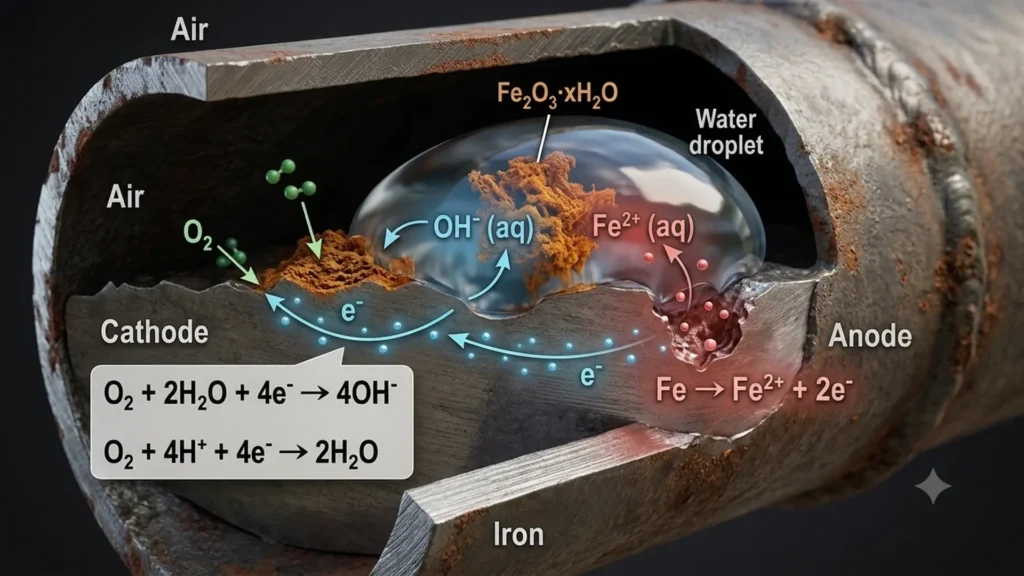
Most of the electrochemical corrosion processes present in oil facilities correspond to electrochemical mechanisms. For this phenomenon to occur, four fundamental elements must coexist: an anode, where the metal loses electrons; a cathode, where reduction reactions occur; an electrolyte that allows the transport of ions; and an electrical connection that facilitates the flow of electrons between both zones.
In the case of carbon steel, iron atoms oxidize and release electrons, transforming into ferrous ions. These electrons migrate to the cathodic zones, where they react with dissolved oxygen or hydrogen ions, depending on the environmental conditions. The result is the formation of corrosion products, such as iron oxides and hydroxides, commonly known as rust.
In the following image, a simple representation of the oxidation of a carbon steel iron water pipe can be seen to illustrate this type of electrochemical corrosion. In the presence of an aerated aqueous medium [H₂O], iron [Fe] transforms into ferrous ions [Fe²⁺], which act as the anode (oxidation reaction). Electrons are transported to the cathode, where, in the presence of dissolved oxygen [O₂], iron oxides [FeₓOₓ] are formed as rust deposits or precipitates (reduction reaction). A byproduct of the reaction at the cathode are hydroxyl ions [OH⁻] (hydrated oxides) resulting from the reduction of aerated water.
The speed of this process depends on different variables, including temperature, pH, oxygen concentration, electrolyte conductivity, flow velocity, and the presence of corrosive gases such as carbon dioxide (CO₂) or hydrogen sulfide (H₂S).
Most frequent corrosion mechanisms in oil & gas
The oil and gas industry faces highly corrosive environments due to the presence of water, acid gases, microorganisms, high temperatures, and variable operational conditions. Properly identifying the degradation mechanism is essential to select the appropriate mitigation strategy, as each type of corrosion presents particular characteristics and requires specific controls.
The most common mechanisms in oil facilities include carbon dioxide (CO₂) corrosion, hydrogen sulfide (H₂S) corrosion, oxygen corrosion, microbiologically influenced corrosion (MIC), under-deposit corrosion, and corrosion under insulation (CUI).
How does carbon dioxide (co₂) corrosion occur?
CO₂ corrosion, commonly known as sweet corrosion, is one of the most important mechanisms in hydrocarbon production and transportation systems. It occurs when carbon dioxide dissolved in water forms carbonic acid (H₂CO₃), reducing the pH of the medium and increasing the dissolution rate of carbon steel.
During this process, the iron in the steel oxidizes, releasing ferrous ions (Fe²⁺), while the cathodic reactions generate hydrogen. As a result, corrosion products such as ferrous carbonate (FeCO₃) can form, whose presence can act as a partial protective layer or, depending on the conditions, generate non-protective deposits that favor localized corrosion.
The severity of CO₂ corrosion depends on variables such as the partial pressure of the gas, temperature, water content, fluid velocity, chemical composition of the water, and the presence of contaminants. In pipelines, production lines, and process equipment, control usually combines corrosion inhibitors, corrosion rate monitoring, proper material selection, and control of operational conditions.
Why does h₂s represent a risk to assets?
Corrosion caused by hydrogen sulfide (H₂S), known as sour corrosion, constitutes one of the most dangerous mechanisms due to its relationship with steel embrittlement and cracking processes.
When H₂S is present in aqueous environments, it favors the formation of iron sulfides (FeS), which can generate protective films under certain conditions. However, it can also promote the absorption of atomic hydrogen into the steel, increasing susceptibility to phenomena such as hydrogen-induced cracking (HIC), sulfide stress cracking (SSC), and stress-oriented hydrogen-induced cracking (SOHIC).
These mechanisms represent a major concern in pipelines, pressure vessels, and equipment used in crude oil and sour gas production. For this reason, material selection must consider criteria established in standards such as ISO 15156/NACE MR0175, which specify requirements for materials exposed to H₂S-containing environments.
Effective H₂S control requires a combination of practices including chemical treatment, removal of contaminants, stress control, selection of resistant materials, and inspection programs aimed at detecting cracks before they compromise the integrity of the component.
Influence of oxygen in the corrosion of industrial equipment
Although oxygen is not usually found in high concentrations within closed hydrocarbon production systems, its presence can generate highly corrosive conditions when it enters through access points such as open tanks, water injection systems, treatment equipment, or failures in deaeration processes.
Oxygen acts primarily as a cathodic agent that accelerates the electrochemical reduction reaction, increasing the corrosion rate of the steel. In addition, it favors the formation of iron oxides and can contribute to the appearance of deep pitting, especially in the presence of chlorides.
Controlling this mechanism requires minimizing oxygen ingress, using specific inhibitors, applying appropriate coatings, and maintaining oxygen removal systems in circuits where necessary.
Microbiologically influenced corrosion (MIC)
Microbiologically Influenced Corrosion (MIC) is a degradation mechanism associated with the activity of microorganisms capable of modifying the chemical conditions on the metallic surface.
Sulfate-reducing bacteria (SRB), iron-oxidizing bacteria, and other microorganisms can produce corrosive metabolites, alter the local pH, and generate biological deposits that create zones with different electrochemical conditions.
MIC is especially problematic in systems where there is stagnant water or low flow velocity, such as tanks, low-circulation pipelines, fire protection systems, and industrial water circuits.
Its control requires a combined approach that includes mechanical cleaning, microbiological analysis, biocide treatment, deposit removal, and periodic monitoring of bacterial activity.
Corrosion under insulation (CUI)
Corrosion Under Insulation (CUI) occurs when moisture becomes trapped beneath thermal insulation systems, creating a favorable environment for external equipment corrosion.
This mechanism mainly affects pipelines, vessels, and equipment operating with thermal cycles, where temperature changes generate condensation within the insulation. Because the damage remains hidden, it can advance for long periods without being detected.
CUI represents one of the main challenges in integrity programs because it requires specific inspections, non-destructive techniques, and preventive strategies such as resistant coatings, proper insulation design, and monitoring of critical areas.
How can corrosion be controlled?
Corrosion control does not depend on a single technology, but on a comprehensive program that combines prevention, monitoring, inspection, and maintenance. The most efficient strategy is one that considers the expected damage mechanisms from the design stage and establishes controls throughout the asset’s life cycle.
Material selection
Proper material selection is the first barrier against corrosion. Not all metals present the same behavior in a given environment; therefore, the choice must consider temperature, pressure, fluid chemical composition, and expected degradation mechanisms.
In critical applications, alloy steels, stainless steels, corrosion-resistant alloys (CRA), and materials with special surface treatments can be used.
Incorrect selection can generate high maintenance costs and significantly reduce the asset’s useful life.
Anti-corrosion coatings
Protective coatings act as a physical barrier between the metal and the corrosive environment. Their main objective is to reduce contact between the electrolyte and the metal surface.
In the oil industry, organic coatings, industrial paints, epoxies, polyurethanes, zinc-rich coatings, and multilayer systems designed for specific conditions are used.
The effectiveness of the coating depends on both the selection of the system and the surface preparation, correct application, quality inspection, and maintenance during operation.
Cathodic protection
Cathodic protection is an electrochemical technique used to reduce corrosion by converting the protected metal into the cathode of an electrochemical cell.
It can be applied using sacrificial anodes or impressed current systems. It is widely used in buried pipelines, marine structures, tanks, and equipment in contact with electrolytes.
Its performance depends on proper electrical design, monitoring of the protection potential, and periodic system maintenance.
Corrosion inhibitors
Inhibitors are chemical substances that, when added in small concentrations to the medium, reduce the speed of the electrochemical reactions responsible for corrosion.
In oil and gas production systems, they are widely used to control internal corrosion caused by CO₂ and H₂S. Their mechanism can include the formation of protective films, reduction of the anodic reaction, or modification of the metallic surface.
The selection of the inhibitor depends on the fluid chemistry, temperature, pressure, flow velocity, and compatibility with other chemicals used in the process.
What technologies are transforming corrosion control?
Modern corrosion management is evolving from reactive models, based mainly on repair after a failure, towards predictive strategies based on continuous monitoring, data analysis, and risk assessment. The integration of new technologies allows knowing the behavior of assets in real time and anticipating conditions that could accelerate degradation mechanisms.
This transformation is especially relevant in the oil and gas industry, where assets operate for decades under variable conditions of pressure, temperature, and chemical composition. The combination of advanced inspection, smart sensors, and digital tools allows improving decision-making and optimizing maintenance programs.
Smart sensors in corrosion monitoring
Traditional corrosion monitoring systems are usually based on periodic measurements using corrosion coupons, intrusive probes, or scheduled inspections. Although these techniques remain important, they present limitations related to the measurement frequency and the ability to detect rapid changes in operational conditions.
Smart sensors allow obtaining continuous information on critical variables such as corrosion rate, electrochemical potential, temperature, pressure, and the composition of the medium. Technologies such as electrical resistance (ER) sensors, linear polarization resistance (LPR), and advanced electrochemical systems provide real-time data that facilitate an early response to abnormal conditions.
These systems, integrated with digital platforms, allow transitioning from fixed-interval maintenance to predictive maintenance based on the actual condition of the asset.
Artificial intelligence in corrosion prediction
Artificial intelligence (AI) and Machine Learning are taking on a relevant role in integrity management due to their ability to analyze large volumes of operational information.
Predictive models can use historical inspection data, process variables, fluid chemical composition, environmental conditions, and maintenance records to identify patterns associated with the evolution of corrosion.
In pipeline transportation systems, these tools can help estimate thickness loss rates, prioritize critical areas, and improve inspection planning using tools such as risk-based inspection (RBI).
Although artificial intelligence does not replace the experience of the corrosion specialist, it represents a complementary tool to improve the accuracy of analysis and reduce uncertainty in decision-making.
Digital twins in asset integrity
Digital Twins represent an important evolution in the management of industrial assets. They consist of virtual models capable of reproducing the behavior of physical equipment using operational information, historical data, and information obtained through sensors.
In the corrosion area, a digital twin can integrate information on materials, damage mechanisms, corrosion rate, operating conditions, and inspection history to estimate the current condition of the asset and project its future behavior.
This technology allows evaluating different operational scenarios, identifying potential risks, and optimizing maintenance strategies before a failure occurs.
Advanced inspections in corrosion control
Non-destructive testing (NDT) continues to be an essential tool for evaluating the condition of equipment and structures. However, technological evolution has allowed the development of techniques with greater sensitivity and analysis capabilities.
Methods such as advanced ultrasound (PAUT and TFM), digital radiography, guided waves, eddy currents, and intelligent in-line inspection (ILI) tools allow detecting damage mechanisms in early stages.
These technologies are especially important for identifying localized corrosion, loss of thickness, hydrogen-associated cracks, and defects that could go unnoticed using conventional methods.
What is the future of corrosion control?
The future of corrosion control will be determined by a combination of scientific knowledge, digitalization, and advanced integrity management strategies. The energy transition is also modifying traditional challenges due to the incorporation of new fuels and operational conditions.
The transportation of hydrogen, carbon dioxide (CO₂), biogas, and other alternative gases requires a deeper understanding of the interaction between materials and new corrosive environments.
Modern integrity programs must integrate risk analysis, continuous monitoring, artificial intelligence, and predictive technologies to ensure that existing assets can operate safely for extended periods.
The current trend points towards data-driven corrosion management, where decisions do not rely solely on periodic inspections, but on a comprehensive and dynamic view of the asset’s behavior.
Additional improvement: control method according to the corrosion mechanism
The selection of the appropriate control method depends mainly on the dominant damage mechanism. There is no one-size-fits-all solution for all corrosive environments; therefore, the strategy must be aligned with the specific operating conditions.
| Corrosion mechanism | Typical environment | Recommended control method |
| CO₂ corrosion | Pipelines, wells, and equipment with water and dissolved CO₂ | Corrosion inhibitors, electrochemical monitoring, water control, material selection |
| H₂S corrosion | Sour gas production and sour environments | Resistant materials according to ISO 15156/NACE MR0175, chemical control, stress reduction |
| Microbiologically influenced corrosion (MIC) | Systems with stagnant water or low velocity | Biocides, mechanical cleaning, microbiological analysis, and monitoring |
| Corrosion under insulation (CUI) | Thermally insulated equipment | Appropriate coatings, advanced inspection, humidity control |
| Atmospheric corrosion | Structures exposed to the environment | Industrial paints, metallic coatings, preventive maintenance |
| Galvanic corrosion | Contact between different metals | Electrical insulation, proper material selection, and design control |
This relationship between mechanism and mitigation strategy allows for the development of more efficient control programs, reducing operational costs, and increasing asset reliability.
Conclusions
Corrosion control constitutes an essential element to guarantee the safety, reliability, and availability of the assets used in the oil and gas industry. Although corrosion is a natural phenomenon associated with the interaction between materials and their environment, its effects can be significantly reduced through comprehensive prevention and monitoring programs.
Correct identification of the damage mechanism represents the first step to selecting the appropriate mitigation strategy. Corrosion caused by CO₂, H₂S, oxygen, microorganisms, or external conditions such as CUI require specific approaches that combine appropriate materials, chemical protection, coatings, cathodic protection, and advanced inspection.
Technological evolution is transforming corrosion management through smart sensors, artificial intelligence, digital twins, and predictive analysis. These tools make it possible to anticipate failures, optimize maintenance, and move towards condition- and risk-based integrity models.
In an energy scenario characterized by new fuels and higher operational safety demands, corrosion control will continue to be a strategic factor to extend the useful life of assets and guarantee safer and more sustainable operations.
References
- AMPP. (2023). Corrosion Control in the Oil and Gas Industry. Association for Materials Protection and Performance.
- American Petroleum Institute. (2021). API Recommended Practice 580: Risk-Based Inspection. API Publishing Services.
- American Petroleum Institute. (2023). API Recommended Practice 571: Damage Mechanisms Affecting Fixed Equipment in the Refining Industry. API Publishing Services.
- DNV. (2021). DNV-RP-G101: Risk Based Inspection of Offshore Topsides Static Mechanical Equipment. DNV.
- International Organization for Standardization. (2020). ISO 15156: Petroleum and natural gas industries — Materials for use in H₂S-containing environments in oil and gas production. ISO.
- Revie, R. W., & Uhlig, H. H. (2008). Corrosion and Corrosion Control: An Introduction to Corrosion Science and Engineering. Wiley.
- Schweitzer, P. A. (2010). Fundamentals of Corrosion: Mechanisms, Causes and Preventive Methods. CRC Press.
Frequently Asked Questions (FAQ)
What is the most effective method for corrosion control?
There is no single universal method. The most effective control depends on the corrosion mechanism, operating conditions, and the material used. Generally, combined strategies are applied that include material selection, inhibitors, coatings, cathodic protection, and continuous monitoring.
What are the most common types of corrosion in the oil industry?
The most common mechanisms include CO₂ corrosion, H₂S corrosion, microbiologically influenced corrosion (MIC), corrosion under insulation (CUI), oxygen corrosion, and localized corrosion such as pitting and crevice corrosion.
Why is internal corrosion a major risk in pipelines?
Internal corrosion can progressively reduce the pipe’s thickness, generate loss of mechanical strength, and cause leaks or catastrophic failures. Its early detection through monitoring and inspection is essential to ensure the integrity of the system.
How does artificial intelligence help corrosion control?
Artificial intelligence makes it possible to analyze large amounts of operational and historical data to identify patterns, predict corrosion rates, prioritize inspections, and improve decision-making within integrity programs.
