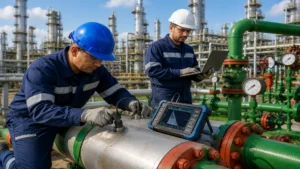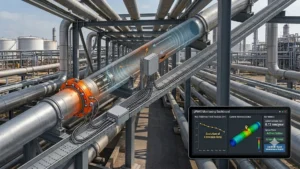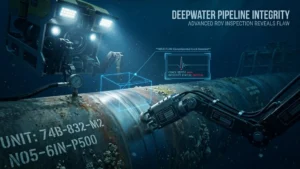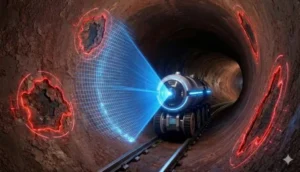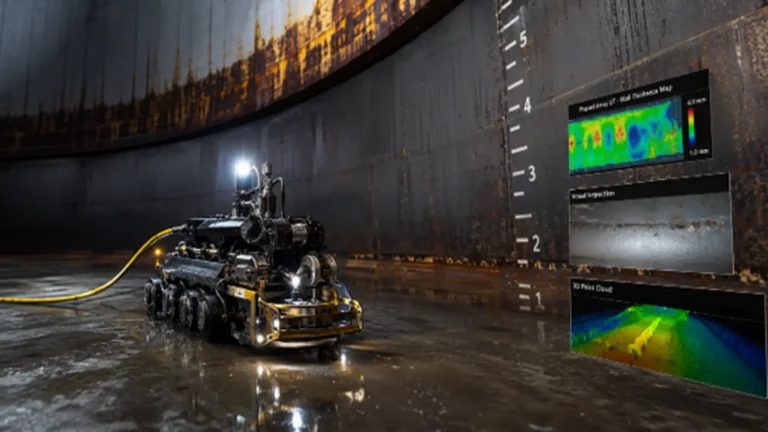
What was once a promising concept is now a strategic asset for the industry, especially in the energy sector, where operational continuity, personnel safety, and mechanical integrity are top priorities. In this context, robotic inspection of storage tanks has emerged as a more efficient and significantly less intrusive alternative to conventional inspection methods. Its value extends well beyond task automation, it fundamentally transforms how critical information about an asset’s actual condition is collected, analyzed, and used for engineering decision-making.
The logic behind robotic inspection
Companies such as HMT, GUL, Square Robot, IRTS, PetroBot, and ROBOPLANET are leading the evolution of in-service storage tank inspection by reducing confined-space entry requirements while significantly improving the quality and reliability of inspection data. This represents a meaningful shift in inspection engineering. Today, simply observing a tank is no longer sufficient; engineers must accurately characterize its condition through precise data acquisition, rapid deployment, and minimized personnel exposure to hazardous environments.
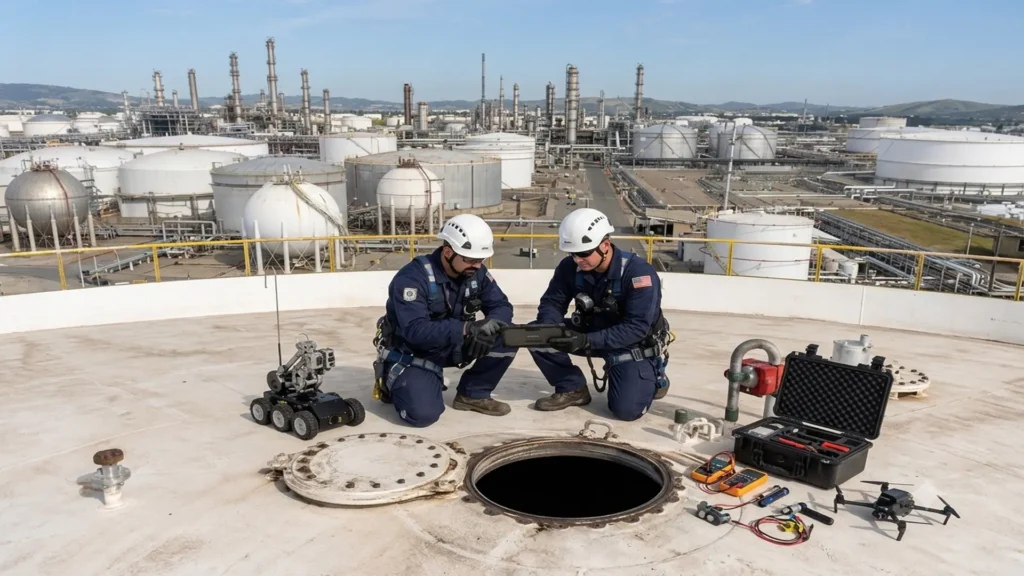
For decades, internal inspections of storage tanks required the asset to be removed from service, emptied, cleaned, gas-freed or inerted, and prepared before inspectors could safely enter the vessel. Besides being costly, this process resulted in production losses, increased resource consumption, and considerable risks associated with confined-space operations. Robotic inspection technologies emerged as a practical response to these challenges by enabling comprehensive evaluations with little or no interruption to operations while minimizing direct human intervention.
From an engineering standpoint, this represents a significant advancement because inspection efforts can now focus primarily on the actual condition of the asset rather than on the logistical limitations imposed by traditional inspection methods. The true value lies not merely in the robot itself, but in the integration of autonomous mobility, advanced sensing technologies, high-resolution data acquisition, and engineering analysis. When these elements operate together effectively, inspection evolves from a routine maintenance activity into a reliable source of information for asset integrity management and risk-based decision-making.
Companies driving the trend
Square Robot has become one of the most visible references in the field of internal inspection for aboveground storage tanks (ASTs). Its approach is centered on submersible robotic systems capable of operating inside tanks without taking them out of service, generating high-resolution data that support corrosion assessment and structural condition evaluation. This capability is particularly valuable for refineries, terminals, and operators under significant pressure to maximize asset availability.
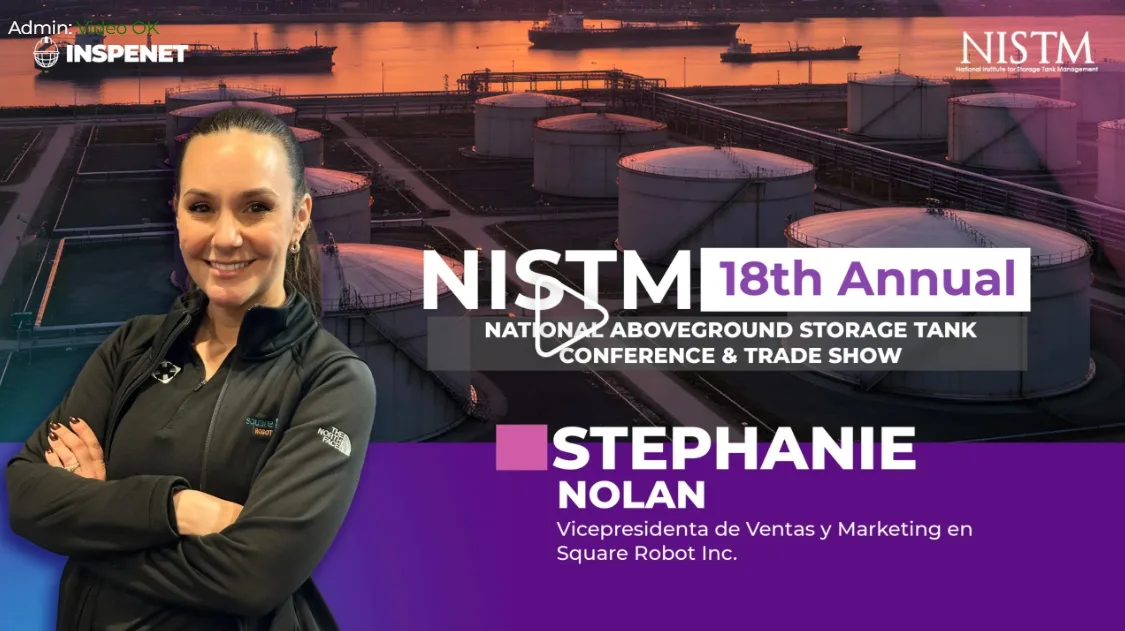
In this regard, Inspenet interviewed Stephanie Nolan during NISTM 2025, where she explained that the robot acquires inspection data using 256-element phased-array ultrasonic technology, enabling coverage of the entire tank bottom surface. The system also generates visual imagery and settlement analyses, providing a continuous and highly detailed view of the tank’s internal structural condition.
In the following video, filmed during the NISTM 2025 event, Inspenet interviews Stephanie Nolan, vice president of Sales and Marketing at Square Robot, about the latest technology in robotic tank inspection.
IRTS has developed robotic inspection solutions specifically focused on in-service tank inspection and aligned with standards such as API 653. This positioning makes the company particularly relevant in regions where tank integrity is critical and operational continuity has a direct financial impact. In parallel, PetroBot offers ATEX-certified robotic NDT inspection systems, expanding the application range to hazardous environments and assets subject to stricter operational constraints.
HMT has adopted a complementary strategy by strengthening its tank engineering expertise through partnerships involving drone-based and robotic data acquisition, integrating traditional tank engineering with digitalization and remote inspection technologies. This hybrid model is particularly important because it demonstrates that the future of inspection will not depend on a single technology, but rather on the integration of multiple tools working toward a common objective: better technical decisions with lower operational risk.
Other notable players include ROBOPLANET and Manta Robotics, which bring additional diversity to the market through platforms focused on NDT applications, remote access, and the reduction of confined-space work. The presence of these companies confirms that robotic tank inspection is no longer an experimental niche; it has become a rapidly expanding technical field with growing industrial adoption.
Why it matters for mechanical integrity
The great contribution of robotic inspection is not only automation, but the improvement of the integrity process. Robots can carry ultrasound, high-definition cameras, scanning systems, and other NDT technologies that detect corrosion, deformations, weld damage, and thickness loss with a level of detail that is highly useful for reliability engineering. In other words, the asset is no longer evaluated by approximations and starts to be evaluated by finer, better-documented evidence.
This has a direct effect on decision-making. With better data, inspection intervals can be optimized, corrective work can be prioritized, and risk can be managed with greater technical criteria. Furthermore, by reducing the need for human entry, potential incidents associated with vapors, hazardous atmospheres, and high physical effort tasks also decrease.
The role of digitalization
Robotics does not operate in isolation. In practice, robotic inspection is typically integrated with advanced analytics software, three-dimensional visualization, digital twins, cloud-based data management platforms, and risk-based maintenance strategies. This digital ecosystem is what transforms inspection from a one-time assessment into a continuous engineering process that supports long-term asset management.
The true value of digitalization lies in its ability to convert large volumes of inspection data into actionable engineering information. Instead of producing a static inspection report, modern robotic platforms generate digital records that can be compared over time, allowing engineers to monitor degradation trends, quantify corrosion growth rates, evaluate structural changes, and make more informed maintenance decisions.
Digital twins are becoming an increasingly important component of this process. By integrating inspection data with engineering models and operational history, they provide a continuously updated virtual representation of the asset. This enables integrity engineers to simulate future degradation scenarios, evaluate maintenance alternatives, and optimize inspection planning based on actual asset condition rather than fixed inspection intervals.
Likewise, the integration of robotic inspection data with Asset Integrity Management (AIM) systems, Computerized Maintenance Management Systems (CMMS), and enterprise asset management platforms significantly improves data traceability and decision-making. Inspection results become immediately available to engineering, maintenance, and operations personnel, facilitating cross-functional collaboration and supporting a more proactive maintenance philosophy.
The industry’s direction is becoming increasingly evident. Leading technology providers are no longer offering robotic platforms alone; they deliver comprehensive inspection ecosystems that integrate data acquisition, automated processing, engineering interpretation, digital reporting, and lifecycle asset management. From this perspective, robotics is no longer the final product—it is one component of a broader digital strategy designed to improve asset reliability and operational performance.
Limitations and application criteria
Despite its many advantages, robotic inspection should not be viewed as a universal solution. Storage tanks differ considerably in geometry, construction details, stored products, internal coatings, operating conditions, accessibility, and degradation mechanisms. Consequently, not every asset is equally suitable for robotic inspection, and no single technology can address every inspection objective. [es.roboplanet]
Several factors may influence the effectiveness of a robotic inspection campaign. Heavy sediment accumulation, sludge deposits, elevated operating temperatures, complex internal configurations, coating conditions, or the specific damage mechanism under investigation may reduce inspection efficiency or require complementary inspection techniques. In many cases, conventional NDT methods continue to play an important role in validating findings or examining areas beyond the capabilities of robotic systems.
For this reason, engineering judgment remains indispensable. Selecting robotic inspection should be based on a comprehensive evaluation of asset criticality, safety risks, expected degradation mechanisms, regulatory requirements, operational constraints, and the anticipated return on investment. The objective should never be to implement the newest technology simply because it is available, but rather to select the inspection strategy that provides the most reliable information for the specific asset under evaluation.
This distinction reflects one of the fundamental principles of engineering practice: technology creates value only when it is applied appropriately. Robotics is most effective when integrated into a broader inspection strategy that combines engineering expertise, sound risk assessment, applicable industry standards, and asset-specific knowledge. Ultimately, successful inspection programs are defined not by the sophistication of the tools employed, but by the quality of the engineering decisions they enable.
Conclusions
Robotic inspection of storage tanks is rapidly becoming an essential component of modern asset integrity programs. Its greatest contribution extends far beyond automation; it enables owners and operators to inspect critical assets with reduced risk, minimal operational disruption, and significantly higher-quality inspection data. As industries continue to prioritize safety, reliability, and operational efficiency, robotic technologies are redefining how storage tank inspections are planned and executed.
Companies such as Square Robot, IRTS, PetroBot, HMT, ROBOPLANET, Manta Robotics, and other technology providers are helping establish a new industry benchmark in which internal tank inspections no longer rely exclusively on human entry. Instead, inspection is increasingly based on the integration of robotics, advanced non-destructive testing (NDT), digital data acquisition, and engineering analysis to deliver more comprehensive and reliable assessments of asset condition.
Perhaps the most significant change is not technological but methodological. Inspection is evolving from a compliance-driven activity into a strategic engineering function that supports asset integrity management throughout the equipment lifecycle. High-resolution inspection data, combined with digital analytics and engineering expertise, enable organizations to make more informed decisions regarding maintenance planning, repair prioritization, inspection intervals, and long-term asset reliability.
For engineers and asset owners alike, the central takeaway is straightforward: robotics does not replace engineering—it enhances it. The effectiveness of any robotic inspection program ultimately depends not on the sophistication of the technology itself, but on the quality of the engineering interpretation behind the data.
Looking ahead, the future of storage tank inspection will undoubtedly become more integrated, more digital, and increasingly data-driven. Organizations that successfully combine robotics, advanced NDT technologies, digital asset management, and sound engineering judgment will be best positioned to improve safety, optimize maintenance expenditures, extend asset service life, and strengthen the overall integrity of their storage infrastructure.
References
- Inspenet (2025) Underwater robotics for tank inspection without stopping operations. https://inspenet.com/en/inspenet-tv/underwater-robotics-tank-inspection/
- IRTS Global. (2026). irts-global – International Robotic Tank Solutions.
- Manta Robotics. (2026). Manta Robotics LLC: Home.
- PetroBot. (s. f.). PetroBot – Robotic NDT Inspection Solutions for All Industries.
- ROBOPLANET. (2026, 14 de junio). Inspección de tanques de almacenamiento – END.
- ROSEN Group. (s. f.). Servicios de inspección de tanques de almacenamiento.
- Square Robot. (2022, 17 de mayo). In-Service Aboveground Storage Tank Inspection Using Robotics. YouTube.
- HMT y Aero Velocity. (2026, 26 de febrero). Aero Velocity partners with HMT for tank inspection services. Investing.com.