Table of Contents
- How do flow batteries work?
- Stack architecture (battery)
- Advantages of standalone lithium storage
- Applications of flow batteries in the electric sector
- Challenges vs. other storage technologies
- Iron-chromium and organic electrolytes: Alternatives to vanadium
- The flow batteries in renewable energy integration
- Conclusions
- References
- Frequently Asked Questions (FAQs)
Lithium-free flow batteries, particularly vanadium, iron-chromium, and aqueous organic electrolyte systems, address the need to store gigawatt-hours for 8, 12, or even 100 hours without degrading the system’s life cycle or scaling fire risks along with it. They do not compete with lithium-ion batteries and operate in a distinct technical category designed for long-duration energy storage (LDES).
Stationary energy storage is the bottleneck of the process that determines whether the global energy transition will be completed within the timelines committed to under the Paris Agreement.
How do flow batteries work?
Unlike conventional batteries, where energy and power are physically integrated within the same solid cell, a flow battery radically separates both functions.
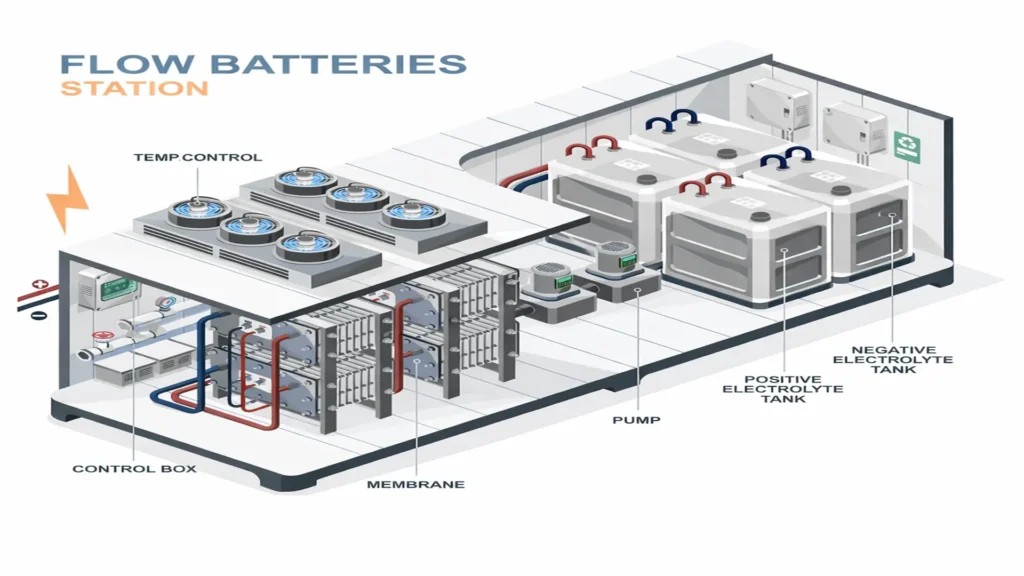
electrochemical stack—the assembly of cells in which redox reactions take place, while energy capacity depends exclusively on the volume of electrolyte stored in two external reservoirs. Below is an illustrative image showing how these prototypes work.
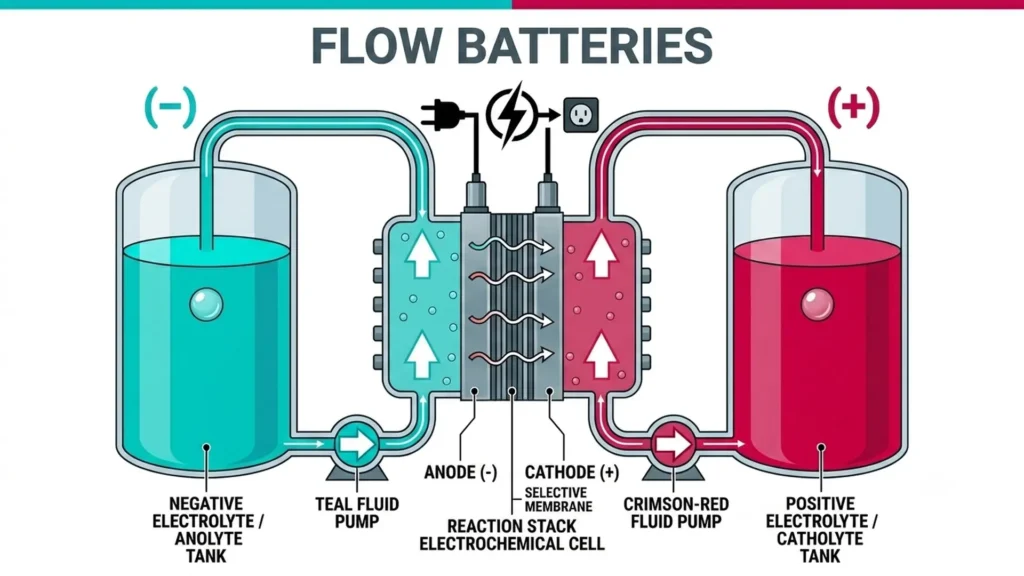
The charge and discharge cycle is rigorously reversible. During charging, an external power converter drives electrons through the external circuit, forcing the active ions in the electrolyte to oxidize or reduce according to the half-cell of each compartment.
During discharge, the flow is reversed: the ions return to their equilibrium state, releasing electrons that circulate through the external circuit as useful current.
An ion-exchange membrane, usually made of perfluorosulfonic acid of the Nafion type or, in more modern systems, sulfonated SPEEK reinforced with hydroxylated boron nitride, separates the two half-compartments, allowing protons to pass through while blocking the mixing of the active electrolytes.
The electrolytes circulate continuously via low-pressure pumps, which adds a small parasitic load (typically 2–5% of system efficiency) but guarantees the chemical homogeneity of the fluid, eliminates concentration stratification, and allows the system temperature to be precisely controlled.
This active thermal control is a standout advantage over solid cells: non-isothermal dynamic models published in 2025 have shown that well-managed vanadium systems maintain their performance within the 5–40 °C range without accelerated degradation.
Stack architecture (battery)
Carbon electrodes and bipolar plates
The battery is the essential part of the system. It consists of individual cells stacked in series, where each cell comprises a porous carbon electrode (generally carbon felt or thermally treated graphite carbon) on which electron transfer reactions take place, a current collector (bipolar plates) made of graphite or a polymer-graphite composite, and the ion-exchange membrane.
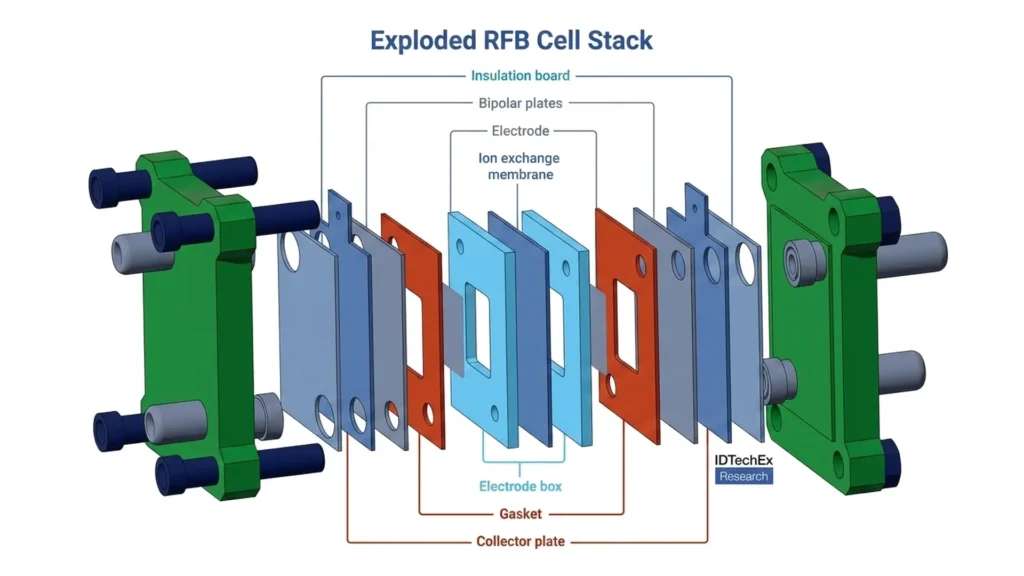
The flow field design (serpentine, interdigitated, or parallel) within the bipolar plates determines the distribution of the electrolyte across the electrode surface, and consequently, the operational current density of the system.
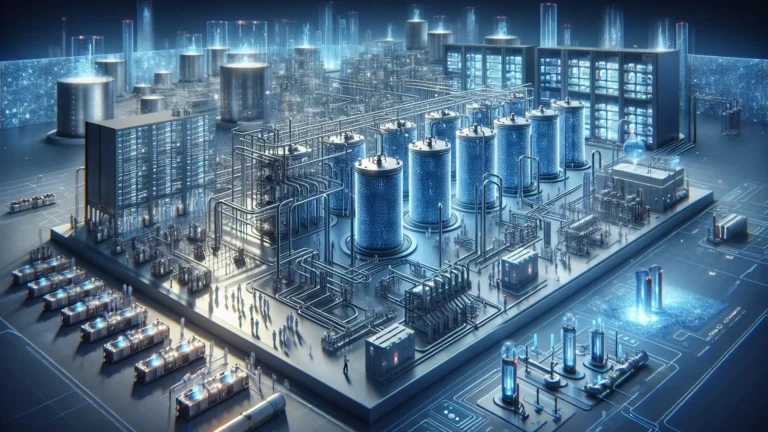
The following image shows a representative illustration of a flow battery station.
Advantages of standalone lithium storage
Lifespan is the most powerful technical argument for flow batteries. A well-designed vanadium system can exceed 20,000 charge-discharge cycles with minimal degradation, equivalent to more than 20 years of daily operation.
The reason is structural: redox reactions occur in the liquid electrolyte, not on solid electrodes, eliminating the ion intercalation and de-intercalation phenomenon within a crystal lattice that causes mechanical fatigue of the electrodes in lithium-ion cells.
While the stack can degrade through other mechanisms (membrane contamination, carbon electrode corrosion), the electrolyte itself remains active indefinitely.
Material circularity is another critical differentiator. Sumitomo Electric has documented a 99.2% recyclability rate for its VRFB systems: 70% of the electrolyte is directly reused and 29.2% of the structural components are recycled, leaving a mere 0.8% of the system as non-recoverable waste.
This profile contrasts drastically with the lithium value chain, where the technical and economic difficulties of scaling recycling were exposed in January 2025 when Li-Cycle, one of North America’s largest lithium-ion recyclers, filed for bankruptcy protection in Canada and the United States, citing engineering cost overruns at its Rochester plant.
The absence of thermal runaway risk warrants specific technical focus. In lithium-ion cells, thermal runaway can be triggered by an internal short circuit, overcharging, or mechanical damage, escalating to temperatures exceeding 700–900 °C along with the release of flammable gases.
Aqueous flow batteries are non-combustible by definition: their electrolytes are aqueous solutions containing vanadium, iron ions, or organic molecules dissolved in water. There is no physicochemical mechanism capable of triggering self-catalytic combustion.
Applications of flow batteries in the electric sector
The benchmark project validating the scale of this technology is China’s Jimusar installation, completed in December 2025: a 200 MW / 1 GWh vanadium system paired with a 1 GW photovoltaic plant.
It is the largest flow battery storage system in the world and serves as an industrial-scale testbed to validate the economic viability of the technology for analysts and investors. Concurrently, Australia is developing the Copwood VFB Energy Hub, which at 50 MW / 500 MWh will become the largest VRFB project outside China once operational.
These projects are not isolated milestones: in 2025, twelve large-scale vanadium projects were connected to the grid in China, consolidating an ecosystem for electrolyte supply, stack manufacturing, and system operation that was experimental just four years ago.
For grid engineers, the practical relevance is immediate: flow systems can provide energy arbitrage services (storing excess solar energy at noon and discharging it during the evening peak), frequency regulation in stand-by mode, and reactive voltage support, all within the same physical asset.
The following video examines the actual implementation of flow batteries in the electricity sector through case studies of large-scale energy storage.
Challenges vs. other storage technologies
Round-trip efficiency: The gap with lithium
Round-trip efficiency (RTE) is the parameter where flow batteries face their greatest challenge against lithium-ion. Commercial vanadium systems operate between 70% and 85% RTE, whereas lithium-ion cells reach 90–95%.
The difference stems from two sources: the energy consumed by the electrolyte circulation pumps (parasitic load) and internal losses within the membrane (ionic resistance and crossover). In high-current-density systems (≥100 mA/cm2), ohmic losses are amplified; in low-current-density systems, the stack becomes larger and more expensive.
Advanced membrane research is addressing this issue through materials chemistry.
In 2025, a team from ACS Energy & Fuels published results on hybrid SPEEK/sulfonated graphitic carbon nitride (S/SGN) membranes that achieve an energy efficiency of 86.2% at 60 mA/cm² and maintain stability over 500 cycles. This outperforms the benchmark Nafion 212 (82.2%) with a self-discharge time of 91.2 hours compared to Nafion’s 23.2 hours. These are laboratory results, but they plot the trajectory toward technological convergence.
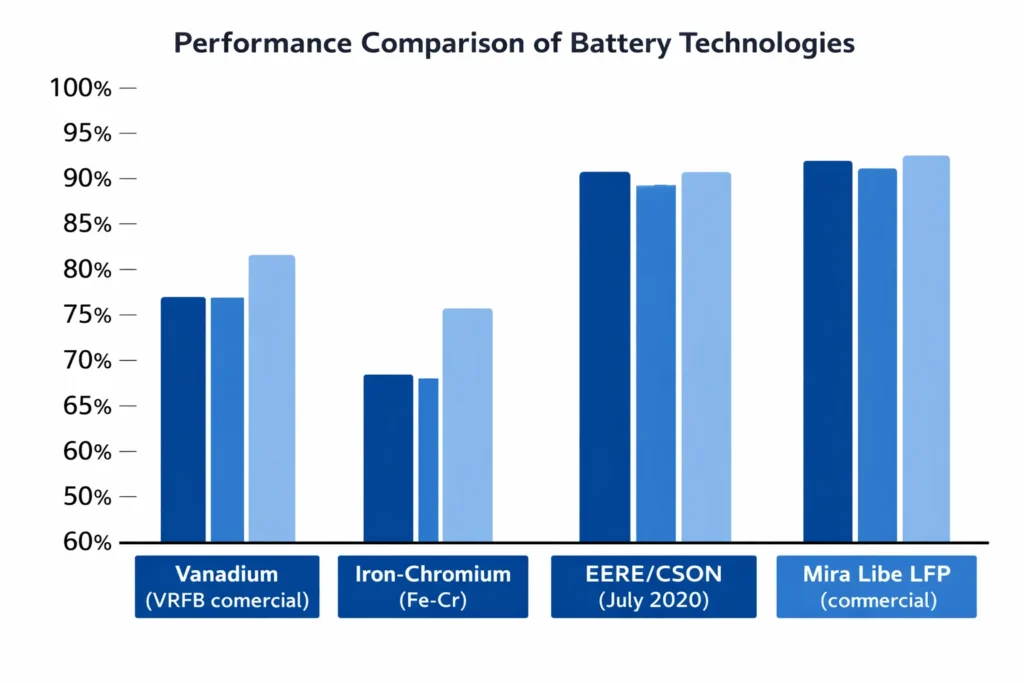
The bar chart above shows the RTE rankings by technology; it is a direct comparison that answers the question, “Who is leading, and by how much?” The SPEEK/S-SGN bar is the most significant data point: it outperforms the benchmark Nafion 212 and is approaching the lithium threshold, which clearly indicates the direction in which the technology is heading.
Structural volumetric energy density
The energy density of flow systems is 20–50 Wh/kg, compared to 150–250 Wh/kg for modern lithium-ion. This 5–10× differential is not a correctable technical defect: it is a direct consequence of the liquid-phase storage mechanism and the tank volumes required to achieve the desired capacity.
For stationary applications where space is not the restricting parameter; grid substations, ground-level industrial facilities, open-field solar storage projects, this limitation is acceptable.
For mobile applications or in high-density urban environments, lithium-ion remains the only technically viable option.
The practical implication for the system designer is important: a 10 MWh flow installation requires approximately 200–500 m³ of total system volume (including tanks, stack, and auxiliaries), while an equivalent lithium system occupies perhaps 20–50 m³.
Large-scale open-field storage projects absorb this difference without issue; projects in restricted urban environments will have to evaluate the trade-off on a case-by-case basis.
Iron-chromium and organic electrolytes: Alternatives to vanadium
Vanadium is the most mature chemistry for flow batteries, but it is neither the only one nor necessarily the most economical in the long term. Iron-chromium batteries (Fe-Cr RFBs) utilize much more abundant and cheaper materials: iron and chromium are global byproducts of the steel industry.
In August 2025, researchers from UNIST published a significant breakthrough in Angewandte Chemie International Edition regarding the extension of Fe-Cr cell lifespans. They addressed the two historical hurdles of this chemistry: the slow kinetics of the Cr3+/Cr2+ reaction and the parasitic hydrogen evolution reaction (HER) that consumes active capacity.
Aqueous organic redox flow batteries (AORFBs) represent the most active frontier of academic research in 2025–2026. They utilize dissolved organic molecules, quinones, viologens, TEMPO, and their derivatives as redox carriers instead of transition metals.
Their fundamental appeal lies in their synthesis from abundant biomass or petrochemical sources, the ability to tailor redox potential through molecular engineering, and the complete elimination of transition metals from the electrolyte.
High-solubility AORFBs have demonstrated energy densities of 25–45 Wh/L in laboratories, nearing the threshold of commercial competitiveness. The current challenge is the stability of the organic electrolyte after thousands of cycles: molecular degradation, irreversible oxidation, deprotonation, or hydrolysis of the redox carriers currently limits cycle life to 500 –2,000 cycles in reported systems, well below the 20,000 cycles of vanadium.
Comparative Table: Flow batteries vs. Other storage technologies
| Parameter | Vanadium (VRFB) | Iron-Chromium (Fe-Cr) | Lithium-Ion (LFP) |
|---|---|---|---|
| RTE (Round-Trip Efficiency) | 70–85% | 65–75% | 90–95% |
| Energy Density | 20–50 Wh/kg | 10–30 Wh/kg | 150–250 Wh/kg |
| Cycle Life | >20,000 cycles | >10,000 cycles | 4,000–8,000 cycles |
| Fire Risk | None (Aqueous) | None (Aqueous) | Leakage / Runaway Risk |
| Energy Scalability | Independent of power | Independent of power | Proportional to modules |
| Typical CAPEX (2025) | 400–800 USD/kWh | 250–500 USD/kWh* | 150–300 USD/kWh |
| Technology Maturity | TRL 9 (Commercial) | TRL 6–8 | TRL 9 (Commercial) |
The flow batteries in renewable energy integration
Renewable intermittency as a grid engineering problem
The massive integration of solar and wind generation into the electrical grid introduces two technical phenomena that long-duration storage must resolve: the duck curve and the seasonal mismatch.
The duck curve, the sharp drop in net demand during peak solar hours followed by a steep evening ramp, can be managed with 4–8 hours of storage, which is the natural operational range of medium-scale flow systems.
The seasonal mismatch, the excess of solar generation in summer versus a deficit in winter at mid-latitudes, requires days or weeks of storage. This is a regime where no electrochemical technology is currently cost-competitive, but where very large-scale flow systems or green hydrogen stand as the most plausible candidates.
Synthetic grid inertia is another vector where flow systems deliver distinct value. Replacing conventional synchronous generators with renewables reduces the electrical system’s inertia, increasing the Rate of Change of Frequency (ROCOF) during disturbances.
The inverters of modern storage systems, including those coupled to flow batteries, can be programmed to emulate the inertial response of a synchronous generator through Virtual Inertia Control (VIC), injecting or absorbing active power based on the measured ROCOF.
This capability is especially relevant in contexts with high renewable penetration like Spain, Germany, or Australia, where grid frequency stability is a critical and growing operational challenge.
Conclusions
Lithium-free flow batteries represent a fundamental paradigm shift for long-duration stationary energy storage (LDES). By physically separating power (the stack) from energy capacity (the volume of the electrolyte tanks), this technology offers a design flexibility and a declining marginal cost scalability that traditional solid lithium-ion cells cannot replicate in an economically viable way for durations ranging from 8 to 100 hours.
Despite having a lower round-trip efficiency (RTE) and lower volumetric energy density compared to lithium, flow systems solidify their position thanks to their near-zero degradation (>20,000 cycles), total immunity to thermal runaway, and recyclability rates exceeding 99%. Commercial projects at the gigawatt-hour scale prove that this technology is mature and ready to stabilize grids with high renewable energy penetration.
References
- https://sumitomoelectric.com
- https://www.idtechex.com
- https://interestingengineering.com
Frequently Asked Questions (FAQs)
What are lithium-free flow batteries?
They are stationary electrochemical storage systems that use liquid electrolytes, solutions of metal ions like vanadium or iron-chromium, or organic molecules in water, instead of lithium-based solid electrodes.
Energy is stored in the electrolyte tanks and converted into electricity via redox reactions within a stack of electrochemical cells. Unlike lithium-ion, they are non-combustible, do not degrade their electrodes through cycling, and allow energy capacity to scale independently of installed power.
How do lithium-free flow batteries work?
Two external tanks store electrolytes with ions in different oxidation states (for example, V2+/V3+ in the anolyte and V4+/V5+ in the catholyte in the case of vanadium). Low-pressure pumps circulate the electrolytes through an electrochemical stack where the ions are oxidized or reduced. This process exchanges electrons through the external circuit (creating useful electrical current) and protons through an ion-exchange membrane that separates the two half-compartments.
The process is completely reversible: by reversing the direction of the external current, the system recharges the electrolytes back to their original state.
Why are they suitable for long-duration storage?
Because their architecture decouples power (determined by stack size) from energy (determined by electrolyte volume). To store more energy, one simply needs to add more electrolyte and larger tanks without modifying the power electronics.
This decreasing marginal cost with scale makes flow batteries economically competitive in terms of LCOE (Levelized Cost of Storage) for discharge durations of 8 hours or longer.
What are the benefits of vanadium flow batteries?
Vanadium redox systems (VRFBs) offer five distinct technical advantages:
1. A cycle life exceeding 20,000 cycles with minimal degradation.
2. Intrinsic safety: a non-flammable aqueous electrolyte with zero thermal runaway risk.
3. Material circularity, boasting a 99.2% recyclability rate (Sumitomo Electric).
4. Independent scalability of power and energy, which minimizes long-term storage costs.
5. The ability to provide multiple grid services simultaneously (arbitrage, frequency regulation, voltage support) without compromising the system’s lifespan.
What are the primary current applications of flow batteries?
The primary markets are utility-scale storage paired with renewables (solar and wind), remote and island microgrids, backup power for critical industrial facilities, and deferral of grid infrastructure investments.