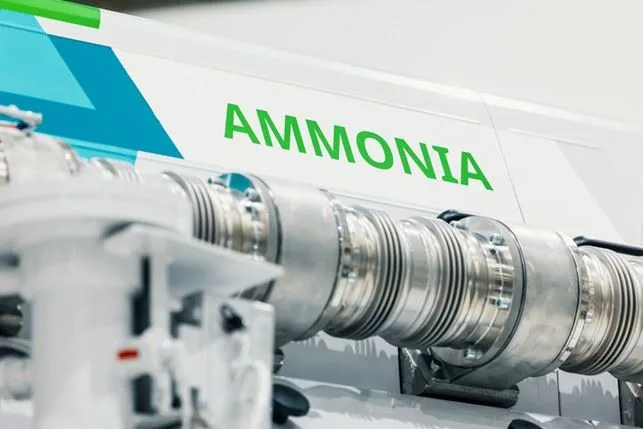
The technology group Wärtsilä has announced a significant upgrade to its Wärtsilä 25 Ammonia engine, increasing its power to 345 kW per cylinder at 1,000 rpm—an advancement that positions ammonia as a viable alternative in maritime propulsion.
This increase matches the performance of its liquefied natural gas (LNG) equivalent, removing one of the main technical barriers to the adoption of alternative fuels. A key component of the system is that this improvement allows for a reduction in the number of cylinders required to achieve the same total power.
The direct consequence is clear: lower mechanical complexity, weight reduction, and simplified installation—decisive factors in the design of more efficient and competitive vessels.
Fewer cylinders, greater flexibility in naval design
The power increase redefines the architecture of propulsion systems. By requiring fewer cylinders, naval engineers have more freedom to optimize space, improve weight distribution, and simplify maintenance.
Furthermore, the engine offers an operating range of 1.9 to 3.1 MW, making it a versatile solution for both main propulsion and auxiliary generation. This flexibility is particularly relevant for next-generation vessels designed under energy efficiency criteria.
Another differentiating element is its ability to convert between ammonia and LNG, introducing an additional level of adaptability based on fuel availability and environmental regulations.
Ammonia: An essential component for decarbonization
The development of ammonia engines responds to the growing regulatory pressure driven by the International Maritime Organization, which has established strict emission reduction targets for maritime transport.
Ammonia stands out for its potential as a carbon-free fuel at the point of use, making it a high-impact operational parameter within the future energy mix of the maritime sector. However, its adoption largely depends on technological advancements like this one.
Type-approval tests conducted in 2025 under the supervision of classification societies validate the system’s reliability and safety—key elements for its large-scale commercial adoption.
Wärtsilä: Commercial availability and energy transition
The new version of the Wärtsilä 25 Ammonia engine will be commercially available with deliveries expected starting in 2028, marking a clear horizon for its implementation in naval projects.
This advancement not only improves technical performance but also reduces the total cost of ownership—a determining factor for shipowners evaluating the transition to alternative fuels.
Overall, the improvement positions Wärtsilä as a key player in the race for maritime decarbonization, demonstrating that innovation in engine engineering will be one of the fundamental pillars for transforming the maritime industry in the coming decades.
Source and photo: https://www.wartsila.com