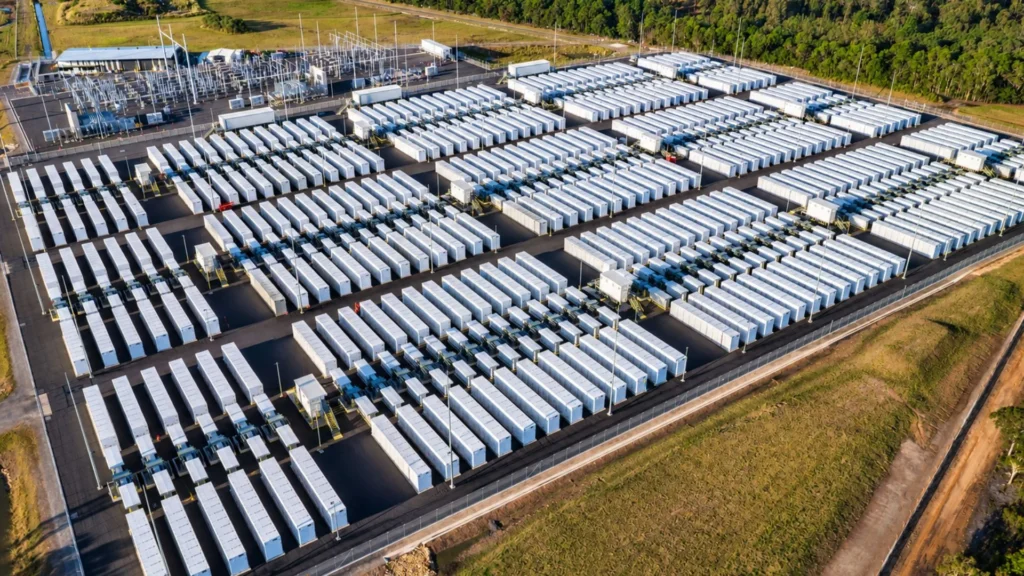
Waratah Superbattery the battery storage facility is now fully operational in New South Wales after receiving approval from the Australian Energy Market Operator (AEMO). With 1,680 MWh of storage capacity, the system strengthens Australia’s electricity grid at a time marked by the expansion of renewable energy. Full commissioning comes after more than a year of partial operation. The battery had been operating under this partial scheme since August 2025, while testing and the necessary processes to reach full operational capacity were underway.
The Waratah Superbattery reinforces the electrical grid
Waratah was designed to respond quickly to problems on transmission lines. Forest fires, fallen trees, or lightning strikes can disrupt electricity transmission and increase pressure on the grid. In these situations, the battery acts as a backup, capable of reacting to outages. According to the New South Wales government, at maximum capacity it can supply the equivalent of the consumption of up to 340,000 homes during peak demand periods. Battery storage is thus gaining prominence within the Australian electricity system, its operation coinciding with the gradual retirement of older coal-fired power plants and the integration of a greater volume of renewable generation into the grid.
From an old coal-fired power plant to energy storage
The Superbatería Waratah it was built on the site of a former coal-fired power station, located about 100 kilometers north of Sydney. The project reflects the transformation underway in New South Wales’ energy infrastructure. A site formerly dedicated to coal-fired power generation now houses a system designed to store electricity and support grid operations. New South Wales Energy Minister Penny Sharpe noted that the project will help maintain supply for homes and businesses while coal-fired power plants are decommissioned. It will also allow more renewable energy to flow through the grid.
EnergyCo, Akaysha Energy and TransGrid participate in Waratah
EnergyCo commissioned the development of the Superbatería Waratah as part of the energy infrastructure promoted by the New South Wales Government. Construction was carried out by Akaysha Energy, a BlackRock portfolio company. TransGrid, for its part, made improvements to the transmission network surrounding the project and will be responsible for monitoring its performance. AEMO’s authorization to operate at full capacity completes a key stage in the technical process that allowed for the progressive increase of the battery’s share within the electricity system.
Waratah leads in power output in Australia
According to BloombergNEF data, Waratah is currently the largest operating battery in Australia in terms of power output. In this metric, the project surpasses Synergy’s Collie Energy Storage Project, located in Western Australia. Collie has a power output of 500 MW and a storage capacity of 2,400 MWh. However, Collie can store more energy than Waratah, with 2,400 MWh compared to the New South Wales facility’s 1,680 MWh. Meanwhile, Australia continues to develop other larger-scale energy storage projects.
Storage accompanies Australia’s renewable energy expansion
The full operation of the Superbatería Waratah this expands the grid’s responsiveness at a time of transformation for the Australian electricity system. The combination of energy storage, transmission infrastructure, and renewable generation will become increasingly important as the share of coal-fired power plants declines. Waratah will thus play an operational role in this transformation, providing backup capacity and rapid response from New South Wales.
Source: Energy Connects
Photo: Shutterstock