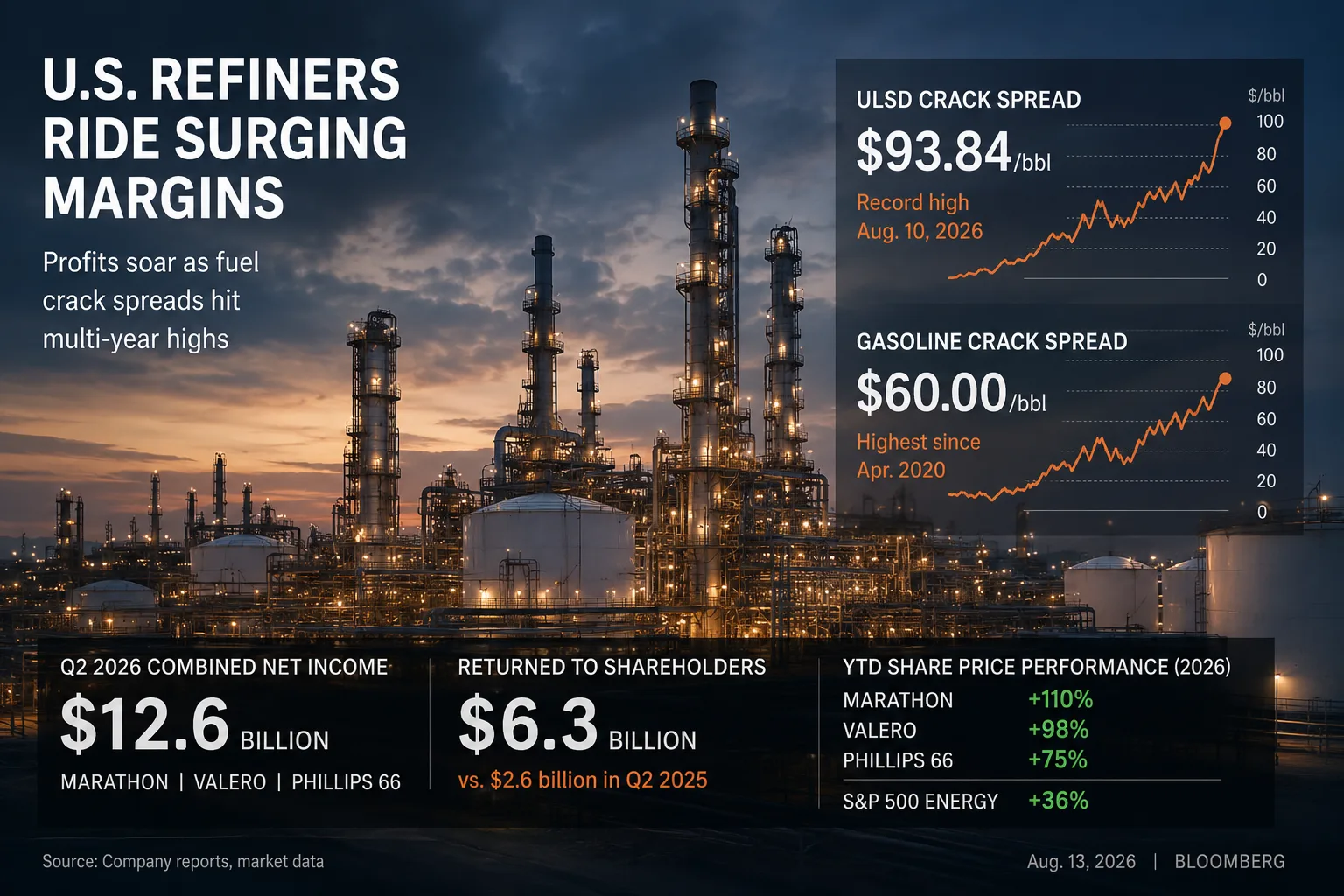
U.S. refining margins are going through an exceptional period amid an international market marked by constraints on fuel supplies and disruptions to energy flows. Marathon Petroleum, Valero Energy, and Phillips 66 collectively earned US$12.6 billion in profits during the second quarter of 2026, their highest combined result since 2022.
The performance coincides with a sharp strengthening of refined product margins. Disruptions associated with the Strait of Hormuz and attacks on Russian refining facilities have contributed to restricting international fuel availability, creating favorable conditions for U.S. refiners with available operating capacity.
Part of those earnings is already flowing back to investors. The three companies collectively returned US$6.3 billion through dividends and share buybacks during the quarter, compared with US$2.6 billion in the same period a year earlier.
Beyond the corporate figures, market behavior shows how available processing capacity can become more valuable when the international supply of refined products comes under pressure.
U.S. refining margins reach exceptional levels
One of the main benchmarks used to assess the economic conditions of the refining business is the crack spread, an indicator that approximates the difference between the value of certain refined products and the cost of the crude oil used as feedstock.
In recent weeks, these spreads have reached exceptionally high levels.
The crack spread for ultra-low sulfur diesel (ULSD) futures reached US$93.84 per barrel on August 10, while the gasoline crack spread climbed to US$60 per barrel on July 17, its highest level since April 2020. The movement helps explain the favorable environment faced by major U.S. refiners during the period.
However, a high crack spread does not directly equal the profit earned by a refinery. Actual profitability also depends on the cost and type of crude oil processed, each facility’s configuration, product yields, energy consumption, maintenance, logistics, and capacity utilization.
Therefore, these indicators should be interpreted as a benchmark for market conditions rather than as a direct measure of the companies’ net profits.
Why are U.S. refiners making so much money?
The answer is related to the interaction between product availability, crude oil prices, processing capacity, and international disruptions.
When the supply of gasoline, diesel, and other fuels becomes constrained while demand remains sufficient to absorb available volumes, those products can increase in value relative to the crude oil used to produce them.
That relationship is partially reflected in the widening of crack spreads. In the current environment, restrictions on energy movements through Hormuz and disruptions caused by attacks on Russian facilities have reduced some of the flexibility of the international fuel supply system. The available information identifies these factors among those that have supported U.S. refining margins.
For an operating refinery, a market in which refined products are relatively more valuable can improve the economics of converting crude oil into gasoline, diesel, and other derivatives. However, the benefit is not uniform across all facilities.
A refinery facing operational problems, scheduled maintenance, logistics constraints, or a less favorable configuration may capture a different share of those market conditions. This is why rising crack spreads must be analyzed alongside each company’s operational performance.
What happened during the second quarter reflects precisely that combination: exceptionally strong product margins and major U.S. refiners positioned to capitalize on them.
US$6.3 billion returned to shareholders
Favorable conditions are also reflected in capital allocation. Marathon Petroleum, Valero, and Phillips 66 distributed US$6.3 billion through dividends and share buybacks during the second quarter, more than double the amount returned a year earlier. Corporate authorizations also show that buybacks remain an important part of their strategies.
Phillips 66 approved a US$10 billion expansion of its share repurchase program in July. Valero authorized another US$5 billion program, in addition to the capacity it still had available under a previous authorization.
The stock market has accompanied this trend. Marathon had gained nearly 110% during 2026, Valero was up more than 98%, and Phillips 66 had risen around 75%, compared with an approximately 36% increase in the S&P 500 energy sector over the period covered by the available information.
These movements reflect investors’ expectations regarding the companies’ ability to convert favorable refining market conditions into cash generation.
How long can these margins remain this strong?
This is the main question for the second half of 2026. Current conditions are favorable, but refining margins are cyclical and can respond quickly to changes in inventories, demand, crude oil prices, refinery utilization, and the international availability of fuels.
The companies themselves are already seeing some moderation. Marathon has indicated that product margins remain strong, although they have declined from the levels recorded during the second quarter and the first few weeks of the third. Valero has also identified recent changes in jet fuel margins.
The seasonal component adds another factor. The U.S. market is moving away from the period of peak summer gasoline demand toward a stage in which other distillates and, later, demand associated with the heating season begin to gain importance.
Therefore, there is not enough basis to assume that the second quarter’s exceptional results will automatically be repeated throughout the rest of the year.
Refining gains strategic value in a market under pressure
The results of Marathon, Valero, and Phillips 66 illustrate a fundamental characteristic of the downstream business: the value of a refinery depends not only on how much crude oil it can process, but also on the relative value of the products it produces and the market conditions prevailing when those products are sold.
During the second quarter, that combination was particularly favorable. International restrictions affecting certain energy flows coincided with strong product spreads and major U.S. refiners capable of maintaining sufficient operations to capitalize on those conditions. Their combined profits reached US$12.6 billion.
However, there is another side to this phenomenon. A tighter fuel market can transfer some of that pressure to consumers and transportation-dependent sectors.
The average U.S. gasoline price rose above US$4 per gallon in late March for the first time in more than three years, during a period of significant market volatility.
The remainder of 2026 will show how much of the current strength can be sustained. If international restrictions persist and product availability remains tight, margins could retain some of their strength. A normalization of energy flows, rising inventories, or changes in demand could have the opposite effect.
For this reason, rather than interpreting the US$12.6 billion as a new normal, the second quarter should be understood as a demonstration of how dramatically refining economics can change when geopolitics, fuel availability, processing capacity, and prices converge in the same direction.
Source: EnergyNow / Reuters.