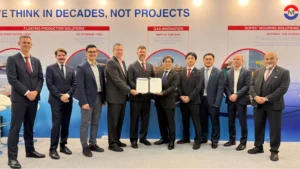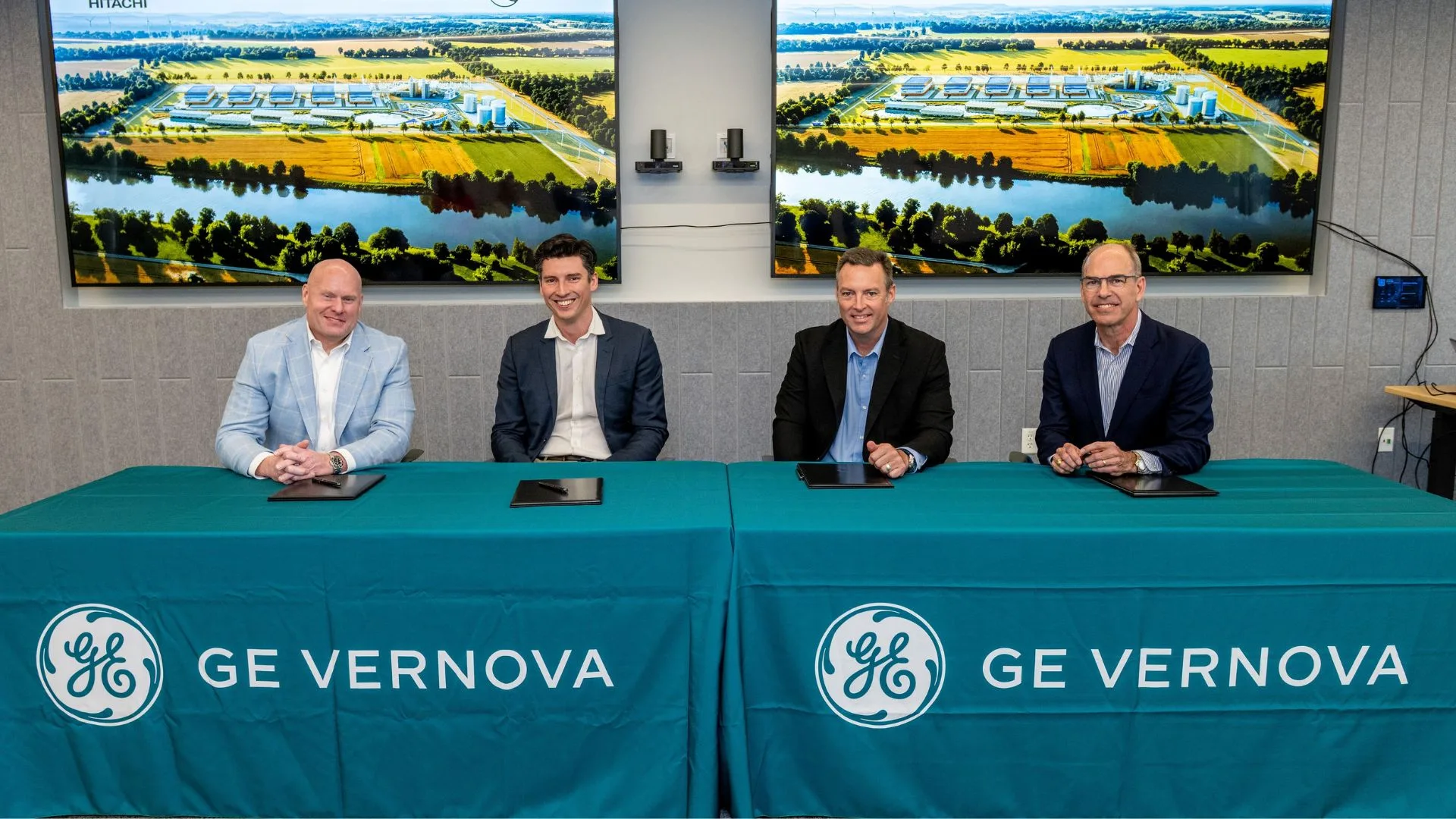
Blue Energy and GE Vernova Hitachi Nuclear Energy (GVH) have taken a new step to develop a 2.5 GW hybrid gas and nuclear power plant in Victoria, Texas. The companies signed an agreement that will advance the project’s engineering, licensing, and safety analyses.
The facility will combine GE Vernova 7HA.02 gas turbines with BWRX-300 small modular reactors. The project is subject to a final investment decision expected in 2027 and aims to meet the rapid growth in electricity demand in the United States.
In particular, Blue Energy is targeting consumption from data centers, artificial intelligence, and advanced manufacturing, sectors that require large amounts of continuous electricity.
Natural Gas First, Nuclear Power Later
Initially, the Texas project will use two GE Vernova gas turbines to supply approximately 1 GW of power to a nearby data center by 2030.
Subsequently, Blue Energy plans to incorporate up to five BWRX-300 small modular reactors starting in 2032. These units would contribute an additional 1.5 GW, bringing the plant’s combined capacity to 2.5 GW.
This strategy allows for phased generation development. Natural gas would cover demand during the first phase while nuclear capacity comes online later.
Likewise, the combination offers Blue Energy a path to serve large electrical loads before completing the nuclear portion of the project.
Eric Gray, CEO of GE Vernova’s Power segment, explained that meeting increased electricity demand requires proven and scalable technologies along with the ability to integrate them.
The proposal precisely brings together two GE Vernova technologies: the HA family gas turbines and the small modular reactors developed by GE Vernova Hitachi.
Hybrid Gas Plant to Incorporate Nuclear Power with BWRX-300 Reactors
The nuclear portion will utilize the BWRX-300, a small modular boiling water reactor developed by GE Vernova Hitachi Nuclear Energy.
Each reactor is designed to provide approximately 300 MW of electrical capacity. The installation of up to five units would allow the planned 1.5 GW for the second phase of the Victoria complex to be achieved.
The design already has a reference under construction. The first BWRX-300 is currently being developed at Ontario Power Generation’s Darlington nuclear site in Canada, with completion expected by the end of this decade.
If it meets that timeline, it could become the first grid-scale SMR of its kind to enter operation in the Western world.
Blue Energy Bets on Nuclear Prefabrication
Furthermore, one of the project’s central elements will be Blue Energy’s construction model. The company seeks to shift a significant portion of the work from the nuclear site to external manufacturing facilities.
Its strategy leverages the BWRX-300’s modular and standardized design to manufacture large components before transporting them to Texas. Afterwards, the modules can be integrated and assembled at the plant’s operating location.
Blue Energy calls this system “Blue Way.” The company argues that prefabrication, logistics, and assembly of large modules can increase cost predictability and reduce construction timelines.
Jake Jurewicz, CEO and co-founder of Blue Energy, noted that the company aims to transform nuclear construction into a financeable and repeatable process with shorter execution times.
The company is also exploring, together with GE Vernova Hitachi, external contracting and manufacturing methods for large power plant modules. The goal is to accelerate the supply chain associated with BWRX-300 deployment.
Texas Could Become a Testbed for the Gas-Nuclear Model
The Victoria project proposes an unusual configuration: using natural gas generation as the primary source of electricity and then adding modular nuclear capacity to provide base load power.
If the investment materializes in 2027, the turbines would be the first to begin producing electricity. The BWRX-300 reactors would subsequently expand the complex’s capacity without relying exclusively on a large nuclear power plant built from scratch.
Blue Energy, founded in 2023, specializes in the development of financeable, turnkey nuclear power plants through prefabrication. GE Vernova Hitachi, for its part, contributes expertise in nuclear technology and the development of boiling water reactors.
The timeline sets 2030 as the target for the first 1 GW of gas generation and 2032 to begin incorporating the 1.5 GW of nuclear power.
With this sequence, the Texas project seeks to test a model in which natural gas, small modular reactors, and prefabricated construction work within a single strategy to supply large electricity consumers.
Source and photo: GE Vernova