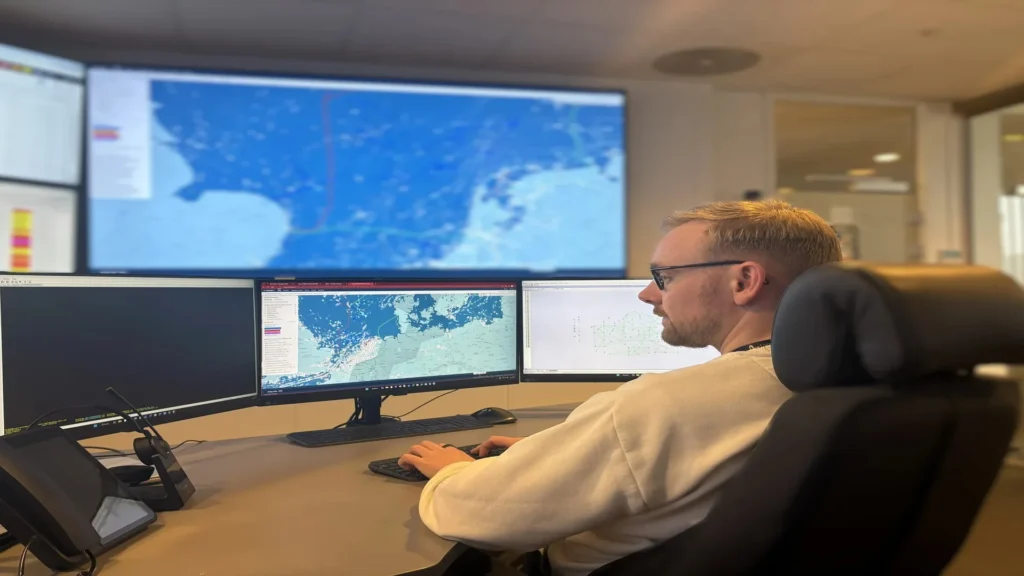
The protection of critical underwater infrastructure is moving towards a new operational stage. Tampnet and Starboard Maritime Intelligence announced the integration of fiber optic detection technologies within an AI-powered maritime intelligence platform, with the aim of improving surveillance and response to threats on submarine cables.
The new solution combines Distributed Acoustic Sensing (DAS) and State of Polarization (SoP) signals into a single operational interface. This integration will allow operators to simultaneously visualize acoustic events, vibrations, and physical disturbances detected in the submarine fiber optic cable.
More precise, real-time underwater monitoring
The combination of both technologies offers a more comprehensive analytical capability regarding what is happening around the submarine infrastructure. While DAS identifies acoustic and vibrational activity near the cable, SoP provides additional sensitivity to detect physical contact and direct disturbances to the fiber.
According to the companies, this capability makes it easier to distinguish between contact events and situations without real physical impact, reducing false alerts and improving risk assessment.
Likewise, the platform incorporates AIS maritime traffic information and inferred vessel trajectories, allowing maritime movements to be correlated with possible anomalies detected on the submarine network.
Existing infrastructure converted into a sensor network
Fiber optic detection technology leverages conventional submarine communication cables to transform them into long-range, continuous sensors. This allows operators to monitor extensive underwater routes without deploying additional equipment on the seabed.
Tampnet confirmed that the detection system is already implemented across much of its global underwater network. With this new operational integration, the company aims to accelerate the everyday use of these tools in maritime security operations and the protection of critical assets.
Anders Tysdal, Tampnet’s infrastructure director, explained that the goal is to make fiber optic detection an operational tool from day one, using existing infrastructure to improve incident response capabilities.
Maritime AI improves the protection of critical infrastructure
Starboard Maritime Intelligence, for its part, incorporated these capabilities into its AI-powered maritime domain knowledge platform. The company noted that the integration allows analysts to access multiple detection modalities from a single interface, simplifying the operational workflow.
Among the available features are:
- Visualization of DAS and SoP signals on operational maps
- sensitivity settings and thresholds by location
- rapid identification of contact events
- Automatic correlation with nearby maritime traffic
The solution is also aimed at strengthening the preventive protection of critical underwater infrastructure, especially in regions with high maritime activity or strategic energy routes.
Greater attention to the safety of submarine cables
The announcement comes amid growing international concern about the security of undersea cables and critical communications networks. These infrastructures carry a large portion of global data traffic and support energy, industrial, and governmental operations.
The incorporation of smart sensors and real-time analytics platforms is gaining relevance as a tool to detect early interference and improve maritime resilience.
Source and photo: Tampnet