Table of Contents
- Introduction - Ecosystems and Platforms
- WHY does a Bendable Detector should exist - The importance of conformability and intimate contact.
- What manufacturing codes exactly demand:
- WHY does the use of a Bendable Detector make Business Sense – Optimized imaging workflow, reduced image acquisition time and increased productivity.
- An actionable approach for radiographic imaging professionals and business decision-makers - Building your own use case for a conformable DR detector (Part I of III)
At Carestream NDT we want to share not only our technological developments and product portfolio, but also the knowledge and practical experience that our staff obtains by working shoulder-to-shoulder with customers like you. We aim to share this knowledge and experience in a straightforward fashion so that our readers may find practical applications in their everyday activities.
This series is directed but not limited to NDE professionals in the following industries: Oil & Gas, Nuclear, Construction, Foundry and Castings, Energy Generation, Aerospace, Transportation, Automotive, Military and Defense, Agriculture, Art Restoration & Museum Artifacts, and NDE Services Companies.
Introduction – Ecosystems and Platforms
Since the momentous discovery of x-rays made by Röntgen in November of 1895, imaging processes have enhanced our senses allowing us humans not only to see inside ourselves in health- related imaging processes but also have granted us the power to see inside individual objects and complex assemblies that constitute the remarkably diverse type of assets that surround us.
Industries such as oil and gas, nuclear, construction, foundry and castings, energy generation, aerospace, NDE services companies, transportation, automotive, military and defense, or even non-industrial activities such as art restoration and museum artifacts make ample use of a very diverse palette of radiographic, ultrasonic, infrared and eddy current imaging capabilities.
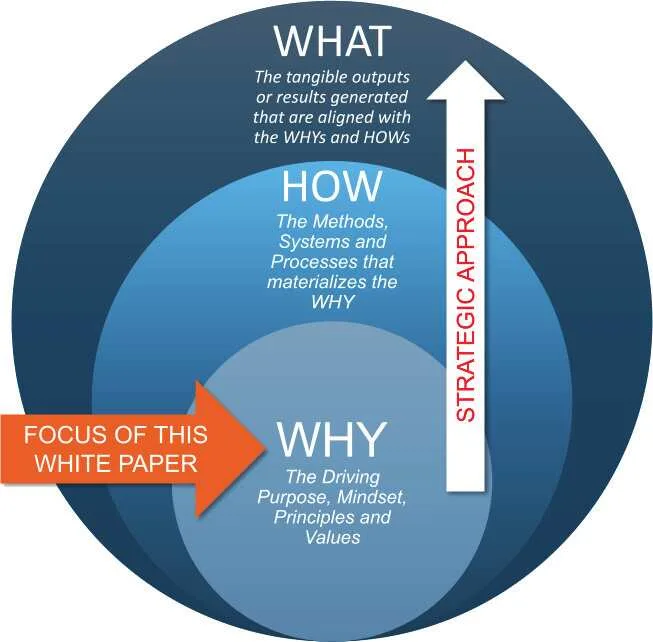
adapted from Simon Sinek’s Golden Circle [5]
This richness of imaging capabilities not only contributes to assure the quality and safety of the associated assets but also provides essential information and knowledge to support substantially important decision-making processes at all hierarchical levels in key stakeholders in the asset’s ecosystem such as designers, manufacturing and construction companies, operators, owners and regulatory bodies.
Radiographic Film, Imaging Plates (IPs) for Computed Radiography (CR), and Digital Detectors Arrays (DDAs) for Digital Radiography (DR) and Computed Tomography (CT) offer a rich palette of imaging capabilities that range from the carefully controlled environment of a R&D laboratory to the harsh, and often hostile, environmental conditions of field applications in an off-shore platform.
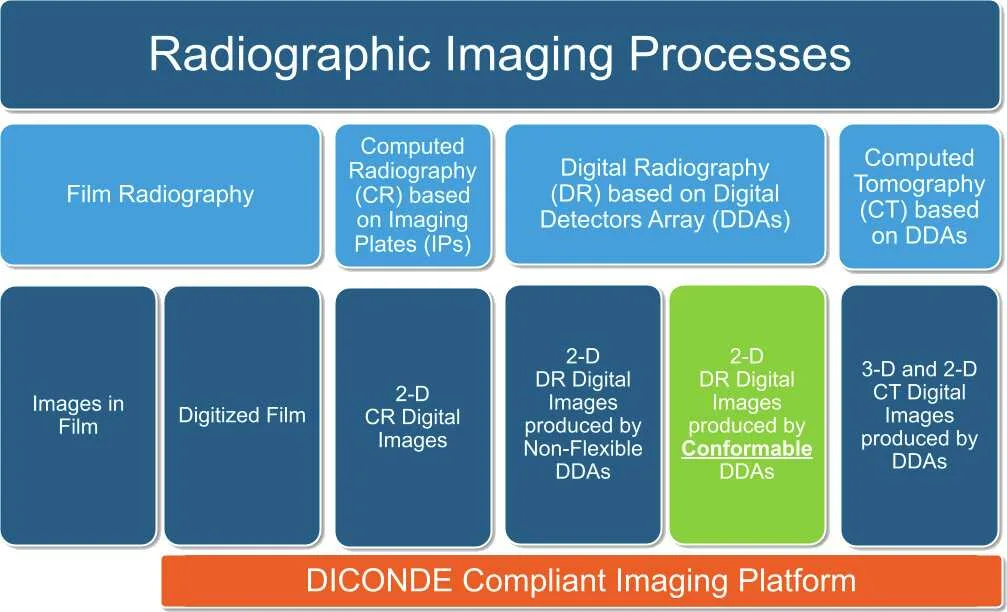
Competitive and sustainable imaging operations must have not only a clear perspective of the constituents of its imaging ecosystem, as is shown in Figure 2, but also of the role that any supporting imaging software platform should have to streamline the capture, analysis, transmission, storage and preservation of trustworthy images. A vendor-independent DICONDE-compliant imaging platform shall ensure technological advancements in imaging media, hardware, and software create a positive syngenetic effect on the rest of the constituents of the imaging ecosystem; here the importance of establishing a proper alignment between the adoption of advancements in recording media technology, imaging platforms, and the technical requirements integrated into codes and regulations.
WHY does a Bendable Detector should exist – The importance of conformability and intimate contact.
Radiographic image formation principles advise, that whenever is feasible, the distance between the subject and the recording media, regardless if it is film, IPs or DDAs, should be maintained as minimal as it is possible to minimize distortion and unsharpness effects on the resulting image. This image formation principle is replicated in the radiographic inspection requirements contained within an ample spectrum of manufacturing and construction codes worldwide.
Codes such as the ASME BPVC for boilers and pressure vessels or AWS D1.1/D1.1M in steel construction, specifications such as API 6A and standards such as ASME B31.1, ASME B31.3 or API 1104 have as a common trait that they embrace this imaging principle not only for the inspection of welds on pipes or tubular components, but also integrate it in the radiographic inspection requirements for castings, rolled products, forges. pipes, tubing or other manufactured components formed with round surfaces.
Single-wall exposure / single-wall viewing (SWE/SWV) as is shown in Figure 3, double-wall exposure / single-wall viewing (DWE/SWV) as is shown in Figure 5, and double-wall exposure for double-wall viewing (DWE/DWV) techniques as is shown in Figure 6 constitute the fundamental repertoire of radiographers around the world regardless of the industrial sector where they participate.
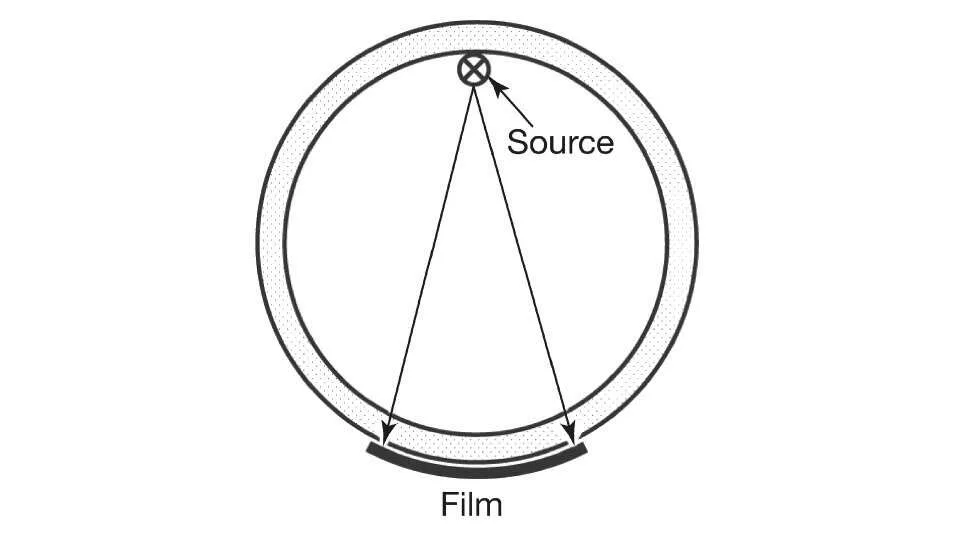
from ASNT Nondestructive Testing Handbook, fourth edition: Volume 3, Radiographic Testing [6]
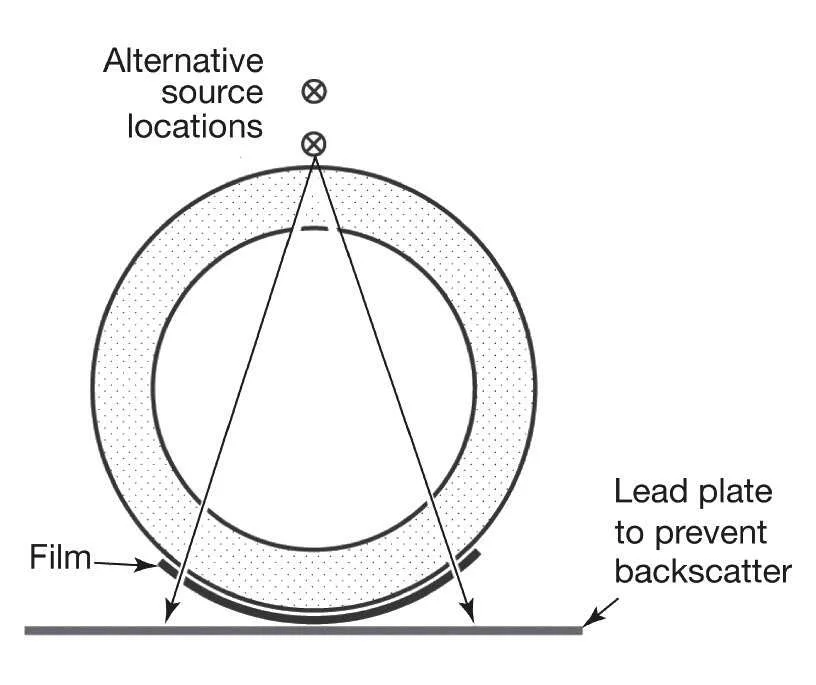
Testing Handbook, fourth edition: Volume 3, Radiographic Testing [6]
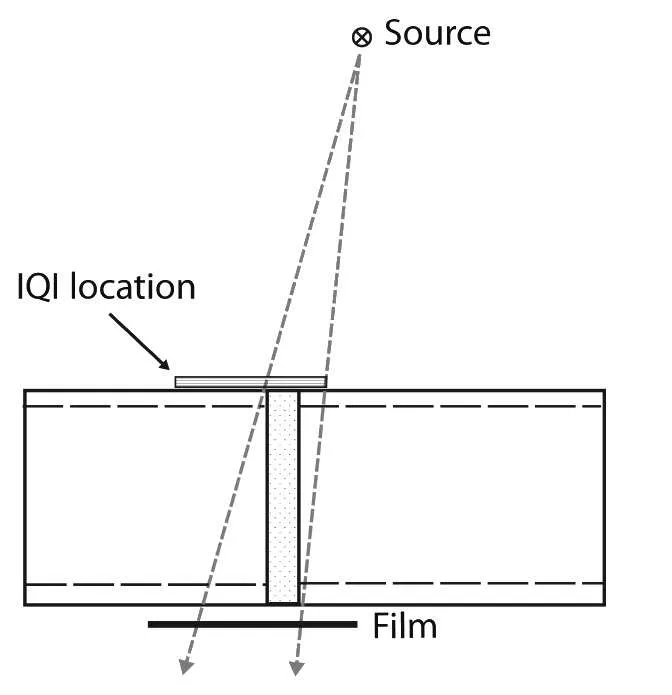
Testing Handbook, fourth edition: Volume 3, Radiographic Testing [6]
Specific applications based on the shape of the inspected assets, such as panoramic expositions (See Figure 6) in pressure vessels, large diameter pipes or tanks, constitute clear variations of these fundamental techniques.
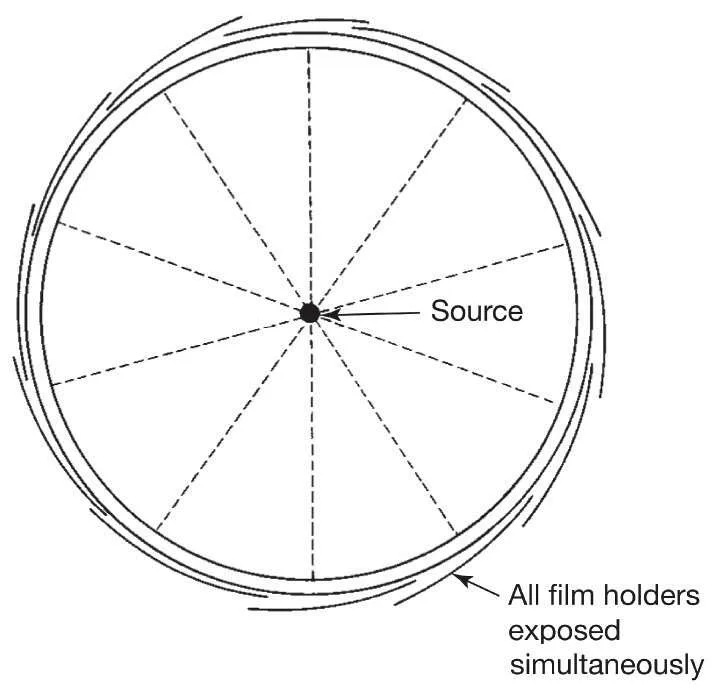
Handbook, fourth edition: Volume 3, Radiographic Testing [6]
What manufacturing codes exactly demand:
Table 1 provides a glimpse of the technical requirements related to radiographic techniques very diverse set of industries where radiographic standards emphasize and prioritize the use of flexible radiographic media.
| Document | Requirement | Excerpt | Scope of application |
| ASME Boiler and Pressure Vessels Code 2023 edition [7] | Section V Article 2 Paragraph T-271 Radiographic Technique | “A single-wall exposure technique shall be used for radiography whenever practical. When it is not practical to use a single-wall technique, a double wall technique shall be used. An adequate number of exposures shall be made to demonstrate that the required coverage has been obtained.” | Since 1914 ASME BPVC have been considered an essential reference within a wide spectrum of industries such as nuclear, electric power-generation, petrochemical, and transportation, among others. |
| ASME B31.1 – 2022 Power Piping [8] | Chapter VI Inspection, Examination, and Testing, Paragraph 136.4.5 Radiography | “(a) When required by this Chapter (see Table 136.4.1-1), radiographic examination shall be performed in accordance with the requirements of ASME BPVC, Section V, Article 2, except that the requirements of T-274 are to be used as a guide but not for the rejection of radiographs unless the geometrical unsharpness exceeds 0.07 in. (2.0 mm).” | This standard prescribes requirements for piping systems typically found in electric power generating stations, industrial and institutional plants, geothermal heating systems, and central and district heating and cooling systems. |
| ASME B31.3 -2022 Process Piping [9] | Chapter VI Inspection, Examination, and Testing, Paragraph 344.5 Radiographic Examination | “344.5.1 Method. (…) Radiography of welds and of components other than castings shall be performed in accordance with ASME BPVC, Section V, Article 2.” | This standard contains requirements for piping typically found in petroleum refineries; chemical, pharmaceutical, textile, paper, semiconductor, and cryogenic plants; and related processing plants and terminals. |
| API Specification 6A, 21st Edition – Specification for Wellhead and Tree Equipment [10] | 10.4.2.16 Weld NDE-Volumetric Paragraph 10.4.2.16.2 Test Method Radiographic Examination | “Radiographic examinations shall be performed in accordance with the procedures specified in ASME BPVC Section V, Article 2 (or equivalent) with a minimum sensitivity of 2%(2-2T).” | This specification identifies requirements for wellhead and tree equipment for use in the petroleum and natural gas industries. |
| API Standard 1104, 22nd Edition – Welding Pipelines and Related Facilities [11] | Section 11.1* Radiographic Test Methods, Subsection 11.1.2.3 Other Imaging Media, paragraph f) Exposure geometry * Section 11.1 presents the requirements for producing radiographic images on film or other media through the use of X- rays or gamma rays. | “Whether single-wall exposure for single-wall viewing (SWE/ SWV), double-wall exposure for single-wall viewing (DWE/ SWV), or double-wall exposure for double-wall viewing (DWE/ DWV);” whether in motion or still imaging; the scanning speed for in motion imaging; the distance from the source or focal spot to the imager surface; the relative positions of the imager surface, weld, source, IQIs, and the intervals or reference markers; the amount of geometric magnification; the total magnification used for viewing; and the number of images required for radiography of a complete weld”. | This standard provides requirements for gas and arc welding used in the construction and in-service repair of pipes and components for the compression, pumping and pipeline transmission of crude oil, petroleum products, fuel gases, carbon dioxide and nitrogen. |
| AWS D1.1/ D1.1M:2020 Structural Welding Code — Steel [12] | Clause 10 – Tubular Structures Section 10.28 Supplementary RT Requirements for Tubular Connections Paragraph 10.28.1 Circumferential Groove Welds in Butt Joints. | “The technique used to radiograph circumferential butt joints shall be capable of covering the entire circumference. The technique shall preferably be single-wall exposure/ single-wall view. Where accessibility or pipe size prohibits this, the technique may be double-wall exposure/ single-wall view or double-wall exposure/double-wall view.” | This code contains the requirements for fabricating and erecting welded steel structures for a very diverse set of construction sectors. Clause 10 covers butt joints between tubulars, T-, Y-. K- connections of tubulars to tubulars, or tubulars welded to flat plates or flat elements of other members. |
All the technical references listed above, and their equivalents codes, specifications, and standards in other regions of the world such as Europe, Asia or Africa, have in common that they emphasize the importance of direct contact of the radiographic detector with the inspected zone, whenever this condition is technically feasible but until today, only film and computed radiography (CR) imaging plates (IPs) could satisfy that requirement.
Aiming to expand, enrich, and reinforce the imaging capabilities of our customers in a very diverse set of industries, we have developed an amorphous silicon conformable digital detector array (DDA) that is flexible and that allows the detector to be in direct contact with the inspected component. This conformable detector can be bent repeatedly around pipe welds of varying diameters resulting in significant image quality improvement, workflow time savings and productivity benefits for the static capture of radiographic images on curved components.
WHY does the use of a Bendable Detector make Business Sense – Optimized imaging workflow, reduced image acquisition time and increased productivity.
For field radiography applications the detector design should be portable, thin, flexible, easily attached, and able to withstand harsh environments. Size, weight, scintillator type, pixel pitch, bit depth, radiation shielding, load limits, temperature, moisture, atmospheric pressure, vibration mitigation, drop resistance, and ingress protection are all additional considerations. High-quality digital images can be obtained utilizing either tethered or wireless image acquisition modes. The improved productivity obtained from bendable detectors relative to film and CR benefits not only the industrial sectors listed in Table 1 but also to the constituents on their business ecosystem.
As we have reviewed before, industrial radiography serves a wide variety of segments and applications. More than half of the static two-dimensional exposures are accomplished with the use of radioisotopes outside in field settings. Some field radiography exposures are done with portable battery-powered pulse X-ray sources. Continuous X-ray exposures are typically done at a facility inside a vault or cabinet. Conformable DDA’s are operated in the same way as rigid detectors. They do not require a cassette like film or CR imaging plates. Multiple detector sizes are available to accommodate different inspection areas and bend radii. The detector is repeatedly bent around components as part of daily inspection operations. The manufacturer’s recommended bad pixel map process is utilized to update the existing pixel map daily or prior to an inspection set. The detector may have a tether wire to an access point interface box, whereby the interface box can communicate wirelessly or via tether to a tablet or laptop. The image quality for digital radiography (DR) is superior to film and CR, and image quality for single viewing is improved. The combination of both factors leads to a significant and measurable image quality advantage.
Conformable DDA’s also have a significant productivity advantage relative to film and CR.
| Why would you use conformable DR versus film or CR? | |||
| Productivity | Operational Savings | Health and Safety | Envirmonmental Impact |
| • Instant Images (no processing time associated with film development or IPs Scanning) • Labor flexibility (complete twice as much work in the same time lapse) • Reduce work burden associated with retakes | •Consumables (including films and chemicals or imaging plates) • Inventory carryings costs • Chemical wastes disposal costs • Film scanning and archiving • Isotope replacement costs | • Smaller exclusion zones are possible • Reduce radiographer’s fatigue (associated with running films and imaging plates) | • Eliminate impacts associated with chemicals production, distribution and waste disposal. • Eliminate water consumption impact associated with film processing |
Brian White, Research Scientist and Level III Radiographer at Carestream NDT, explains the practical implications of the notions discussed in the present white paper in the following terms [8]:
“Applications for conformable detectors include any curved exposure technique that requires single viewing. The detectors may also be utilized flat for double viewing. We anticipate that conformable detectors will be initially deployed into field radiography applications exposed with Iridium. In the future, radiographers will find new ways to use these detectors in ways that we have not considered. The primary industrial markets include oil and gas and inspection services. Other potential markets include aerospace, defense, security, casting, and power. The industrial radiography industry will benefit tremendously from conformable detector technology. The primary advantage is productivity, the ability to get the inspection done quicker, which results in cost savings. In addition, digitization and digital technology provide numerous benefits relative to analog processes. Digitization enables digital transformation as part of the fourth industrial revolution.”
An actionable approach for radiographic imaging professionals and business decision-makers – Building your own use case for a conformable DR detector (Part I of III)
- As an initial step in this stage, it will be interesting to make a list of the components and assemblies within the scope of your work that require radiographic imaging processes based on the options integrated in Figure 2.
- Next, for each component or assembly type make a list of the codes, specifications or standards that describe the radiographical technique applicable to the components and assemblies already included in your list.
- Then, for each codes, specifications or standards in your list validate if digital radiography using DDAs is a feasible radiographic imaging processes.
- Finally (for this stage of analysis ), review either single-wall exposure for single-wall viewing (SWE/ SWV), panoramic, double-wall exposure for single-wall viewing (DWE/SWV), double-wall exposure for double-wall viewing (DWE/DWV) or other exposure technique is applicable for each component or assembly where digital radiography using DDAs is allowed.
| A.- Component / Assembly | B.- Applicable Codes | C.- Is DR allowed? | D.- Applicable Exposure | Next Stage is available in the second white paper of this series |
| Circumferential Weld in a Pressure Vesse | ASME BPVC, Section VIII-1 UW-51 and Section V Article 2. | Yes, ASME BPVC, Section V, Article 2, Mandatory Appendix IX Radiography Using Digital Detector Systems. | Panoramic |
At this stage, you should have consolidated into a single document:
- A comprehensive list of the most common components or assembles where you need to perform radiographic imaging processes,
- Which of those radiographic imaging applications have the option to be performed with DR and
- Which are suitable to use a conformable DR detector.
To move forward in the construction of your business case, we advise you to review other White Papers in this series:
Building Your Own Use Case for a Conformable DR Detector
Part I – “The Why’s” Expanding, Enriching and Reinforcing Your Imaging Capabilities (This White Paper)
Part II – “The How’s” Proposing an actionable approach to a new set of imaging capabilities
Part III – “The What’s” An Instructive Comparison of Conformable DDAs to Film and CR Imaging Plates
- For readers interested in exploring how digital radiography (DR) can be integrated into your processes: https://www.carestream.com/en/us/nondestructive-testing-ndt-solutions
- For readers interested in exploring supplementary white papers on practical application and innovation on imaging processes: https://www.carestream.com/en/us/nondestructive-testing-ndt-solutions/ndt-white-papers
Here are some supplementary information resources from Carestream NDT’s products and services portfolio:
Products
- HPX ARC 1025 PH
- HPX ARC 1043 PH
- INDUSTREX Fieldview, Tablet
- INDUSTREX Digital Viewing Software
- Advanced Industrial Radiographic Training Academy
- ayData NDT Archive Solution
- Virtual NDT Showcase
- Resource Center
- NDT White Papers
Services – Training and Supplementary Resources:
- Digital Detector Array Radiography – 40 Hour Online Course
- Digital Imaging – 40 Hour Classroom Training
Resources from ASNT
References:
- White, Brian S. “ Conformable Digital Detector Arrays for Nondestructive Evaluation,” 13th European Conference on Nondestructive Testing, Lisbon, Portugal, 2024.
- White, Brian S. “ Conformable Digital Detector Arrays Compared to Film and Computed Radiography,” ASNT 2023 Annual Conference, Houston, Texas USA, 2023
- White, Brian S. “Exposure Factors for Film and Digital Detector Array Radiography,” 20th World Conference on Nondestructive Testing, Incheon, South Korea, 2024.
- ASTM Standard E2736-17(2022), 2022, “Standard Guide for Digital Detector Array Radiography” ASTM International, West Conshohocken, PA, 2022, www.astm.org.
- Sinek, Simon. Start with why: How great leaders inspire everyone to take action. Penguin, 2009.
- Bossi, R., Nondestructive Testing Handbook, fourth edition: Volume 3, Radiographic Testing, Columbus, OH, American Society of Nondestructive Testing, 2019.
- ASME, Boiler and Pressure Vessel Code, Section V (Nondestructive Examination), American Society of Mechanical Engineers, Boiler and Pressure Vessel Committee, New York., N.Y., 2023.
- ASME, “ASME B31.1-2022 Edition, Power Piping,” ASME Code for Pressure Piping, B31, An American National Standard, The American Society of Mechanical Engineers, New York., NY., 2022
- ASME, “ASME B31.3-2022 Edition, Process Piping,” ASME Code for Pressure Piping, B31, An American National Standard, The American Society of Mechanical Engineers, New York., NY., 2022
- API (American Petroleum Institute), Specification for Wellhead and Tree Equipment, 21st Edition, No. API 6A., 2018. 11. API (American Petroleum Institute), Welding Pipelines and Related Facilities, 22nd Edition, No. API 1104., 2018.
- AWS (American Welding Society), AWS D1.1/D1.1M:2020 Structural Welding Code – Steel, Miami: American Welding Society (AWS), 2020.