Table of Contents
- The Mission MMX will search for at least 10 grams of Phobos
- How were Phobos and Deimos formed?
- Samples from Phobos will provide clues about water and organic matter
- Landing on Phobos will be one of the main challenges
- Japan already has experience bringing back extraterrestrial material
- MMX would return to Earth around 2031
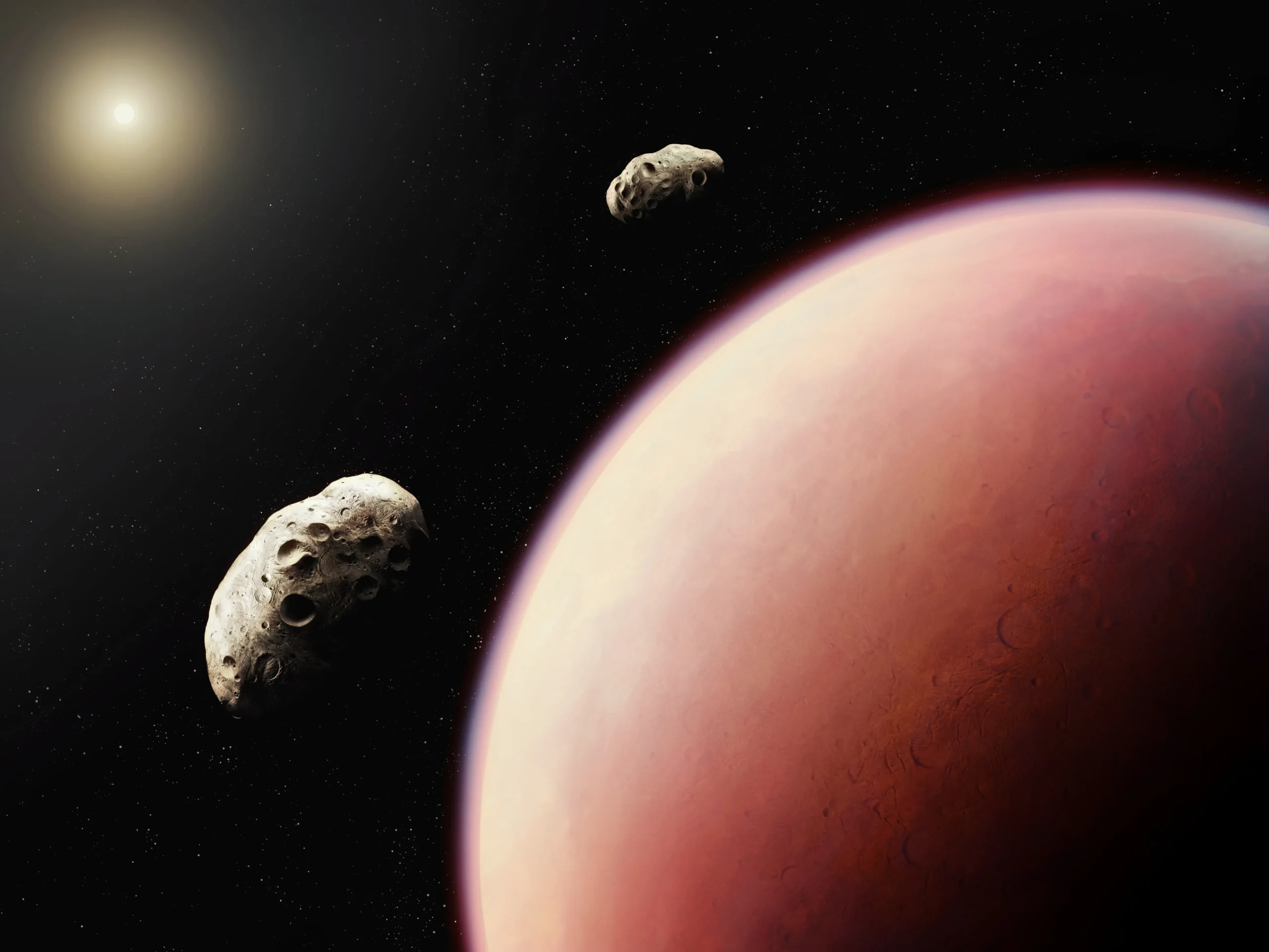
Japan is preparing one of its most ambitious space missions, the Japan Aerospace Exploration Agency (JAXA) plans to send the mission MMX towards the moons of Mars with the objective of landing on Phobos, collecting at least 10 grams of material from its surface and transporting it to Earth.
The Martian Moons eXploration (MMX) mission it will launch from the Tanegashima Space Center and its primary destination will be Phobos, the larger of Mars’ two moons. The spacecraft will also study Deimos from a distance before beginning its return journey.
Furthermore, the material obtained could help answer a question scientists have been trying to answer for decades, how Phobos and Deimos formed. The answer would have implications for understanding the early evolution of the solar system and the transport of water and organic compounds to the rocky planets.
The Mission MMX will search for at least 10 grams of Phobos
After arriving in the vicinity of Mars, the MMX spacecraft will remain in orbit around the planet for approximately three years. During that time, it will conduct scientific observations and attempt to land on Phobos.
On the surface, the mission will collect at least 10 grams of dust and rock, although the amount seems small, these samples can later be studied in terrestrial laboratories using instruments much more complex than those a space probe can carry.
Furthermore, the IDEFIX rover will make direct observations of Phobos, this vehicle it is part of a broad international cooperation involving organizations such as the French National Centre for Space Studies (CNES) and the German Aerospace Center (DLR).
The Japanese mission also includes participation from NASA and the European Space Agency (ESA), making MMX an international project led by JAXA.
How were Phobos and Deimos formed?
Currently there are two main explanations about the origin of Mars’ moons, one of them suggests that Phobos and Deimos arose from material generated after a large impact against the planet.
The second hypothesis proposes a different origin, namely that both bodies are ancient asteroids from other regions of the solar system who ended up trapped by Martian gravity.
Determining which scenario is closest to reality will allow us to reconstruct part of Mars’ early history, furthermore, understanding the composition of Phobos could provide information about the processes that distributed materials throughout the solar system during its early formation.
Samples from Phobos will provide clues about water and organic matter
Specifically, one of MMX’s scientific questions is related to the transport of water, volatile substances, and organic compounds from the outer regions of the solar system to the rocky planets.
These processes are important for studying how the conditions necessary for habitability appeared on worlds like Earth and possibly Mars.
Astrophysicist Patrick Michel, a participant in the IDEFIX project, explained that if Phobos and Deimos preserve materials associated with those primitive transport mechanisms, they could provide clues about the arrival of essential components for the emergence of life on terrestrial planets.
Therefore, MMX goes beyond the study of two small satellites, the samples obtained can serve as a physical record of processes that occurred during the early stages of the solar system.
Landing on Phobos will be one of the main challenges
However, reaching the surface presents particular difficulties, Phobos has extremely low gravity, so a conventional landing could cause the spacecraft to bounce after touching the ground.
The engineers had to develop a system capable of absorbing the impact and keeping the probe stable, Mitsubishi Electric participated in this technical challenge by developing the landing legs.
The operation will also allow scientists to test technologies that could prove useful for future human missions to the Martian environment. JAXA is even studying Phobos’ potential as a kind of natural space station for round-trip operations related to Mars.
Japan already has experience bringing back extraterrestrial material
JAXA arrives at MMX with direct experience in sample return operations, the Hayabusa-2 mission successfully transported 5.4 grams of rock and dust obtained from the asteroid Ryugu to Earth in 2020.
Japan also managed to land the SLIM probe on the Moon in 2024, although the vehicle ended up in an unexpected position after the descent, it continued to transmit information and managed to survive several lunar nights.
This background will be especially relevant for MMX because the new mission combines interplanetary navigation, landing on a low-gravity body, material collection, takeoff, and return to Earth.
MMX would return to Earth around 2031
After completing its scientific operations, MMX will begin its return journey, the plan is for a capsule containing samples from Phobos to land in Australia around 2031.
By then, Japan could find itself in an international race to return material from the Martian system, China plans to launch Tianwen-3 around 2028 with the goal of collecting samples directly from Mars and bringing them back to Earth around 2031.
In this way, the coming years could usher in a new era in Martian exploration, moving from studying Mars and its satellites through robots to have material available that scientists can analyze directly in terrestrial laboratories.
For JAXA, the small cargo from Phobos could help reconstruct billions of years of planetary history and offer new clues about how water and organic components reached the rocky worlds of the solar system.
Source: Japantoday
Photo: Shutterstock