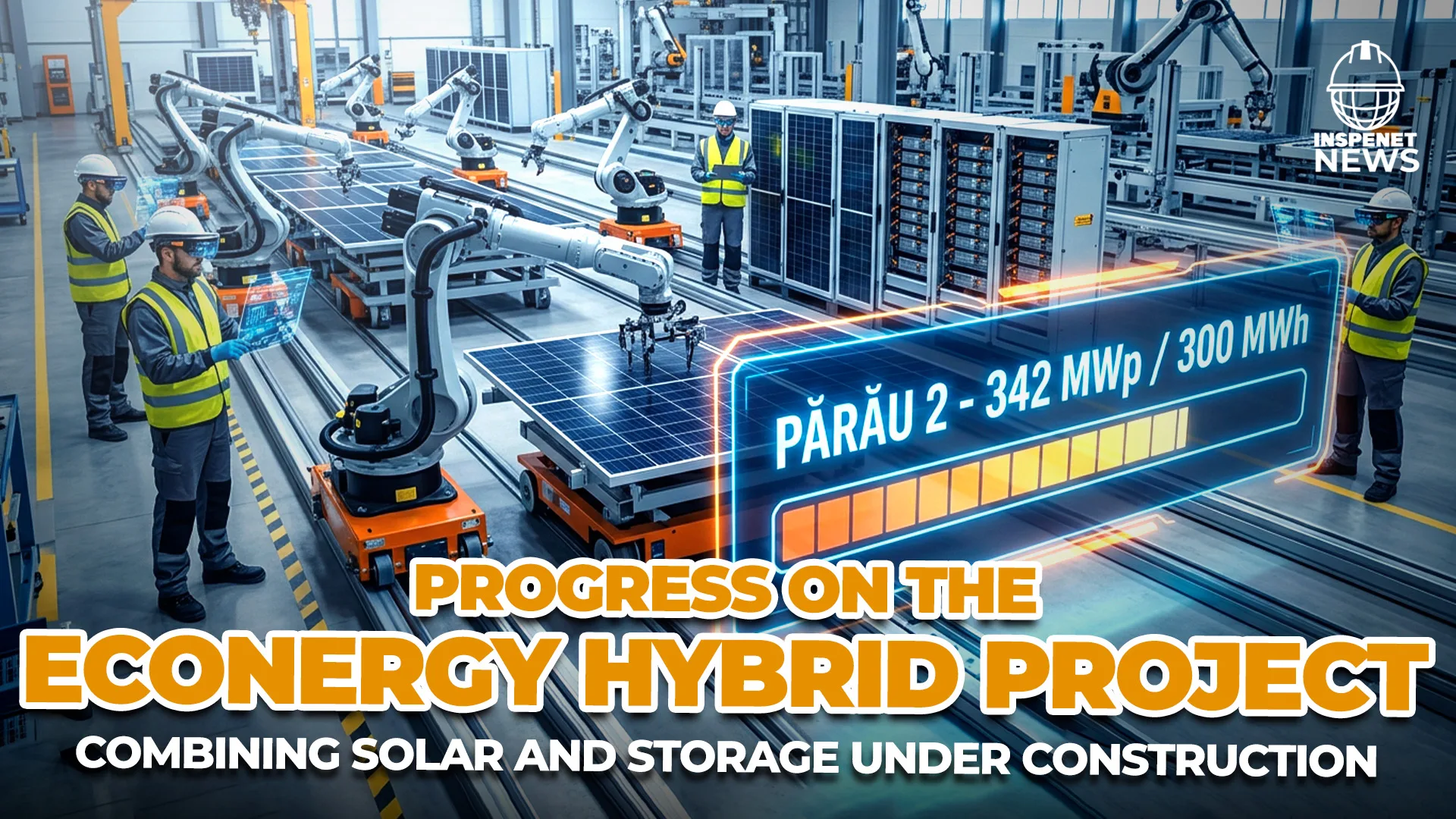
Econergy secures $265 million for Părău 2 in Romania
Econergy has secured financing agreements for approximately €229 million, equivalent to $265 million, to move forward with Părău 2. The energy project is being built in Brașov County, Romania, and will combine solar photovoltaic generation with battery storage.
In addition, Părău 2 will have a 342 MWp photovoltaic plant along with a 150 MW/300 MWh BESS energy storage system. The installation will allow some of the electricity produced to be stored and later delivered to the grid as needed.
The project is already under construction and Econergy expects to begin commercial operation in early 2028. Before then, the loan agreements must meet the corresponding conditions and financial closing is expected within a period of three months.
Econergy secures €229 million to develop Părău 2
Specifically, the financing comes from a consortium made up of six financial entities, the operation involves Banca Comercială Intesa Sanpaolo România together with its subsidiary Privredna banka Zagreb, the Black Sea Trade and Development Bank, the European Bank for Reconstruction and Development (EBRD), Exim Banca Românească, NLB and OTP Bank.
In this way, Econergy obtains resources to develop a project that combines two technologies at the same site. On one hand, there will be photovoltaic generation, and on the other, energy storage using batteries.
The financing also shows the economic scale that Părău 2 has reached. Its 342 MWp of photovoltaic capacity will be accompanied by a BESS designed to store up to 300 MWh of energy.
Părău 2 will combine a 342 MWp solar project with batteries
The solar plant will have a peak power of 342 MWp. The BESS system will have 150 MW of power and 300 MWh of storage capacity.
This combination will allow a portion of the electricity produced by the solar project to be stored. This energy can then be supplied to the grid when needed.
Thus, energy storage will give greater flexibility to the operation of Părău 2. It will also facilitate the integration of renewable production within Romania's electricity system by reducing the dependence on generation and consumption coinciding at the same time.
What will the 150 MW/300 MWh BESS contribute?
In practical terms, the 150 MW power indicates the system's delivery capacity, while the 300 MWh represents the amount of energy it can store.
Therefore, the BESS can shift some of the electricity generated by the solar panels over time. This feature is important in a photovoltaic project due to the variations in generation throughout the day.
Furthermore, the joint installation of the plant and the batteries will allow for more flexible management of the electricity produced before supplying it to the grid.
The EBRD will contribute up to 120 million euros
Within the financial structure, the EBRD is considering a contribution of up to €120 million. This amount is divided into loan A of up to €57 million and loan B of up to €63 million.
In turn, loan B incorporates a debt service line of 3.6 million euros, provided by Privredna banka Zagreb and NLB.
On the other hand, Intesa Sanpaolo and Exim Banca Românească will jointly provide a €25 million line of credit earmarked for VAT. This will be supplemented by another €9.5 million line of credit related to Părău 2's participation in Romania's Contracts for Difference (CFD) mechanism.
InvestEU supports part of the financing
In addition, approximately 114.4 million euros of the main line are backed by an InvestEU guarantee from the European Union.
This hedge is intended to reduce the risks associated with the project's exposure to revenue from the electricity market. This backstop is particularly important because a portion of Părău 2's capacity will be sold on the market.
Părău 2 has a CfD of 125 MW for 15 years
Meanwhile, Părău 2 secured the largest capacity allocation in Romania's first contract for difference auction.
The project received an allocation of 125 MW of alternating current at an exercise price of €49.4 per MWh. The agreement will last for 15 years from the date the facility begins operating.
Meanwhile, the generation capacity that remains outside of that allocation will be exposed to electricity market prices.
What does the contract for difference mean for Părău 2?
The CfD provides a long-term revenue benchmark for the 125 MW included in the contract. This way, a portion of the production will have a mechanism in place for 15 years.
However, Părău 2 will also maintain market exposure. This combination explains the relevance of the InvestEU guarantee within the agreed financing structure for the project.
Econergy plans to put Părău 2 into operation in 2028
Părău 2 is currently under construction. According to the published schedule, Econergy expects the project to begin commercial operation in early 2028.
Before reaching that stage, financial closing must be completed. The loan agreements are subject to customary terms and conditions, and this process is expected to conclude in approximately three months.
Once operational, the complex will incorporate both photovoltaic generation and energy storage on the same site. This will allow Econergy to manage an asset that can produce electricity during daylight hours and store a portion for later delivery.
Energy storage is gaining ground alongside solar power in Romania.
Finally, Părău 2 demonstrates how battery storage can be directly integrated into large-scale solar projects. The facility will not rely solely on its 342 MWp photovoltaic capacity, as it will also have 300 MWh of electricity storage capacity.
This configuration can bring greater flexibility to the Romanian electricity system as generation from renewable sources increases. The batteries allow for better management of the differences between solar production hours and the times when the grid needs electricity.
For Econergy, the €229 million financing provides the necessary resources to continue construction of one of its largest projects in Romania. The next step will be to complete the financial closing and move towards the planned start of operations in early 2028.
News of additional interest
MD&A coordinates four turbine repairs
Mechanical Dynamics & Analysis (MD&A) completed extensive inspection and repair work involving two steam turbine systems and two gas turbine generators. The work was primarily concentrated at its St. Louis, Missouri facility and brought together several of the company's divisions to service rotors, diaphragms, valves, actuators, and other components. Necessary parts were also supplied to complete the work within a tight schedule.
The inspections revealed issues such as slip ring deformation, heat damage, and blockages that could limit the cooling of some generators. MD&A repaired or replaced the affected components and performed electrical, thermal, and mechanical tests. The steam turbine rotors also underwent dimensional, metallurgical, and non-destructive testing before completing their balancing and quality control process.
Texas is preparing a hybrid gas and nuclear power plant
Blue Energy and GE Vernova Hitachi Nuclear Energy are moving forward with the development of a 2.5 GW hybrid natural gas and nuclear power plant in Victoria, Texas. The new agreement allows for continued engineering, permitting, and safety studies ahead of a final investment decision expected in 2027. The project aims to address the sharp increase in electricity consumption from data centers and advanced manufacturing facilities in the United States.
The plan envisions starting with approximately 1 GW generated by two GE Vernova 7HA.02 gas turbines in 2030. From 2032 onwards, up to five BWRX-300 modular reactors would be added, contributing another 1.5 GW. Blue Energy also aims to accelerate construction using prefabricated components and a model that allows for gas-fired generation initially while the nuclear component is being developed. The company estimates that this approach could reduce the typical timelines for new nuclear projects by at least five years.
Electric aviation is taking short routes
Electric aviation is beginning to gain ground on routes where batteries offer the greatest advantages. Training aircraft, eVTOLs, and regional models are moving toward commercial operations, while long-haul flights will continue to rely on traditional fuel for years to come. Among the projects under development are Heart Aerospace's ES-30, designed for 30 passengers, and Archer's Midnight, which is already conducting piloted flights while continuing its certification process.
Technology is also advancing in engines and larger aircraft. In 2025, Safran obtained European certification for its ENGINeUS 100 electric motor for applications with up to 19 seats. Its appeal lies in its efficient, quiet propulsion system with fewer combustion-related components. This is especially important given rising fuel costs: according to figures cited by the source, IATA projects an average price of $152 per barrel in 2026.
Pakistan looks to US crude after Hormuz crisis
Cnergyico , Pakistan's largest refiner, is increasing its purchases of US crude following disruptions caused by the war with Iran. The situation highlighted the country's heavy reliance on the Middle East, as nearly 90% of its oil and liquefied natural gas imports passed through the Strait of Hormuz before the conflict. In nine months, Cnergyico imported approximately 8.1 million barrels from the United States.
The shift also reflects commercial interests. Pakistan is seeking to purchase more US products to reduce its trade surplus with the United States and secure lower tariffs. Cnergyico could increase its orders if it gains access to a mechanism that would allow US exporters to defer payments for up to three years. The company is also exploring new offshore facilities as part of a $1.2 billion modernization program.